High Voltage Plasma Lamp Is Also Tasteful Steampunk

Instructables user [Admiral Aaron Ravensdale] just finished a high voltage plasma bulb build that makes creative use of off-the-shelf parts. As a self-described steampunk, [Adm. Ravensdale] also earned some cred by included working gears in his build.

The heart of the build is a “flicker flame” candle light bulb. These light bulbs have two flame-shaped plates inside the bulb to act as electrodes. Instead of the Argon that normally fills an incandescent light bulb, the candle bulb is filled with Neon. When excited, Argon gives off a rather unnatural purple glow – not very convincing for a simulated candle and certainly not steampunk. The Neon in the flickering candle bulb gives off a brilliant orange, perfect for simulating a flame and will surely impress the duchess during afternoon tea.

After the right plasma bulb was found, [The Admiral] scavenged the rest of the high voltage electronics from disposable cameras. Attaching three electrodes to a brass gear, the entire mechanism was made to spin using parts from an old clock and a CD drive motor. We’re always impressed with the scavenging abilities of steampunkers – we’d still be waiting for our gears to arrive if we attempted this. Check out the video of this really cool and very inexpensive plasma bulb after the break.

Continue reading “High Voltage Plasma Lamp Is Also Tasteful Steampunk” →

Morphing Hexapod Has Us Drooling

morphex_morphing_hexabot

Hexapod robots seem to be a dime a dozen lately, but we think you will be hard pressed to not be wowed by [Zenta’s] latest creation. He’s built a bunch of hex and octopods before, but hasn’t tried building anything quite like this.

His MorpHex bot might look like your standard hexapod, but once it gets moving, you can see that it’s quite unique. Utilizing over 25 servos driven by a single ARC-32 controller, MorpHex moves in smooth, fluid-like motions, making it almost seem like it’s alive. The inner portion of the body can fan out, extending the overall length of the bot, though it’s more meant to allow the bot to morph into a ball and back, rather than increase its size.

In the teaser video below, you can see MorpHex in action, with its parts flowing together more like a jellyfish than any sort of land animal. While [Zenta] is continuing to work on MorpHex’s sphere-morphing capabilities, we think it would make for an awesome and creepy spiderbot!

[Thanks, weaz]

Continue reading “Morphing Hexapod Has Us Drooling” →

Dumpster Hackers And Junkyard Makers Get Their Own TV Show

junkies_tv_show_science_channel

The Science Channel has a new show premiering tomorrow night that we think you won’t want to miss.

JUNKies takes a look at a group of junkyard engineers led by [Jimmy “The Junk Genius” Ruocco], who also happens to be the junkyard’s owner. From the trailer you can see below, the show looks like it will be pretty entertaining, combining the best parts of Junkyard Wars, Mythbusters, and even Jackass – with hilarious and interesting results.

The show includes crazy stuff that [Jimmy] and his crew piece together, as well as the creations of individuals that come by the shop looking for parts. When the crew is not busy concocting crazy machines, they seem more than happy to help random inventors and makers dig out just the right parts for their projects.

The show airs tomorrow night, 8/18, at 10 PM Eastern, so be sure to check it out and let us know what you think!

[via Make]

Build Your Own SMS Chatroom

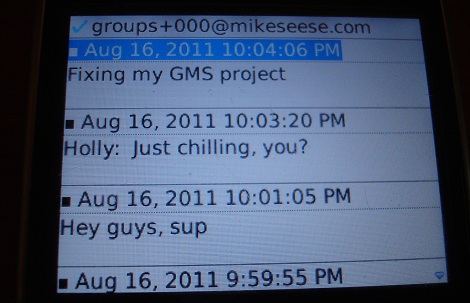
While he was organizing a party, [Mike Seese] hit upon the idea of chatroom that would operate over SMS. Not being content with the ‘reply all’ function, [Mike] built a Group Messaging Service that runs on his home server.

The chat room is initiated by sending a text to a server. Your friends then reply, and the chatroom is then opened. The project was written in C++, and [Mike] put everything on github for your perusal. The software does use libraries from /n software’s IP*Works, but if you have any trouble obtaining those libraries feel free to drop [Mike] a line.

The great thing about this project is the fact that it’s platform independent – as long as a phone can do SMS, it’ll work. Seems like a great thing for those of us still using the old Nokia ‘bar’ phones. An SMS chatroom has been done before but this is the first time we’ve seen a build that will run off your server, and not internet-based services.

While it may not be the best idea for people without unlimited texts on their phone plan, it’s a really great idea and we’re wondering why something like this isn’t available via Google Voice.

MilliOhm Measurement Made Easy

When [Kerry] wanted to measure some very small resistances very accurately he did not want to fork out the big bucks for a high end multimeter or a mico-ohmmeter, so he decided to build one himself. Measuring resistance is a simple enough concept, it directly implements Ohms law (V=IR). The problem with very small resistances is that when you apply a sensibly sized constant current to the load, the voltage to be measured is too small for conventional multimeter.

To overcome the problem [Kerry] designed a constant current source of very high accuracy using the AD8276 unity gain difference amplifier and the AD8603 high precision opamp. Then to boost the voltage across the load he used the LMP8358 programmable gain precision opamp, this allowed him to easily change the gain for different magnitude resistance, the circuit diagrams are all available on his site. Finally he used four point probes to eliminate probe wire resistance errors, ending up with the ability to measure small resistances with very high accuracy.

Very Clean Android Headphone Controller Project

Here’s an Android headphone add-on so clean that most people won’t know you built it yourself. [Will Robertson] was unsatisfied with the stock headphones that came with his HTC phone, but didn’t want to lose the control interface when upgrading. He built this add-on that lets him control the Android music player.

He was inspired to do this after reading about the control interface in one of our previous features. That hack detailed how to add control based on the 4-conductor headphone jack, but didn’t see us through to a clean finished product. [Will] picked up where it left off by designing a sleek surface mount board that hosts a headphone jack and three tactile switches. A patch cable is soldered opposite the jack, making this work as a pass-through device. The icing on the cake is the shrink tubing that masks the fact that this is a diy dongle.

If you want to follow his lead, [Will] posted his EagleCAD design files and footprints for the components he used in the post linked at the top.

TI’s New Web Site Appeals To The Penny Pincher In Us

tideals_chronos_watch

We’ve got to admit, we’re pretty much cheapskates when it comes to buying electronic bits online. Whether its microcontrollers or PCBs, we hate to part with money. So, we were pretty excited to hear that Texas Instruments is dishing out deals two weeks at a time to hackers, makers, and the like.

Several of you wrote in to tip us off to TI’s new site: TI Deals. Basically, they are deeply discounting various products, changing the lineup every two weeks. Now, we were expecting something like 20%-25% off certain items, but so far the TI Deals look pretty sweet. Right now, they are offering the Chronos watch kit for 50% off – which is a pretty nice discount. We’re definitely interested to see what sorts of other things will go on the chopping block in the future.

Thinking of picking up a Chronos watch? Let us know what sort of project you have planned.

If you are on the fence and need a little inspiration, check out these Chronos-based projects we have featured in the past:

Printable gripping rover is wristwatch controlled

Google two-factor authentication in a wristwatch

Wireless Sniffing and Jamming of Chronos and iclicker

Texas Instruments watch claims it’s a computer mouse