Using An MSP430 For Time Lapse Photography

vistaquest_keychain_timelapse_msp430

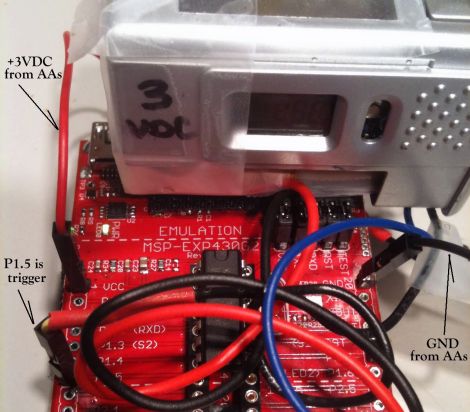
Hackaday reader [onefivefour] had an old VistaQuest VQ1005 keychain camera kicking around, and wanted to do something useful with it. A while back he hooked up a 555 timer and did a bit of time lapse photography, but he wanted more control over the process. Specifically, he desired the ability to tweak the delay between shots in a more granular fashion, as well as way to prevent the VistaQuest from going to sleep after sitting idle for 60 seconds.

His weapon of choice to get this task done was an MSP430, since the microcontroller can be found quite cheaply, and because it is relatively easy to use. He added a few header pins to the LaunchPad board wiring them up to the camera’s trigger as well as the on/off switch. When the wire connected to the trigger is pulled low, the camera snaps a picture. The wire connected to the on/off switch is always held low, ensuring that the camera is on and ready to go whenever it’s time to take a shot.

It’s a relatively simple project, but definitely useful. While there are many ways to build an intervalometer, the MSP430 is a great platform to use, especially for beginners.

Stick around to see a quick video [onefivefour] put together, showing off his time lapse rig’s capabilities.

Continue reading “Using An MSP430 For Time Lapse Photography” →

Heathkit Is Back From The Dead

Although now it’s impossible for a DIY nut to build electronics for less money than a factory, this wasn’t always the case. For 45 years, Heathkit produced inexpensive kits for just about everything. Heathkit closed it’s kit business in 1992, but now they’re back. They’re starting out with a few DIY kits at first, namely an ultrasonic garage parking assistant and a wireless swimming pool monitor.

Heathkit is calling all builders to submit their ideas for future kits. While this comeback rings of some other outlets with a rich heritage, Heathkit is still remembered fondly; Barry Goldwater jetted out to the Heath HQ twice a year for kits. Not many people are that attached to Realistic and Optimus gear.

If you’re wondering about the kind of stuff Heathkit offered, feel free to check out the 1984 catalog that features computers with 128kB of RAM available for only $1899.00 (yes, a very competitive price)

Tip ‘o the hat to [Jeffrey Bail (N1BMX)].

High Voltage: Using Enclosed Relays For HV Switching


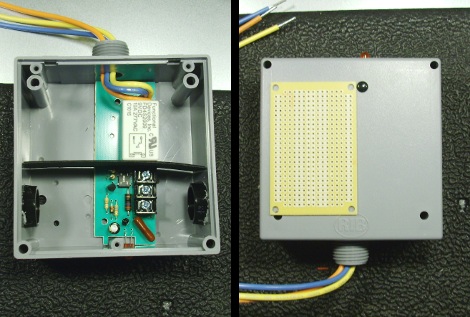
After seeing many projects that use microcontrollers to switch mains voltages [Rob Miles] decided to share his preferred method. The shots you see above are an enclosed relay, part number RIBTU1C manufactured by Functional Devices Inc.

This in itself is not the full control scheme that he uses, but it takes care of the bulk of the hardware. He uses a triggering circuit based on a 555 timer (PDF). [Rob] mentioned that if you shop around, you can get the relay, 555 timer, and other components for under $15. This is a great solution for the money when you consider that you get an enclosure meant for handling high voltage and a nice terminal block to which you can connect the mains wiring. The relay itself can be triggered by a 9V battery via the transistor in the control circuit.

Notice the protoboard in the image above. There’s plenty of room for your driver circuit to rest inside the box, protected by that barrier from the HV circuitry. Check out the rest of the images he sent us after the break.

Continue reading “High Voltage: Using Enclosed Relays For HV Switching” →

Meet Radio Shack’s New Parallax Lineup

It looks like Radio Shack is pretty serious about their new found commitment to their focus on the DIY, inventor, creator and geek demographics. [Ken Gracey], Parallax forum guru, put up a post on the Parallax stuff that will be sold at Radio Shack. Everything is priced, “below spousal approval level,” but no word on what those prices are.

Here’s the (probably not conclusive) list we gleaned from the pics: 2-axis joystick, gyroscope, GPS, compass and altimeter modules, an infrared sensor, 2×16 backlit LCD, BASIC stamp 2 board, and an XBee 2-pack that we assume would be priced above girlfriend approval levels.

We’re curious about how many (and in what quantity) of these items will be stocked at the East Nowheresville strip mall, and again there’s no mention of improving the selection of individual components.

At Hack A Day, we were thinking how amazing a Radio Shack ‘component vending machine’ would be. A modified pick and place machine that will dole out caps, resistors, other components, and has the potential to be competitive with online stores. Anyone feel like sending that suggestion in?

Project 25 Digital Radios (law Enforcement Grade) Vulnerable To The IM-ME

Would you believe you can track, and even jam law enforcement radio communications using a pretty pink pager? It turns out the digital radios using the APCO-25 protocol can be jammed using the IM-ME hardware. We’ve seen this ‘toy’ so many times… yet it keeps on surprising us. Or rather, [Travis Goodspeed’s] ability to do amazing stuff with the hardware is what makes us perk up.

Details about this were presented in a paper at the USENIX conference a few weeks ago. Join us after the break where we’ve embedded the thirty-minute talk. There’s a lot of interesting stuff in there. The IM-ME can be used to decode the metadata that starts each radio communication. That means you can track who is talking to whom. But for us the most interesting part was starting at about 15:30 when the presenter, [Matt Blaze], talked about directed jamming that can be used to alter law enforcement behavior. A jammer can be set to only jam encrypted communications. This may prompt an officer to switch off encryption, allowing the attackers to listen in on everything being said to or from that radio.

Continue reading “Project 25 Digital Radios (law Enforcement Grade) Vulnerable To The IM-ME” →

DIY RC Sensor Board

diy_telemetry_sensor_board_hitec_aurora

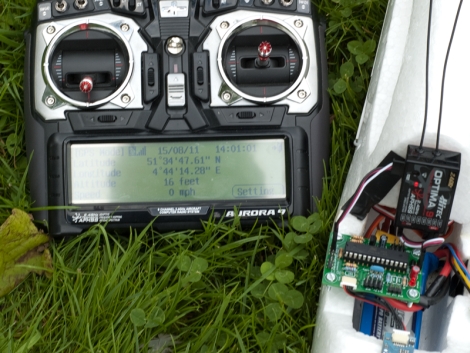
Along with hobby electronics, flying RC planes is one of [Diederich’s] favorite hobbies. When out in the field, he prefers to use an Aurora 9 radio controller, and while the remote is great, he was a bit disappointed in Hitec’s telemetry sensor lineup. He says that the sensors are pretty decent, though limited, and he was positive he could build a better telemetry solution.

His sensor board is completely open source, and comes with a long list of features. First and foremost, it emulates all of the messages that can be sent to the radio controller by Hitec’s off the shelf models, making it a simple drop-in replacement. He uses an ATMega8L microcontroller to run the show, including all sorts of input pins and connectors to support GPS as well as voltage and current monitoring.

He has made a DIY kit available for purchase online, but all of the sensor’s schematics and a BOM are available for free, should you desire to roll your own.

We love seeing DIYers show up manufacturers in this way, especially when they share the goods with their fellow hobbyists. Nice job!

Robotic Artist Listens To Your Criticism

[Ben Grosser] built an interactive painting robot that’s pretty far removed from the LED and Arduino builds we usually see. The robot is adapted from one of the many CNC routers we’ve featured over the years. The control system is written in Python and uses genetic algorithms and a microphone to decide what to paint next.

Robot artists have been around for decades now. When [Harold Cohen] exhibited his robotic artist AARON, gallery patrons lined up to watch a robot paint. The paintings were originally just a monochrome line drawing that was later colored in by [Cohen]. [Ben] made his robot paint directly onto canvas with oil paints, so there’s no question of what the computer intends the final product to be.

[Ben] came up with a really neat build, but we’re wondering about having this robot artist on display inside a cavernous exhibition hall. Surely the echos from the servos and stepper motors would be picked up by the mic and interpreted by the painting algorithm. Barring some control systems, it would probably be the robot’s commentary on its own decent into madness.

Check out a video of the robot in action after the break, followed by a violin/robot duet the shows how the audio is interpreted.

Continue reading “Robotic Artist Listens To Your Criticism” →