build_status_board

LED Build Monitor Helps Keep An Eye On Your Servers

In his line of work, Hackaday reader [Pedantite] often has to monitor the build status of several continuous integration servers throughout the day. One afternoon, he got the idea to install a set of stop lights in the office in order to monitor the status of the servers, but filed it away as a “wouldn’t it be cool if…” project.

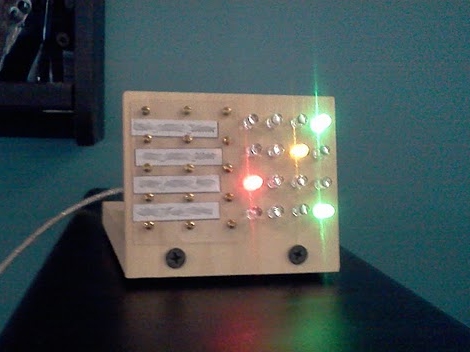
After some time had passed, he was bitten by the idea bug again and decided he would build a physical device to display the status of his build processes. This time around, he brainstormed on a smaller scale and the result is the “Indictron” you see above.

He built a simple LED board made up of four rows of four LEDs to display the build processes. Different LEDs are lit depending on the project’s current build status as well as the results of the previous build. The board uses an ATmega88, and interfaces with a compiler watchdog application using a virtual USB package made specifically for AVR micro controllers.

The end result is a simple, yet useful status board that “just works”. He does not seem to have code or schematics posted on his site at the moment, but we’re pretty sure he would share them upon request.

If you’re interested in a bit more of [Pedantite’s] work, check out his “Good Times” parental timer we featured last week.


Homebrew Z80 Computer Inspires Awe

How this one missed us, we’ll never know.

[GG] built himself a retro-styled Z80 nanocomputer over two years using all 1980’s tech. Laid out on one of the largest pieces of perfboard we’ve ever seen on a project, the computer uses a vintage Z80 CPU running at 2.5MHz, 8K ROM, 16K RAM, RS-232 and Parallel ports, an EPROM burner, and an AM95 math coprocessor for 32-bit floating point arithmetic.

We’ve seen a few homebrew computers before, including a Z80 laptop, but this blows them away. For his computer, [GG] created 8BASIC, A Basic interpreter that makes best use of the six 7-segment displays and eight 16-segment displays. The display isn’t really a limitation because [GG] also put together something in Visual Basic so his PC can communicate with his nanocomputer.

[GG] even went so far as to include error detection on the ROM and RAM, as well as an on-board power supply. If you can’t admire the dedication that went into this, at least admire the great wire porn. We’re just sad [GG] never did a proper write-up of his project. He could certainly teach us all something.

Video of [GG]’s work after the jump.

Continue reading “Homebrew Z80 Computer Inspires Awe”

Dishwasher Notifier For The Absent-minded

dish_o_tron_6000

[Quinn] over at BlondiHacks is admittedly pretty absent-minded when it comes to household chores such as emptying the dishwasher. She often can’t remember if the dishes are dirty or ready to be put away, so she decided it was time to devise a mechanism that would help keep her on task. She originally considered a double-sided sign that said “Clean” on one side, “Dirty” on the other, but she chose the fun option and decided to over-engineer the problem instead.

She ultimately focused on two conditions that she needed to monitor: when the dishwasher had been run, and when the dishes have been emptied. To tackle the first condition, she used a thermistor to detect when the door of the dishwasher got hot from the wash cycle. The second wasn’t quite as easy, since she often peeks into the dishwasher to grab a clean dish when needed, unloading the rest later. She eventually settled on using a tilt switch to monitor the angle of the door, assuming that the dishes have been removed if the door was open for over a minute.

[Quinn] reports that her Dish-o-Tron 6000 works well, and she had a good time building it. Sure the whole thing is kind of overkill, but where’s the fun in moderation?

Prototyping With A GPS Module

[Oneironaut] is trying out a new GPS module with the prototype seen above. It’s a San Jose Navigation device identified as FV-M8 and sold by Sparkfun for just under a hundred bucks. That’s it hanging off the bottom-right of the breadboard seen above. They’ve packed a lot of power into the small footprint, and made it very easy to control at the same time. Although the device is fully configurable, you can start grabbing serial data from it just by connecting a single data line, 3.3V, and ground.

[Oneironaut] tests it out by streaming the serial data to a character LCD screen, then comparing the output to his handheld Garmin GPS device. You can see him describe his ATmega32-based test platform in the video after the break. We’re used to seeing spy-tech for most of his projects and this will eventually join those ranks. He’s thinking of putting together a magnetic tracking module that plays nicely with Google Earth.

Continue reading “Prototyping With A GPS Module”

Geohot Case Settlement

It looks like Sony and [George Hotz] have reached an out-of-court settlement in the case brought against the hacker who is more well-known as [Geohot].

This is the end (we think) of an ongoing saga that originally drew our ire when Sony removed OtherOS support as a sledge-hammer-type fix for holes that [Geohot] found in the security system used by PlayStation 3 hardware. Our beef with that move is that it punished people who bought a PS3 knowing that it could run Linux natively, only to have that rug retroactively pulled out from under them. [Geohot] then went on to publish details that allow those with the proper skills to leave a smoldering pile of slag where Sony’s hardware security used to reside.

They slapped him with a lawsuit for publishing those details. This settlement doesn’t have him admitting any wrongdoing. We’re not going to editorialize on the morals or ethics of [George’s] actions, but we do still think that Sony greatly overreacted at several points along this unfortunate string of events.

[Thanks Buggs187]

Do Your Projects Violate International Traffic In Arms Regulations?

From time to time we consider the ramifications of hacking prowess being used for evil purposes. Knowledge is a powerful thing, but alone it is not a dangerous thing. Malicious intent is what takes a clever project and turns it to a tragic end. Conscientious hackers realize this, and [George Hadley] is one of them. While working on a new project he wondered if there were guidelines as to what knowledge should and should not be shared. It turns out that the United States has a set of International Traffic in Arms Regulations that mention concepts we’ve seen in many projects. He wrote up an article which covers the major points of the ITAR.

The gist of it is that sharing certain knowledge, by posting it on the Internet or otherwise, can be considered arms trafficking. It’ll get you a not-so-friendly visit from government officials and quite possibly a sponsored stay in a secure facility. Information about DIY radar, communications jamming, spying devices, UAVs, and a few other concepts are prohibited from being shared. The one qualifying part of that restriction is that it only applies if the information is not publicly known.

Booby Box – It’s A Trap!

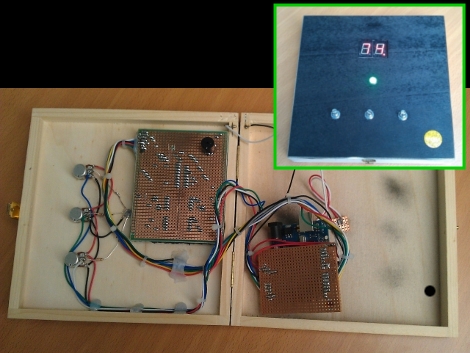
Here’s a puzzle oddity that challenges you to open the box without falling into one of the booby-traps. It was built as a side-distraction from the more serious events happening at Insomni’hack 2011. [Sergio] and a colleague built the box to resemble a ticking bomb like in the blockbuster action movies we know you look forward to seeing each summer. A display on top of the device counts down for ninety seconds with an audible beep to mark the passage of time and boost your tension level. See it ticking away in the clip after the break.

Two wires meet at the edges of the box halves, completing a circuit that will set off an alarm when the contact is broken. There’s also a photocell on the bottom of the box which triggers the alarm if you lift it and expose this sensor to light. The combination necessary to open the box was provided to each competitor; it was not a numerical code, but a color code. Three potentiometers control the red, green, and blue anodes of an RGB LED, while being monitored by an Arduino at the same time. If you can dial in the appropriate color, the lid trap is disabled and the box can be opened. What does the winner get? Why an Arduino, of course!

Continue reading “Booby Box – It’s A Trap!”