Building An Electric Kiln

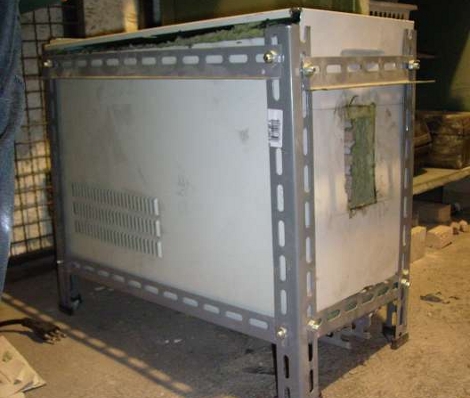
[EmcySquare] is delving into some hobby-blacksmithing by making his own knives. He needs a furnace to heat the metal, and after trying out a few different forge designs he decided to attempt an electric kiln build. The final project seen above is a box within a box. The outer shell is reclaimed using old computer cases and metal shelving brackets. Inside you’ll find a box made from fire brick, with stone-wool insulation to keep the heat where it’s supposed to be.

He cut the bricks to the right size to build the inner box, then added grooves on the inside edge witch will host the heat coils. This cutting was done with an angle grinder and [EmcySquare] notes that it kicks up an extraordinary amount of brick dust to make sure you’re wearing a respirator and goggles. Once the enclosure was ready he set out to fabricate the heat coils. Twelve meters of Kanthal A1 wire was used, shortened to a neat length by shaping coils around a 1 cm diameter wooden dowel. This prototype works but future improvements plan to add automatic temperature control through a thermocouple and a relay.
CNC Mill Built From Junk And Hardware Store Parts

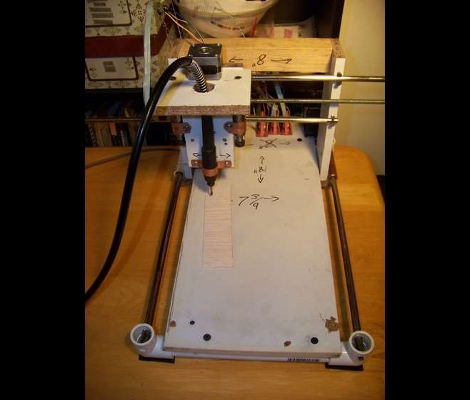
[Csshop] is setting a new bar for building an inexpensive CNC mill. Not only did he complete his build at a very low cost, but it seems to work quite well too. Check out the video after the break to see the device cut out thin wood parts for a toy plane.

The majority of the build uses scrap wood for the body of the mill. The business end of the device is a flexible rotary attachment for a Dremel tool which takes a lot of the weight and bulk out of the gantry assembly. Old flat bed scanners were gutted for the precision ground rod and bearings, as well as the three stepper motors used to drive the axes. An Arduino board controls the device, commanding the stepper motors via EasyDriver boards.

Once the hardware is assembled there’s still a fair amount of work to do. [Csshop] builds his designs in Google Sketchup, but some conversion is necessary to arrive at code that the Arduino will understand. He’s got a second project write-up that covers the software side of things.

Continue reading “CNC Mill Built From Junk And Hardware Store Parts”

RSA SecurID Two-factor Authentication Comprimised


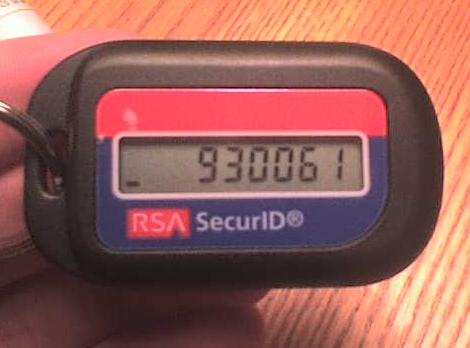
SecurID is a two-factor hardware-based authentication system. It requires you to enter the number displayed on a hardware fob like the one seen above, along with the rest of your login information. It’s regarded to be a very secure method of protecting information when users are logging into a company’s secure system remotely. But as with everything else, there’s always a way to break the security. It sounds like last month someone hacked into the servers of the company that makes SecurID.

You’ll need to read between the lines of that letter from RSA (the security division of EMC) Executive Chairman [Art Coviello]. He admits that someone was poking around in their system and that they got their hands on information that relates to the SecurID system. He goes on to say that the information that the attackers grabbed doesn’t facilitate direct attacks on RSA’s customers.

We’d guess that the attackers may have what they need to brute-force a SecurID system, although perhaps they have now way to match which system belongs to which customer. What’s you’re take on the matter? Lets us know by leaving a comment.

[via Engadget]

Robotics Merit Badge Just Announced

So you know how to build and program robots; what do you want, a badge? Now you can get just that, assuming you’re 11-18 years old and know all of the secret (or not so secret) handshakes, oaths, and pledges. The Boy Scouts of America recently announced the brand-new robotics merit badge. Now kids who cut their teeth building rule-breaking entries in the Pinewood Derby can have a go with robotics kits.

The requirements which must be satisfied to earn the badge start with safety and end with an exploration of the careers associated with the field. Along the way the Boy Scouts are encouraged to learn about keeping an engineering notebook during the design process, planning and programming the hardware, and attending a robotics competition like FIRST or VEX.

It’s not hard to see that this merit badge is right up our alley. We just hope it can grab some attention from the uber-popular badges like Stamp Collecting and Basketry.

Variable Capacitance/reistance Switch Box Has You Covered

variable_cap_resistor_box

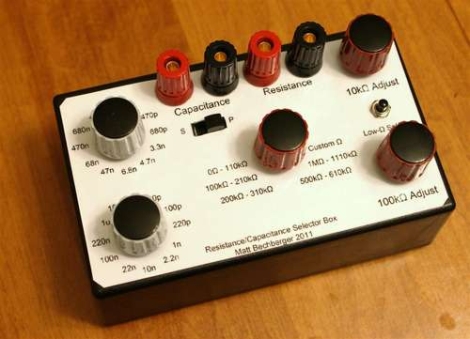
While working on electronics projects, it’s often necessary to test out different capacitance or resistance values as things are moving along. Depending on what you are testing, this can be a tedious process even when using a breadboard. Instructables user [mattthegamer463] recently built a very useful device that would help out in these situations, and would likely be a welcome addition to any Hackaday reader’s workbench.

His variable resistor/capacitor box makes it easy to test out any number of different resistance or capacitance values with a simple turn of a knob. He wired up a pair of pots to provide a wide range of resistance values, being sure to add a low-resistance safety as well as safety override switch for those of you who like to have things blow up in your face live dangerously. A set of 22 capacitors were wired up on a piece of perfboard, each of which can be selected using a pair of knobs. He added a simple switch to allow the capacitors to be toggled between parallel and series orientations as well.

[Matt] did a wonderful job here – this is a great project that can be customized in a multitude of ways to fit almost anyone’s specific needs.

Super Refined Kinect Physics Demo

kinect_demo

Since the Kinect has become so popular among hackers, [Brad Simpson] over at IDEO Labs finally purchased one for their office and immediately got to tinkering. In about 2-3 hours time, he put together a pretty cool physics demo showing off some of the Kinect’s abilities.

Rather than using rough skeleton measurements like most hacks we have seen, he paid careful attention to the software side of things. Starting off using the Kinect’s full resolution (something not everybody does) [Brad] took the data and manipulated it quite a bit before creating the video embedded below. Skeleton data was collected and run through several iterations of a smoothing algorithm to substantially reduce the noise surrounding the resulting outline.

The final product is quite a bit different than the Kinect videos we are used to seeing, and it drastically improves how the user is able to interact with virtual objects added to the environment. As you may have noticed, the blocks that were added to the video never rarely penetrate the outline of the individual in the movie. This isn’t due to some sort of digital trickery – [Brad] was able to prevent the intersection of different objects via his tweaking of the Kinect data feed.

We’re not sure how much computing power this whole setup requires, but the code is available from their Google Code repository, so we hope to see other projects refined by utilizing the techniques shown off here.

[via KinectHacks]

Continue reading “Super Refined Kinect Physics Demo”

New, Inexpensive DSO Now Shipping

Seeed Studio’s line of hacker-friendly tools has expanded by one, they’ve announced that beta units of their DSO Quad oscilloscope are now available for shipping. The DSO Quad is about the size of a thick iPod yet packs impressive features such as two 72MSPS analog channels and a signal generator. By far the coolest ‘feature’ of the DSO Quad is that it’s completely open source.

DSO Quad is a pocket size four-channel digital oscilloscope designed “for common electronic engineering tasks.” It’s based on an ARM Cortex M3 that provides 72MSPS analog bandwidth on two channels with an integrated FPGA and a high speed ADC. In addition to the four data acquisition channels (two analog, two digital), the DSO Quad has a signal generator.  This lets you put out square, triangle, saw, and sine waves from 10Hz to 1MHz. An internal 2MB USB stick can be used to store sampled data, upgrade the firmware, or run custom programs. Since the device is still in beta, some of the software specifications aren’t firm, but if you’re looking for a relatively inexpensive ‘scope, this could be the one for you. Just bear in mind that for this pre-production run you’re not getting any documentation, so be prepared to be off the reservation and on your own.