Motion Controlled Reddit Vote Sign.


A little while back I attended the largest east coast gathering of folks from the ever popular social news site, Reddit.com. Those of you familiar with Reddit already know that it is all about link aggregation. Users post links to interesting websites and material, and can then vote up or vote down content based on interest or relevance. Through the magical site algorithms original and interesting content is, as implied, aggregated up to the front page.  The whimsical nature of this big DC event lead many people to furnish signs of all types based on the culture of the site, internet memes, etc… The signs that really caught my attention were based primarily on the stylistic site layout, blowing up mail icons and other Reddit specific graphics.

The concept of using site graphics gave me the idea of being able to personally vote up or down other peoples’ signs. It was far too easy to just make a cardboard arrow, and I don’t have a color printer. I happened to have a shelved coffee table project involving orange and blue LEDs. Same colors as the arrows! Sweet. To make this project work I would have to work entirely from my project pile, there simply was no time to order anything from the internet. I managed to crank out a functional up/down voting sign in 3 days leading up to the gathering (and the morning of), here is what I did:


Continue reading “Motion Controlled Reddit Vote Sign.” →

Google’s Secret Perk? A Private Hackerspace

google_hackerspace

Working for Google has always had many perks, and most of them are pretty well known. Google employees enjoy free food, on-site workout facilities, and one free day a week to work on whatever they like – but you knew that already. One Google perk however, has been kept pretty quiet until just recently.

Google has provided a hackerspace on their campus for about four years now, which is open to any employee that meets some pretty strict requirements. A written test is given before an employee can access the facilities, and even then they must be deemed worthy of working on particular pieces of equipment.

The idea behind the hackerspace was to help Google stay rooted in the philosophy that, “all good things start in the garage”. While a lot of the employees embark on fun personal projects, several pieces of familiar Google technology were born in the workshop. For instance, the Google Streetview “trikes” were created there, along with a few smartphone prototypes, autonomous car components, and even some secret projects Google declines to speak about at the moment.

It’s an unbelievably cool job perk, and we would be lying if we said we weren’t jealous. For now, we will just have to be happy with stale coffee from the break room.

[via the Adafruit Blog]

[Image via AP]

Watch Hacking, One Day At A Time

watch_a_day

If there is one thing hackers return to time and time again, it is clock/watch hacking. There are always creative ways to tell time, and with several “hackable” wristwatches on the market, there is bound to be no shortage of neat timepiece hacks.

[hudson] from NYC Resistor has decided to take on a fun challenge for the next month revolving around his programmable inPulse watch. Over the upcoming 30 27 days, he will design, program, and publish a watch face for the timepiece. He already has 3 days behind him, and the results are pretty interesting. The concepts are creative and functional, though due to time constraints they sometimes end up a little less polished than he would like.

All of the code is available on his Bitbucket page if you have an inPulse watch and would like to play along or improve on his work.

We think it’s a pretty cool project, and we are eager to see what he produces each day. Stick around to see a quick video showing off one of his 3D watch faces.

Continue reading “Watch Hacking, One Day At A Time” →

can_bus_hacking

Enhance Your Key Fob Via CAN Bus Hacking

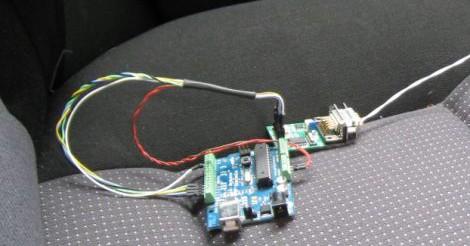
[Igor] drives a 4th generation Volkswagen Golf, and decided he wanted to play around with the CAN bus for a bit. Knowing that the comfort bus is the most accessible and the safest to toy with, he started poking around to see what he could see (Google translation).

He pulled the trim off one of the rear doors and hooked into the comfort bus with an Arudino and a CAN interface module. He sniffed the bus’ traffic for a bit, then decided he would add some functionality to the car that it was sorely lacking. The car’s windows can all be rolled down by turning the key in any lock for more than a few seconds, however this cannot be done remotely. The functionality can be added via 3rd party modules or through manipulating the car’s programming with some prepackaged software, but [Igor] wanted to give it a go himself.

He programmed the Arduino to listen for longer than normal button presses coming from the remote. Once it detects that he is trying to roll the windows up or down, the Arduino issues the proper window control commands to the bus, and his wish is the car’s command.

It’s a pretty simple process, but then again he has just gotten started. We look forward to seeing what else [Igor] is able to pull off in the future.  In the meantime, continue reading to see a quick video of his handiwork.

If you are interested in seeing what you might be able to do with your own car, check out this CAN  bus sniffer we featured a while back.

Continue reading “Enhance Your Key Fob Via CAN Bus Hacking” →

The Silicon IC 50th Anniversary

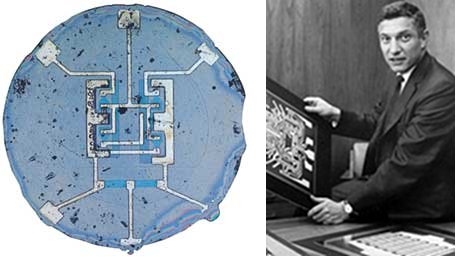
Today marks the 50th anniversary of the first silicon integrated circuit patent. We should not have to explain how important the integrated circuit to this crowd, but it is the biggest thing in electronics since sliced bread.

[Robert Noyce] received the landmark patent on April 25th 1961, and went on to found a little known company you might of heard of (along with [Gordon Moore]), Intel Corporation. He was not the first to invent the IC, that privilege goes to [Jack Kilby] of Texas Instruments, though that design was using a germanium wafer. Silicon has many advantages over previous technology and has become the main technology of IC’s even 50 years later fueling the electronics, computer and mobile industries.

Check out the little article above, and also be sure to check out this video on IC construction we posted about a few months ago from the other company [Robert Noyce] help co-found, Fairchild Semiconductor.

netcast_hack

Hacking LG’s Netcast

LG released a line of Internet-connected TVs in both the US and Europe that utilize Yahoo TV widgets to bring interactive content to the living room. While it sounds like a great idea in theory, users have been disappointed to find that LG has approved a measly 15 widgets since the TVs were released.

OpenLGTV.org.ru user [xeros] has started working on a project that aims to enable more useful content as well as homebrew widgets. The project is known as OpenLGTV BCM, and not only covers LG television sets, but all sets based on the Broadcom platform.

A ton of progress has been made already, as they have been able to install their own busybox environment as well as open the sets to accept more widgets via some clever signature spoofing. The ultimate goal for the project is to completely divorce the sets from the Yahoo platform and replace it with their own open marketplace.

It’s a great start, and we can’t wait to see what sort of progress they make as time goes on.

[Thanks, T]

Extending The Battery Life Of LED Dominoes

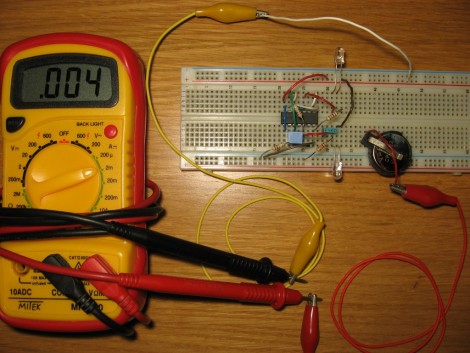
[Fede.tft] wrote in to tell us about some work he’s been doing to save battery life for LED dominoes. He originally got the idea after reading this post about the electronic gaming pieces. That project was aimed at the 555 timer contest and therefore, used a 555 timer. [Fede.tft] calculates the battery life for the CR2302 battery in the 555 circuit at no more than about 80 days. That’s if you never use them and the LEDs are never illuminated. It makes sense to remove the batteries from the device when not in use, but a redesign to increase efficiency is definitely worth the effort.

This rendition does away with the 555 chip in favor of a CMOS chip. By building a circuit around four NAND gates of a CD4011 chip, the standby lifetime of the battery is calculated to increase to about 4.5 years. Not bad! Add to this the fact that replacing the 555 timer didn’t increase the component count, the price for the chip is similar to the 555, and you didn’t need to resort to a microcontroller. Yep, we like it.