Hack A Day Links: April 27, 2011

Remaking the first video game

At the Revision 2011 demo compo, a museum project called [MEGA] won first place in the “Wild” category with their zero bit recreation of “tennis for 2”. Entirely made of analog electronics, the retro game completes its presentation on a round o-scope screen. You can see a video of it after the break.

Mint-tin bicycle computer

[Alexdlp’s] newest instructable is a attractive and compact bicycle computer running off of an Arduino, and sports the usual bike features. It does not stop there, adding in a 16×2 LCD gives more room for data in both numeric form and bar graph form, and adding in a pair of radio modems allows that data to be fed back home where it can be logged and compared, perfect for the more serious biker.

8085 Reference Card


If you enjoy retro computers, or would like to make your own, you will find this Intel 8085 reference card is a real treat. Based on a original reference card, it has been expanded to give more detail for additional interrupts, electrical reference, T-State timing, and undocumented instructions.

Connect a SNES controller to your Android phone

[Bruno] wanted to be able to use a real SNES controller with the emulator on his HTC Android phone, packing in an Arduino, 6 AA batteries, and a breadboard and mission accomplished! Hardly as portable as the phone, but we commend the “get it done” sprit. Join us after the break for a quick video.


Continue reading “Hack A Day Links: April 27, 2011” →

WonderHowTo Inteview Of [Matthias Wandel]

If you’re an avid Hackaday reader chances are that you immediately recognized [Matthias Wandel’s] name. He’s been featured many many times to go along with his many many talents. Most notably, his ability to do some amazing things with wood. But really, it’s the idea that counts, and he seems to have a duffle bag full of them. [Rachel adn Justin] over at WonderHowTo recently published a full interview with Mattias. In it he shares his thoughts on where some of these ideas come from, how he approaches his projects, and even shares some advice for those just getting started.

This is usually the time where we make a witty remark and try to work in links to feature articles from the past. If we were limited to just one it would be pretty tough (although there’s a special place in our hearts for the wasp sucker). Luckily we’re not limited, so here’s a list of some of [Matthias’] projects which Hackaday covered previously:

Playstation Network Breached, No End To Downtime In Sight

psn_logo

If you are not a gamer, or simply a casual player, you may not have heard about the recent breach of Sony’s Playstation Network. In short, the network was infiltrated on April 17th, and the service was completely shut down on the 19th as a precautionary measure. Now, more than a week later services have yet to be restored, but Sony is finally starting to talk a bit more about what happened.

At this point, nobody knows the total extent of the data stolen, but stories are emerging that indicate just about everything that could be accessed was accessed. Sony admits that information such as names, addresses, passwords, and security questions have all been accessed by an unauthorized third party. They have also not completely ruled out the possibility that credit card data has been stolen as well.

It seems the situation has turned from a mere inconvenience to PSN users into a full-blown security and PR nightmare. After a breach like this with so many questions left unanswered, and the gaming network rendered completely useless, we have to ask:

When everything is “fixed” and back to normal, what could Sony possibly do to regain your trust?

Be Lazy, And Get Somewhere At The Same Time

Cruise the beach in comfortable Jamaican style with this motorized hammock. [Stephen Shaffer] and his friends built it for the Red Bull Creation contest which has as its number one requirement, the need to include an Arduino. We’re basically looking at a hammock frame made out of square pipe that has been put on wheels. Watch the video after the break to see the prototyping, construction, and final product. Looks like originally the electric wheelchair base that’s used for propulsion was centered below the hammock. One sharp turn and the rider/operator gets dumped out on the concrete.

The final version includes a couple of wheels that serve as outriggers, keeping the vehicle upright. A PlayStation 2 controller is used for steering and directional control. It’s polled by the Arduino, which then uses servo motors to control the original wheelchair joystick. At least that’s what we were able to figure out by watching the video.

Continue reading “Be Lazy, And Get Somewhere At The Same Time” →

Data Scraping And Visualization With Python

arduino_dial

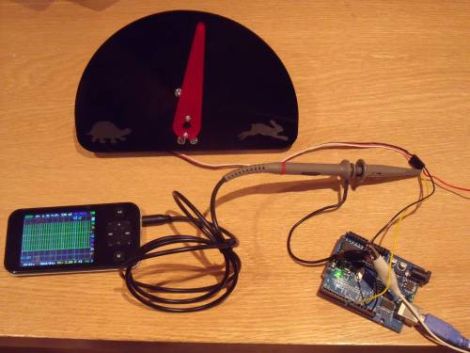
[Greg] built himself a small indicator dial with his laser cutter, and wanted to use it for visualizing server performance and load information. Before he started using it for server monitoring however, he thought he should test out his data parsing skills on a simpler data set.

Pachube has a wealth of information that can be freely used for whatever project you might have in mind, so [Greg] started looking around for something interesting to track. Eventually he located the data feed for a tanker ship and wired his dial to display the ship’s speed. He uses a Python script to interface with the Pachube API, which is fed to his Netduino board. A servo motor then changes the position of the dial based on the feed’s data. Since large tankers don’t change speed often, the experiment was a bit of a letdown. He searched for a bit and tuned into another feed that tracked wind speed in New Zealand, getting much better results.

His future plans include hooking it directly to his network and eventually using it to monitor his servers…at least once the novelty of tracking random data feeds wears off.

All of his code is available on GitHub, and he is happy to make a gauge for anyone who is interested, though he doesn’t currently list a price.

Server Room Light And Temperature Monitoring

environ_monitoring

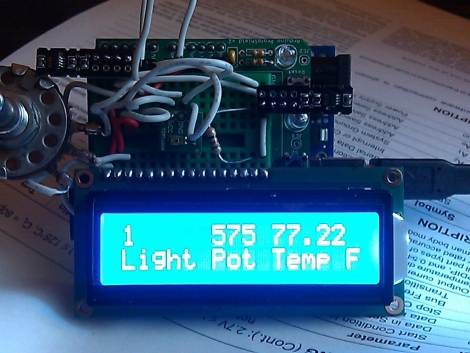
[Jaren] is occasionally forgetful, and frequently wonders if he’s left the lights on in his server room. Not knowing if the lights have been left on drives him nuts until he returns to work the next morning, so he decided he had to do something. He figured it would be easy enough to build a small sensor that would allow him to monitor the status of the overhead lights, but he didn’t want to have his micro controller’s abilities go to waste by performing one simple task. Instead, he laid out plans to add an array of other sensors which will allow him to monitor the room’s temperature, sound levels, as well as the current draw of the servers.

Right now the project is in the beginning stages, but he already has part of his sensor network established. He hooked up a TMP421-based temperature module along with a TEMT6000 ambient light sensor to his Arduino, which displays the data on a small LCD screen he purchased. More sensors are on order, so we should expect to see more progress in the coming weeks.

Hopefully when everything is completed we will see a full set of schematics and code so that anyone can buld their own server room monitoring network from his designs.

DIY Lightbox Repurposes Useless Scanner

[James] didn’t like losing detail when scanning in photographic negatives, so he repurposed an old scanner and turned it into a lightbox.

The Flickr set of the build shows [James] installing a compact fluorescent bulb in the body of the scanner. Aluminum foil reflects the light, and the scanner glass is painted white for diffusion. [James] is quite happy with the result, and is amazed by the detail seen in the negatives under magnification instead of scanning.

We’re trying to figure out [James]’s though process in deciding to build a light box, and the best we can come up with is the hackaday mantra of, “Of course I can do that myself.” Even though he seems happy with his project, we’re wondering how hackaday readers would improve it. Maybe several dozen red, green, and blue LEDs to adjust the color temperature? Post your ideas in the comments.