Screaming Altoids Tin Just In Time For April Fool’s

altoids_screamer

Maker [Dino Segovis] has started on a project he calls “Hack a week” where he will be putting together one hack or project per week, for a full year. The first installment of his video series was finished just two days before April Fool’s, and appropriately enough covers the construction of a circuit you can use to prank your friends.

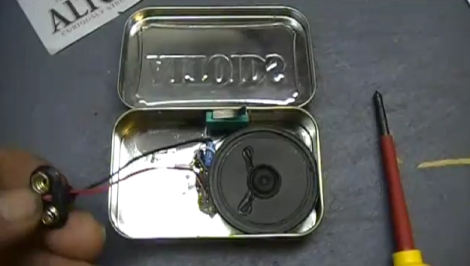
The “Altoids Screamer” is a simple circuit based on a 555 timer that he built into a standard Altoids Tin. The 555 timer is used to generate a loud pitched squeal whenever the tin is opened. This is accomplished by wiring up the 555 in astable mode, and connecting it to a speaker to output the sound. A micro switch is installed inside the tin to detect when the top has been opened, triggering the “scream”.

While it’s not the most complex circuit we’ve seen, it definitely gets the job done and is easy enough to build in time for tomorrow’s festivities. It is a great hack for the office, the library, or any other quiet place.

Continue reading to watch [Dino’s] first Hack a Week video demonstrating the prank’s construction. If you are interested in some more of his work, be sure to check out this automatic ball launcher and this other 555 Screamer toy.

Continue reading “Screaming Altoids Tin Just In Time For April Fool’s” →

Think Geeks Wants You To Have Broken Stuff

Think Geek has a growing pile of returns and damaged product that they’re trying to get rid of. The purveyors of technological oddities, like any other large retailer, sometimes have stuff that doesn’t work right, or has been damaged somewhere between factory and consumer. The broken bits find their way back to the distribution center and now they’re stuck with the task of doing something with it.

They can’t sell it, and we’re happy to say they don’t want to throw it out. So they’re considering giving it away to worth-while causes like Hackerspaces and schools. Looks like no real details have been hammered out as of yet. But if you belong to a Hackerspace or other group that can find a use for this stuff, click-through the link above and sign up to let them know you’re interested. The goldmine of reusable stuff is located in Columbus, Ohio and pick-ups might be available. Otherwise they’re going to need to find a way to cover the cost to ship boxes to those interested.

Don’t forget to document your projects and let us know what you use this stuff for.

[Thanks RenderMan]

Building An Advanced Mobile Phone Service (AMPS) Base Station

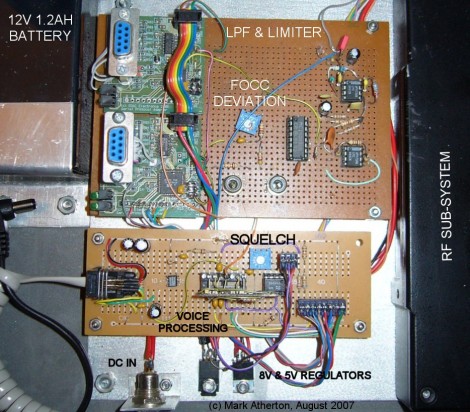
Remember the early days of cellphones and carphones when they were super-bulky and all the rage? Those early handsets used analog technology for communications in a protocol called Advanced Mobile Phone Service (AMPS). As more customers flocked to wireless providers, networks were transitioned over to digital phones in order to save bandwidth. Some places still support AMPS but it has rapidly gone the way of the Dodo. But a few years back [Mark Atherton] got his hands on some old hardware, including a bag-phone and some test equipment, and set out to build a base station that can control AMPS handsets. In short, he’s creating his own analog cellphone tower. There’s a wealth of information on his page. The writeup comes out as a mix of protocol and electronic resources he scavenged across the net, as well as a work log serving as a testament to his successes and failures. He did his experiments in New Zealand, so if you’re thinking of undertaking this make sure to research your local radio regulations first.

[Thanks J]

Solar-powered MP3 Playing Speaker

solar_speakers

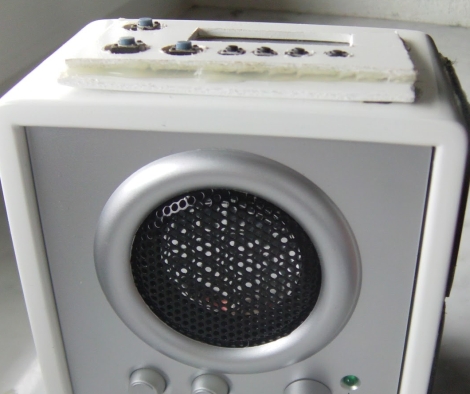
[Valentin] bought a small battery-powered cube speaker with a built-in amp some time ago, but didn’t have much patience for replacing or recharging the batteries. It sat on the shelf for awhile until he decided to revive an old MP3 player he had sitting around.

He gutted a pair of solar garden lamps, retaining the solar panels, the built-in charging circuits, as well as the included rechargeable batteries. The MP3 player was disassembled, and its components were built into the speaker enclosure. The player’s buttons were relocated to the outer shell of the speaker box with a few pieces of wire, allowing him to easily control his music without having to build in a method for opening the case. Both the speaker and the MP3 player are powered by the batteries salvaged from the solar lamps, which is why he opted to mount both of the solar panels on the the side of the speaker enclosure rather than just one.

We like it even though the speaker looks a bit rough at the moment, especially where the MP3 player’s buttons were transplanted. After a few minutes of touch-up work however, it’ll look great.

If you’re interested in some more solar hacks, check out this solar-powered junkbot, these solar toys for kids, and this solar-powered WiFi repeater we featured in the past.

PCBs Without Any Substrate

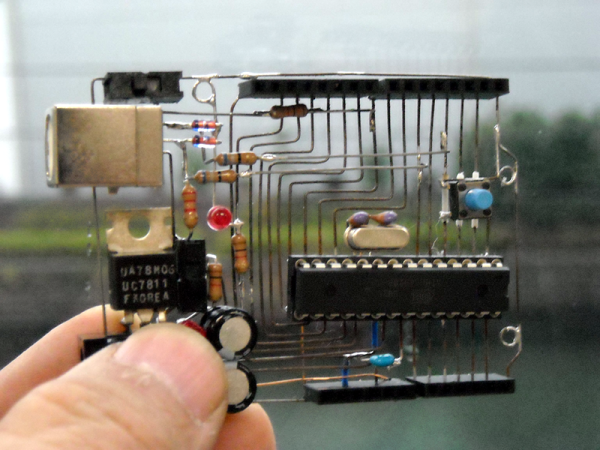
[Kimio Kosaka] is taking the concept of free-formed circuits to the next level with O’Baka Project No.7. It’s a fully functioning Arduino board, without the board. The traces are there and provide all of the support for the rest of the hardware. You can imagine the fragility of the package so it won’t be a surprise to learn that O’Baka Project means ‘stupid’ project.

We don’t think this manufacturing process is completely worthless. The ‘board’ seen above looks quite interesting and might be a good idea when building a show-piece where you want the circuitry to be seen. [Kimio] describes the process he used to achieve this look. The first step is to design a single-sided circuit board; he used EagleCAD. After printing out the traces he used 0.46mm steel wire to trace out each connection. Now heat up that soldering iron – [Kimio] recommends using high-acid flux to ease the process of soldering to the steel.

We think this would nicely compliment projects like LED cubes that use the circuit itself as a support structure. See this Arduino alternative from several different angles in the video after the break.

Continue reading “PCBs Without Any Substrate” →

The ElectroAxé Full-Body Percussion Suit

Carnival in Salvador, Brazil is arguably one of the biggest and craziest parties this world has ever known.  With millions in attendance for what is already an incredible audio and visual display, performers are faced with the daunting task of continually bringing something new and fresh to the masses. One could always add more fireworks or visual displays (never a bad thing), but it will only take you so far. [Kyle McDonald] and [Lucas Werthein]’s answer: The ElectroAxé Full-Body Percussion Suit as demonstrated by Carlinhos Brown at Carnival 2011.

When most people hear the word “axe” as related to music they think of an electric guitar. “Axé” however, refers to a unique Afro-Caribbean fusion genre of music that originated in Salvador in the mid 1980’s and is a favorite at Carnival. [Carlinhos Brown] is a popular Brazilian percussionist and was looking for a creative new way to express himself through his song and dance. Instead of being stuck in one place near his instruments or carrying one or two drums around “marching-band style”, he is now able to move around the stage freely – his body has become his instrument.

In order to make the magic happen, [Kyle] and [Lucas] designed custom laser cut and cnc machined drum pads containing piezo sensors and integrated them with a full-body jump suit. When struck, these sensors send a signal to an Arduino with a Sparkfun Midi Shield housed in a custom enclosure on the performer’s waist. From there the MIDI signal is sent wirelessly and then audio is played through the existing sound system – it appears that a CMD WIDI X-8 wireless MIDI system is employed for the actual wireless transmission.

Although details are somewhat scarce, there are plenty of pictures, (more) available.  You really can’t argue with the results as you watch thousands of people jam along.

Come join in the festivities with video after the break!

Continue reading “The ElectroAxé Full-Body Percussion Suit” →

[Jason Scott] Gets A Job In A Candy Factory — Kinda

Remember when you used to have to dial into a Bulletin Board System to connect with others through computers? How about those fond memories of phone phreaking? If you find that the details are fading in your mind you’ll be happy to know that [Jason Scott] is making sure they’ll never be forgotten. And now he’s landed a new job that will make this mission even easier.

We’re most familiar with [Jason’s] film, BBS: The Documentary. This five-hour epic traverses the oft-forgotten world of the BBS. It pays attention to things like the formation of ASCII art groups, the elite control of the Sysop before the Internet decentralized access to information, and quirky technological limitations like what happened as FIDOnet ran out of addresses for new nodes.

In short, [Jason Scott] is a technological historian. He gives speeches, makes movies, and finds information stashes that history shouldn’t forget. He’s done this outside the tradition of finding a Professorship or Curator position for a major institution. Instead he asked for sabbatical funding through Kickstart, and now he’s found his way to a position that seems like it’s made just for him; Archivist for the Internet Archive. Go get ’em [Jason].