PUSH Competition Winners

nokiapush1

Nokia team PUSH is proud to announce they have winners from the contest they held over the past two months. You may remember when we first told you about the competition, but here’s a recap. All you had to do was think of a good hack for the Nokia N900! Winners will receive funding and other resources to make their hack come alive. What possible hacks made the cut?

Haptastic – A compass and map? Not any more with this wearable guide that can lead the way.

KAPingwiththeN900 – Flying high with this aerial photography project

LIGHT HACK CREW
– Bring light graffiti to the N900

Rocket Pocket – Just Bonkers! An N900 in orbit, we love it!

SolderinSkaters – Tony Hawk who? It’s all about Solderin Skaters!

Augmented Xylophone

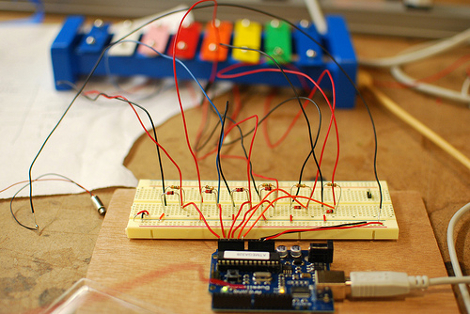
[Ania’s] been working on extending a xylophone in a project called Multixylophoniomnibus. She’s fitted a piezo sensor on the bottom of each xylophone key, interfacing it with an Arduino. When a mallet hits a key the corresponding box augments the sound in one of several ways. It looks like she’s prototyped a box that twangs a rubber band, one that uses a solenoid to clap mini cymbals together, one that rattles a glass full of beads, another that vibrates a glass full of water, and yet another that rattles a chain.

It’s nice to see how versatile the xylophone is for instrument hacking. Her Flickr set is linked above but we’ve also embedded some prototyping videos after the break.

Continue reading “Augmented Xylophone” →

ArduiNIX: Nixie Shield For Arduino

ArduiNIX-nixie-shield

Flock of Butterflies has just published their third post in a series about the ArduiNIX, an Arduino shield that drives Nixie tubes.We’ve featured Nixie tube projects such as a single tube clock, free-formed Nixie circuits, and tubes in a bottle. Now the hurdle of handling high voltage tubes while protecting low voltage logic circuitry has been taken care of for you. The shield can be purchased as a kit but the Eagle CAD files are also available, allowing you to etch your own circuit board.

Although this is meant for the Arduino there is nothing to keep you from using it as a driver with any microcontroller. The board listens for 5V logic levels to switch the multiplexed display of up to eight tubes. Get your hands on some Nixies and give this a try yourself.

Related: ArduiNIX Part 1, ArduiNIX Part 2

Computer Learns From Tic-tac-toe

menace-tic-tac-toe-computer

MENACE, the Matchbox Educable Noughts And Crosses Engine, is a fancy name for a machine that plays Tic-Tac-Toe. The concept is a product of Professor [Donald Mitchie]’s work in the 1960’s and was featured as an example in the “A New THEORY of AWESOMENESS and MIRACLES” talk given at this year’s UK games conference.

[James Bridle] built this fascinating example of how a computational system can learn from its successes and failures. Each box corresponds to one of 304 different board layouts. The operator uses an index sheet to locate the box that corresponds to the current state, shakes the box, then looks to see which bean has randomly fallen into a partition in the box. The color/type of bean corresponds to a space that the machine has “chosen” for that move. If MENACE won the game a bead matching the move that was played would be added to each box used. If MENACE lost, a bead would be removed from each box used. This way the machine cannot make the exact same mistakes twice, and is more likely to repeat successful solutions.

[James] notes that he couldn’t find any evidence of this machine actually being built before. It is possible that this was always a theoretical device but now we’ve seen an actual build. We consider this to be a computer because it is calculating moves based on probability of success but what do you think? If you’re thirsting for more pictures there’s plenty to see in the Flickr set he’s posted.

[via BoingBoing]

Ping-pong Launcher Your Wife Can’t Know About

ping-pong-ball-launcher

Sometime the projects you see at the local hacker space are better left a secret when you return home for the evening. Case in point, this ping-pong ball launcher that can put holes in a sheet of OSB. The projectile is made more lethal because the ball has been injected with water to dramatically increase the density. Compressed air is used to propel it from the 14 round magazine with devastating effect.

We’ve embedded a video of the gun being fired after the break. The creator, [Ron Kessinger], demonstrated this at a Denver hacker space called Club Workshop. We’re hoping there’s no plans for turret automation because this thing’s dangerous! Either way, the significant other who usually watches out for our safety would never approve. Continue reading “Ping-pong Launcher Your Wife Can’t Know About” →

Medium Format Camera, From Scratch

title_image_t

[Peter Johansson] has taken it upon himself to build a medium format camera, from scratch. We know this is a shock to some of you, but this camera uses traditional medium. There is no sensor. He will be loading it with (gasps) film. He bought the lenses pre made, but everything else is being constructed by himself. Probably the most notable parts are the aperture and the shutter. The project is about 80% complete right now. We can’t wait to see it finished.

[via Makezine]

We’ll Take The Fries.

fjdkalfjdklajfdaflj

We’ve all been there; hardest decision we’ve ever had to make. College and debt or freedom but no career? Start a family or live out alone? The number 2 with a small shake or side of fries?!

[Leon] sent in his random number generator, oddly enough not to just generate a number, but help us through with those life altering decisions. Using a noise diode like setup he’s able to generate random bits, which an ATtiny24 then converts and displays on a 7 segment LED. His generator also has the ability to set upper and lower limits. Seems like an awful lot of work to avoid the freedom of choice paradox, but we enjoyed the project none the less. Check out a video after the break. Continue reading “We’ll Take The Fries.” →