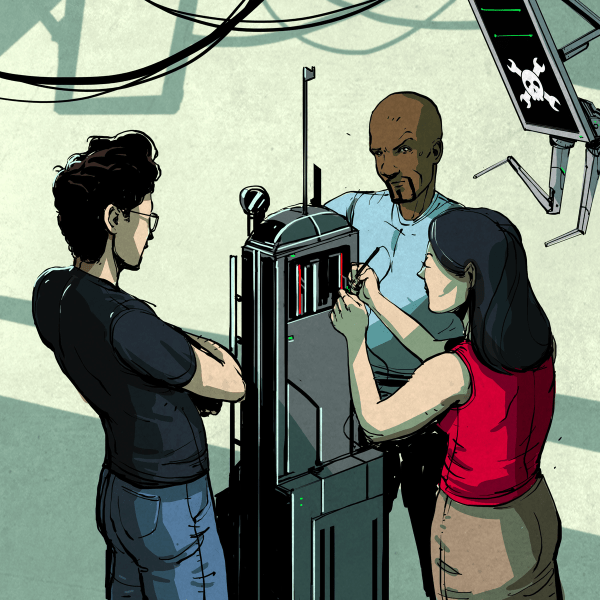
[Nathan] sent in his speaker microphone project. Speakers and microphones are physically similar – usually mics are much smaller to allow decent high frequency response. In this case, [Nathan] wanted something to pick up kick drums or bass guitars, without the cost of a commercial version like the subkick. It’s built around a dual coil 6.5 inch subwoofer. The passive circuit design allows the coils in the speaker to be configured for differing impedance, phase and isolation.
Stroboscope LED Fan Clock
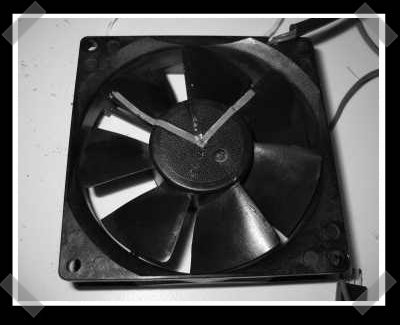
[sprite_tm] sent in one of his latest little adventures – and I love it. To create his stroboscope fan clock, he put a couple of red and green clock hands onto a standard PC fan(I love Panaflo fans), then he built a circuit to strobe a RGB LED to create a set of virtual clock hands on the spinning fan. An ATTiny2313 does all the work, with the help of some transistors to drive the LEDs.
How-To: Introduction To Soldering
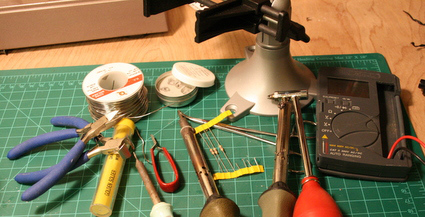
It’s been a while since we’ve had a fresh How-To on the Hack-A-Day, and frankly we’ve missed them. To get things rolling, [Eliot] and I wanted to build a good knowledge base to help you hack your own stuff. I know that soldering won’t be new to many of our readers, but everyone has to start sometime. Our hope is simple: that this new series of How-To’s will help inspire new and experienced hackers alike.
High Power TVBGone
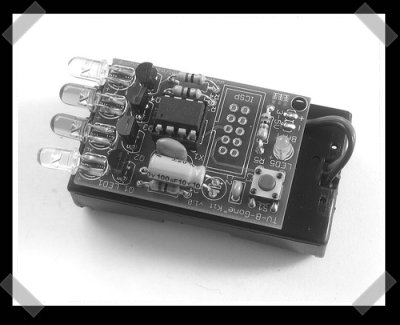
[Ladyada]’s been busy lately. [bladdo] wrote in to tell me that she put together an extra powerful kit version of the TVBgone. This one’s supposed to be good for over 100 feet. If you really, really want to get your ass kicked during the super bowl, this baby in a sports bar should do the trick. There’s an optional programming header, so you could program it to turn every TV onto the SciFi channel.
Remember, I want to hear about your hacks! Use the tips line to send ’em in.
1-wire Thermostat Control
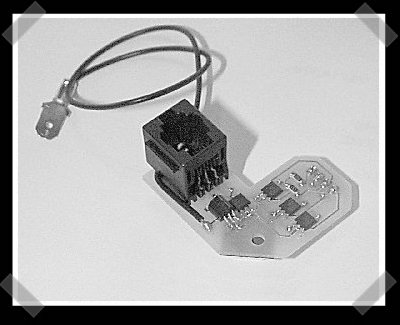
For some reason, computer controllable thermostats are pretty freakin’ expensive. I found a reference to a 1-wire thermostat in this(mirror) sample senior project on home automation. It turns out that Dallas Semiconductor put one together a while back as an application for their TINI platform. (web-application server on a chip). The write-up has since vanished from their site, but I found it thatnks to archive.org. The thermostat used to run about $50, and a similar model still seems to be produced. The 1-wire interface is pretty simple – Maxim’s TINI board to control it: not so much. Just using the 1-wire interface with an inexpensive thermostat and controlling from a PC seems pretty viable to me. Just in case, I mirrored the 1-wire interface schematics here.
Cell Phone Taser
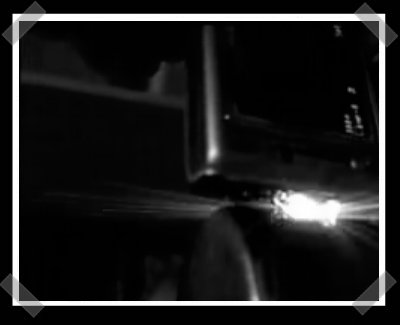
I’m not going to reccomend it, but [cameron] modded his Sony Ericsson k800i to tase people as well as take pictures. Apparently, the k800i has a xenon flash – meaning that it’s got a high voltage potential available to drive the flash. He added a pair of 16uf caps and scored a good 300 volts to share with the unlucky.
ToorCon 9: Retrieving WEP Keys From Road Warriors

[Vivek Ramachandran]’s Cafe Latte attack was one of the last talks we caught at ToorCon. I’ve found quite a few articles about it, but none really get it right. It’s fairly simple and deals with cracking WEP keys from unassociated laptops. First your WEP honeypot tells the client that it has successfully associated. The next thing the client does is broadcast a WEP encrypted ARP packet. By flipping the bits in the ARP packet you can replay the WEP packet and it will appear to the client to be coming from an IP MAC combo of another host on the network. All of the replies will have unique IVs and once you get ~60K you can crack it using PTW. The bit flipping is the same technique used in the fragmentation attack we covered earlier, but Cafe Latte requires generation of far fewer packets. You can read about the Cafe Latte attack on AirTight Networks.