Multicolor Print Head Allows RepRap To Print Rainbows

Multicolor 3D printers have been around for a while, but most of these machines – like the Makerbot Replicator – suffer from alignment problems and the inability to mix colors on the fly. [RichRap] came up with an interesting solution to this problem by having three filament extruders feed into a single hot end, allowing him to change and mix colors on the fly.

To print in multiple colors, [RichRap] developed a three-extruder x carriage that sends colored filament to a single hot end. Unlike the Makerbot Replicator, [Rich]’s extruder can mix and blend different colors into each layer of a print.

The electronics portion of the build, [RichRap] controlled the X, Y, and Z axes of his printer with a RAMPS board, but used a slightly modified Sanguinololu board for the extruder motors. A single motor driver for the extruders is connected to a trio of toggle switches, allowing [RichRap] to switch between filaments on the fly.

[Rich] has a very cool build on his hands, but it’s far from a perfect solution. Right now, any one of the three colors can be used to print, but printing with two or three colors simultaneously requires a change in the firmware. We expect someone to solve this problem in the near future, allowing the holy grail of a CMYK print head to come to fruition.

You can see a demo video of [RichRap]’s tri-color print head after the break.

Continue reading “Multicolor Print Head Allows RepRap To Print Rainbows”
3D Printed Guns, Laws And Regulations, And Philosophical Discussions On The Nature Of Printed Objects

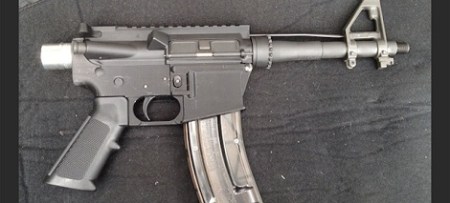
For as long as they’ve been banded about, 3D printers were regarded as the path to a new economy, a method of distributed manufacturing, and a revolution for the current consumer culture. With every revolution, a few people need to get angry and the guys at Defense Distributed are doing their part to make that happen. They’re designing a handgun able to be printed on a hobbyist-level 3D printer

This isn’t the first time we’ve seen a 3D printable weapon; this 3D printed AR-15 lower receiver is the only part of an AR-15 that contains the ID markings and serial number. Legally, the AR lower is the gun, and requires a background check to purchase (with the footnote that this varies from state to state and country to country – long story short, the BATFE probably isn’t happy about a 3D printed AR lower). The one drawback of a 3D printed AR-15 lower is that every other part of the gun must be purchased elsewhere. This is where Defense Distributed comes in: they propose designing a gun that is 100% printable on a hobbist-level 3D printer such as a RepRap or Makerbot.

Right now, Defense Distributed is looking for funding to produce two gun designs. The first design, WikiWep A will serve as a research build, allowing Defense Distributed to answer a few questions on what can be built with a RepRap. WikiWep B will have moving parts for the firing action and very nearly all the parts will be printable on a RepRap or Makerbot.

In the video Defense Distributed put up for their now cancelled IndieGoGo campaign (available after the break), the guys talk about the distribution of a CAD file of completely 3D printable weapon being a threshold of a new economy where laws and regulations cease to apply. We’re not sure we agree with that statement; after all, anyone with some metal forming tools can build an excellent weapon to acquire another weapon, but we’re interested in seeing what governments and regulators will make of Defense Distributed’s project.

Continue reading “3D Printed Guns, Laws And Regulations, And Philosophical Discussions On The Nature Of Printed Objects”

Help Us Decide If This Huge Reprap Array Is The Largest Fleet To Date

30-repraps

Take a minute to think about what your dream job might be.

Done imagining you are a ridiculously wealthy bachelor?  Good.

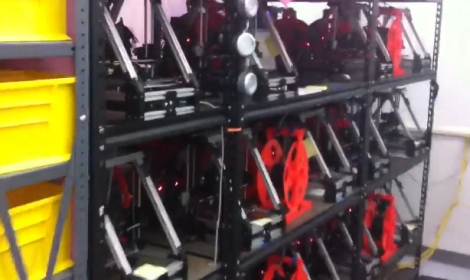
Back here in the real world, [Caleb Cover] has come into what might be one of the coolest hacking-related jobs we’ve seen in awhile. He recently snagged a gig working for Aleph Objects as the fleet master for a large array of 3D printers. His duties include the care and feeding of 30 MiniMax-style repraps, a job description we sure wouldn’t mind having.

Aside from merely gloating about his newfound employment, [Caleb] wrote in asking if we knew of a reprap setup larger than the one he is responsible for. We couldn’t come up with one, but perhaps you can.

Right now, [Caleb] says that he’s working on seeing how well the machines can produce parts to replicate themselves, which will certainly make this the largest collective set of production 3D printers sooner or later.

While you hunt down other large reprap setups at your monotonous desk job, check out the video below to hear the symphony of 3D printing that greets [Caleb] at the door each day.

Think you might have seen a 3D printing setup more massive than this one?  Pics Vids or it didn’t happen.  Seriously, we want to see em!

Continue reading “Help Us Decide If This Huge Reprap Array Is The Largest Fleet To Date”

Turning [M. C. Escher] Prints Into Real Objects

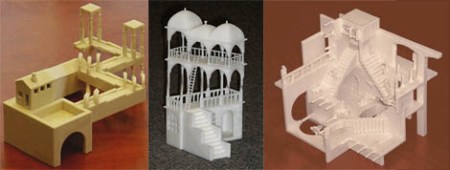
September is coming, and soon college freshmen the world over will be decorating their dorm room walls with Dark Side of the Moon posters and [M.C. Escher] prints. Anyone can go out and simply buy a prism, but what if you wanted a real-life version of objects and buildings from [Escher]’s universe? Professor [Gershon Elber] at the Technion at the Israel Institute of Technology decided to turn [Escher]’s prints into reality.

First beginning with simple shapes such as a Penrose Triangle and a Necker Cube, [Elber] decided to branch out into much more impossible shapes such as [Escher]’s Waterfall, Belvedere, and Relativity. These buildings are extremely hard to visualize in any traditional computer design program, so [Elber] wrote a plugin for his IRIT computer modeling program to design the buildings before committing them to a 3D printer.

In the video after the break, you can see a few rotating views of the resulting [Escher] buildings. Of course they only work from exactly one point of view – and even then, only with one eye closed – but it’s amazing to see these famous architectural studies brought into the real world.

Continue reading “Turning [M. C. Escher] Prints Into Real Objects”

Toorcamp: Type A Machines

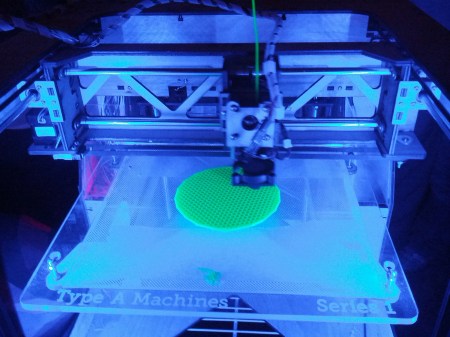
Type A Machines designs and builds 3D printers in San Francisco. [Miloh], one of the founders, brought two of their flagship Series 1 printers to Toorcamp. He printed out a variety of models including water tight cups and quadcopter arms.

The RepRap Arduino MEGA Pololu Shield (RAMPS) is used to drive the stepper motors for each axis, as well as the extruder. This is attached to an Arduino MEGA running the Marlin RepRap firmware. Type A Machines ships the printer with Polylactic Acid (PLA) filament, which is biodegradable.

On software side, you start with a 3D model in STL format. This can be exported from 3D software such as Google SketchUp or Autodesk 123D. You then need a slicer to generate G-code and machine control software to command the printer. [Miloh] used Slic3r and Repetier for his workflow, but he also pointed out a good summary of 3D printer workflows.

The Series 1 was launched at the Bay Area Maker Faire this past May. It has a print volume of 1200 mL, which is the largest print volume of any desktop printer around. The Series 1 brings another option into the low-cost 3D printer market.

3D Printed Exoskeleton Helps This Little Girl Develop More Normal Body Function

This 2-year-old girl has a condition called arthrogryposis which causes her not to be able to move her arms. But with a little help, her muscles can be strengthened to achieve more normal use of her limbs. This is not the first time that an exoskeleton has been used, but the advent of 3D printed parts makes the skeleton work much better.

Previous exoskeletons were made of metal and were quite heavy. When you’re talking about a 25 pound child every extra ounce counts. Moving to plastic parts lightened the load. Now the structure can be mounted on her torso, using rubber bands to aid her movement until her muscles are strong enough to do it on their own.

Of course to [Emma] this isn’t an exoskeleton. It’s her set of magic arms.

Continue reading “3D Printed Exoskeleton Helps This Little Girl Develop More Normal Body Function”

TangiBot And The Perils Of Open Source Hardware

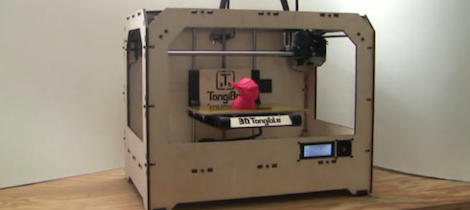
I’ve commented before on the terrible inefficiency and artificially high expense of the current crop of 3D printers. It simply doesn’t make sense to produce the plastic parts of 3D printer kits on a printer farm when there are literally thousands of Chinese injection molding companies that will make those parts cheaper. It looks like [Matt Strong] heeded my call and now has a Makerbot Replicator clone up on Kickstarter that costs $700 less than the official version. We assume the Makerbot lawyers are having a busy morning.

From the info on the Kickstarter page, [Matt] is used parts from his Makerbot Replicator to design a one-to-one copy. Every part and component on [Matt]’s TangiBot is 100% compatible – and seemingly 100% identical – with the Makerbot Replicator. Like the Replicator, [Matt] is offering a dual extruder version that allows you to print in two colors.

At the bottom of the Kickstarter page, under a section titled, “How is 3DTangible able to make a Replicator Clone?,” you’ll see [Matt]’s reasoning for cloning the MakerBot replicator. He says everything is open source, and, “MakerBot used other open source designs when designing and producing their 3D Printers.” We’ll agree that MakerBot used existing extruder designs (and improved upon them), but MakerBot was not this blatant in borrowing from the RepRap project.

For want of editorializing, I’ve complained about the stupid inefficiency of manufacturing 3D printers with 3D printers before. It was only a matter of time before someone realized current manufacturing techniques can be used to make 3D printers cheaper. [Matt] – dude – you were supposed to clone a RepRap. Makerbot has done some really incredible things for the community such as building Thingiverse and generally being an awesome cheerleader for the 3D printing community. Taking the flagship Makerbot printer and making it cheaper will not make [Matt] any friends on the Internet, but at least the laws of economics are coming to the world of 3D printers.

Thanks [Brad] for sending this in.