Reproduce 3D Printed Models By Making Your Own Molds

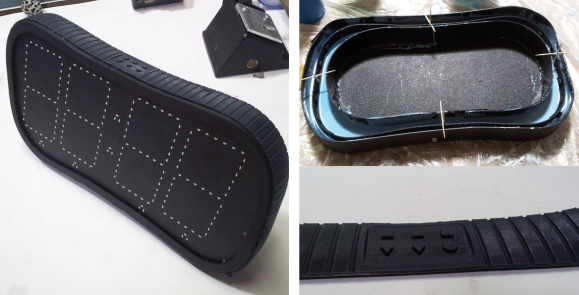
Need fifty copies of that 3D printed whirligig you’re so proud of? It might be faster to just cast copies by using the 3D printed model to make a mold. [Micah] found himself in this situation and managed to cast one copy every 10-12 minutes using the mold seen above.

With the object in hand, you need to find a container which will fit the mold without too much waste. The bottom half of the mold is then filled with modeling clay, a few uniquely shaped objects to act as keys, and the model itself. After getting a good coating of release agent the rest of the mold is filled with a silicone rubber product which is sold for mold making. This creates one half of the mold. After it cures the clay and key objects are removed, everything is sprayed with the release agent, and the other half of the mold is poured.

Now your 3D object can be copied by pouring two-part resins in the to shiny new mold.

Octopus Submarine Is Something Out Of [Jules Verne]’s Imagination

Making an octopus on a Reprap or Makerbot isn’t that terribly hard. There were dozens of these octopuses at nearly every Maker Faire booth with a 3D printer. These octopuses have almost become a right of passage for new owners of 3D printers, and serves as a wonderful reference object on par with the Utah teapot and the Stanford bunny.

[Sean Charlesworth] wasn’t happy with any old octopus; no, he had to build a better octopus, and what better way to do as such then to make a steampunk and [Jules Verne]-inspired model submarine?

[Sean]’s Octopod underwater salvage vehicle was almost entirely printed on a very expensive printer. Save for a few LEDs, electronics, and armature wire, the entire model sub/octopus was printed on an Objet 500 Connex printer.

The Objet is unique among most 3D printers in that it can print objects made of several types of materials. In [Sean]’s show and tell he showed me how the tentacles were made of a hard plastic material and a bendable rubber material. [Sean] put a piece of wire through the length of each tentacle so he could pose the Octopod in just about any way imaginable.

The hull of the Octopod is an amazing amount of work. The cockpit features miniature controls, an illuminated display for a very tiny pilot, and even moving parts that include a mechanical iris in the recovery bay, a winch that works, and even doors that open and close.

[Sean] put a bunch of glamour shots of the Octopod on his web site along with a few videos of the construction process. You can check those videos alongside my interview after the break.

Continue reading “Octopus Submarine Is Something Out Of [Jules Verne]’s Imagination”

Running Into The Form 1 Printer At Maker Faire

[youtube=http://www.youtube.com/watch?v=yxNqMg_dwJI&w=470]

The Form 1 resin printer Kickstarter met its funding goal in just about 8 hours, and after five days is on track to be the most successful Kickstarter to date. Being so successful meant we had to drop by the FormLabs booth at Maker Faire to see what the hubub is.

From the sample prints floating around the booth, the Form 1 printer has amazing resolution – a 3 inch tall statue of a Greek god had as many features as a life-sized statue.

In the video (both above the fold and after the break), [David Cranor] goes over the features and finishing process of objects made on the Form 1.

Continue reading “Running Into The Form 1 Printer At Maker Faire”

Ginormous Ultimaker Can Print Slightly Smaller Ultimakers

[bwattendorf] showed off his Gigimaker, a huge version of a Ultimaker at the Maker Faire this weekend.

It’s got a print area 2.5 feet square and 3.5 feet high. Currently, the team is using the machine to print off parts for smaller desktop-sized 3D printers, but theoretically this printer could be used to print life-sized companion cubes or full sized [Nefertiti] busts.

If you’d like to build your own giant Ultimaker, grab a few sheets of plywood and grab the git repo for the Gigimaker.

Fitting A CNC Machine, 3D Printer, And Vinyl Cutter In A Suitcase

Maker Faire NY is awash with new and interesting computer controlled tools, but the most unusual so far appears to be Popfab, a combination router, 3D printer, and vinyl cutter able to collapse down into a suitcase.

Popfab is the brainchild of [Nadya Peek] and [Ilan Moyer] of the MIT CADLAB. With interchangeable heads for routing PCBs, 3D printing, and vinyl cutting. A conventional machine of this capabilities would have motors all over the place, but [Ilan] used a CoreXY system to make the stepper motors stationary relative to the frame of the machine.

The electronics are standard Printrboard and Pronterface fare, but it’s still a remarkable build that also fits into a suitcase.

Pictures of the machine, the XY system (good luck wrapping your head around that, but I can tell you it relies on the differential movement of the two motors) and the lovely [Nadya] holding up the plastic extrusion head. We’ll get a video up tomorrow. after the break

Continue reading “Fitting A CNC Machine, 3D Printer, And Vinyl Cutter In A Suitcase”

Turning 3D Prints Into Aluminum Castings

[Jeshua] needed a laser head attachment for a 5×10 foot CNC machine he’s working on. Because he has a 3D printer, [Jeshua] could easily print a laser mount and attach it to his CNC gantry, but that wouldn’t look very professional. Instead of decorating his gigantic machine with brightly colored plastic, he decided for a more industrial look by casting a laser head in aluminum using a 3D printed master.

[Jeshua] designed two parts for his laser cutter in OpenSCAD and printed them out on his 3D printer. A few bits of foam insulation were glued on to act as sprues, and an investment mold was made out of 1 part Plaster of Paris and 1 part playground sand.

After the mold had cured, [Jeshua] put is mold in a coffee can furnace to burn out the wax and foam. These hollow molds were placed in sand and the crucible loaded up with aluminum scrap.

The finished laser head fit his CNC machine perfectly – no small feat, considering [Jeshua] needed to take in to account how much the aluminum would contract after cooling. Not bad for one day’s work.

Turning A Shipping Container Into A 3D Printer

Built inside a 20-foot shipping container placed on its end, the Kamermaker – ” room maker” in Dutch – is one of the largest 3D printers we’ve ever seen. Able to print objects as big as 2 meter square and 3.5 meters high, the Kamermaker is designed to print huge objects including furniture, architectural elements, and even entire rooms.

The Kamermaker is a collaboration between Architectburo DUS and Utilimaker and the result of wanting to build the world’s largest 3D printer pavilion. Built inside a stainless steel-clad shipping container, the Kamermaker features a scaled-up version of the X, Y, and Z axes you’d find in any other 3D printer. The only change is a scaling up of current designs, allowing it to print small wind turbines covering its surface or, theoretically, a life-size TARDIS.

Because using traditional plastic filament would be prohibitively expensive, the Utilimaker team chose to extrude plastic pellets on the fly as it is used. There’s an excellent video of the filament extruder here along with a walk-through of the machine in operation after the break.

Continue reading “Turning A Shipping Container Into A 3D Printer”