Vulcan Nails First Flight, But Peregrine Falls Short

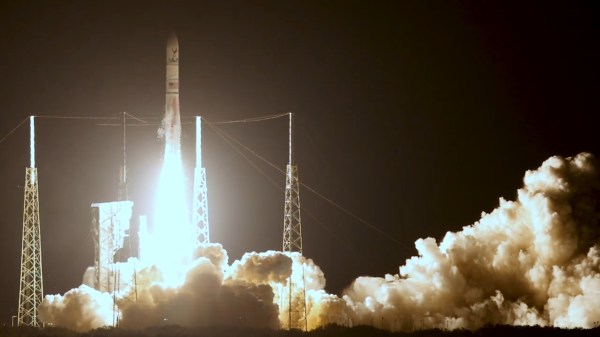
For those with an interest in the history of spaceflight, January 8th promised to be a pretty exciting day. Those who tuned into the early morning live stream were looking forward to seeing the first flight of the Vulcan Centaur, a completely new heavy-lift booster developed by United Launch Alliance. But as noteworthy as the inaugural mission of a rocket might be under normal circumstances, this one was particularly special as it was carrying Peregrine — set to be the first American spacecraft to set down on the lunar surface since the end of the Apollo program in 1972.

Experience has taught us that spaceflight is hard, and first attempts at it doubly so. The likelihood of both vehicles performing as expected and accomplishing all of their mission goals was fairly remote to begin with, but you’ve got to start somewhere. Even in the event of a complete failure, valuable data is collected and real-world experience is gained.

Now, more than 24 hours later, we’re starting to get that data back and finding out what did and didn’t work. There’s been some disappointment for sure, but when everything is said and done, the needle definitely moved in the right direction.

Continue reading “Vulcan Nails First Flight, But Peregrine Falls Short”
37C3: You Think It’s Bad With Pluto? A History Of The Planets

Not every talk at the Chaos Communication Congress is about hacking computers. In this outstanding and educational talk, [Michael Büker] walks us through the history of our understanding of the planets.

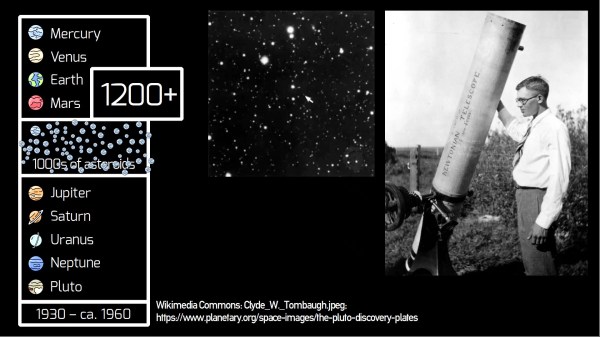
The question “What is a planet?” is probably more about the astronomers doing the looking than the celestial bodies that they’re looking for. In the earliest days, the Sun and the Moon were counted in. They got kicked out soon, but then when we started being able to see asteroids, Ceres, Vesta, and Juno made the list. But by counting all the asteroids, the number got up above 1,200, and it got all too crazy.

Viewed in this longer context, the previously modern idea of having nine planets, which came about in the 1960s and lasted only until 2006, was a blip on the screen. And if you are still a Pluto-is-a-planet holdout, like we were, [Michael]’s argument that counting all the Trans-Neptunian Objects would lead to madness is pretty convincing. It sure would make it harder to build an orrery.

His conclusion is simple and straightforward and has the ring of truth: the solar system is full of bodies, and some are large, and some are small. Some are in regular orbits, and some are not. Which we call “planets” and which we don’t is really about our perception of them and trying to fit this multiplicity into simple classification schemas. What’s in a name, anyway?

Liftoff! The Origin Of The Countdown

What’s the most thrilling part of rocketry? Well, the liftoff, naturally. But what about the sweet anticipation in those tense moments leading up to liftoff? In other words, the countdown. Where did it come from?

Far from being simply a dramatic device, the countdown clock serves a definite purpose — it lets the technicians and the astronauts synchronize their actions during the launch sequence. But where did the countdown  — those famed ten seconds of here we go! that seem to mark the point of no return — come from? Doesn’t it all seem a little theatrical for scientists?

It may surprise you to learn that neither technicians nor astronauts conceived of the countdown. In their book, “Lunar Landings and Rocket Fever: Rediscovering Woman in the Moon”, media scholars Tom Gunning and Katharina Loew reveal that a little-known Fritz Lang movie called Woman In the Moon both “predicted the future of rocketry” and “played an effective role in its early development”.

Continue reading “Liftoff! The Origin Of The Countdown”

Veteran SpaceX Booster Lost Due To Rough Seas

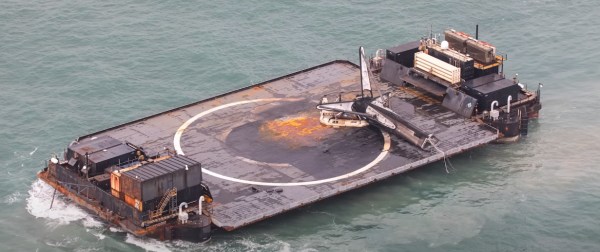
With the notable exception of the now retired Space Shuttle orbiters, essentially every object humanity ever shot into space has been single-use only. But since December of 2015, SpaceX has been landing and refurbishing their Falcon 9 boosters, with the end goal of operating their rockets more like cargo aircraft. Today, while it might go unnoticed to those who aren’t closely following the space industry, the bulk of the company’s launches are performed with boosters that have already completed multiple flights.

This reuse campaign has been so successful these last few years that the recent announcement the company had lost B1058 (Nitter) came as quite a surprise. The 41 meter (134 foot) tall booster had just completed its 19th flight on December 23rd, and had made what appeared to be a perfect landing on the drone ship Just Read the Instructions. But sometime after the live stream ended, SpaceX says high winds and powerful waves caused the booster to topple over.

Continue reading “Veteran SpaceX Booster Lost Due To Rough Seas”

NASA’s Tech Demo Streams First Video From Deep Space Via Laser

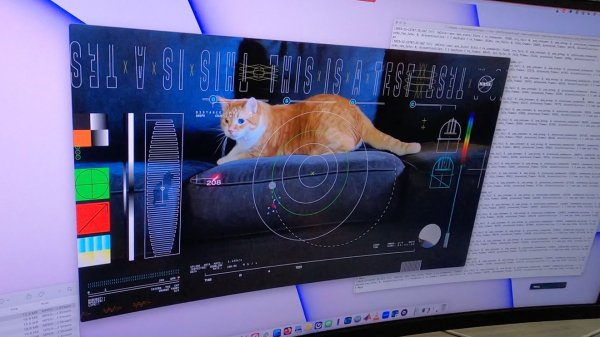
Everyone knows that the most important part of a tech demo is to make the right impression, and the team over at NASA’s Jet Propulsion Laboratory (JPL) definitely had this part nailed down when they showed off streaming a cat video from deep space using laser technology as part of NASA’s Deep Space Optical Communication (DSOC) program. This system consists out of a ground-based laser transmitter and receiver along with a space-based laser transceiver, which for this experiment was positioned at a distance of 31 million kilometers – 80 times the distance between the Moon and Earth – as a part of the Psyche spacecraft.

After a range of tests with the system to shake out potential issues, the team found that they could establish a 267 Mbps link, with a one-way latency of a mere 101 seconds, allowing Psyche’s transceiver to transmit the preinstalled 15-second high-definition video in effectively real-time and making the cat Taters instantly world-famous. Although the potential for space-based cat videos cannot be underestimated, the main purpose of DSOC is to allow spacecraft to send back much larger data sets than they could before.

For robotic and potential future manned missions DSOC would mean high bandwidth video and data links, enabling more science, better communication and possibly the occasional cat video during interplanetary travel.

Continue reading “NASA’s Tech Demo Streams First Video From Deep Space Via Laser”

Parachute Drops Are Still A Viable Solution For Data Recovery From High Altitude Missions

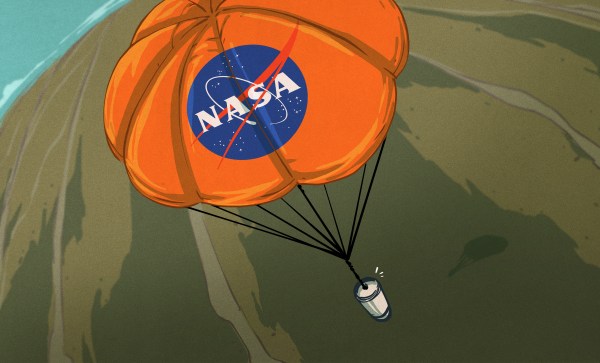
Once upon a time, when the earliest spy satellites were developed, there wasn’t an easy way to send high-quality image data over the air. The satellites would capture images on film and dump out cartridges back to earth with parachutes that would be recovered by military planes.

It all sounds so archaic, so Rube Goldberg, so 1957. And yet, it’s still a viable method for recovering big globs of data from high altitude missions today. Really, you ask? Oh, yes indeed—why, NASA’s gotten back into the habit just recently!

Continue reading “Parachute Drops Are Still A Viable Solution For Data Recovery From High Altitude Missions”

Voyager 1 In Trouble As Engineers Scramble To Debug Issue With Flight Data System

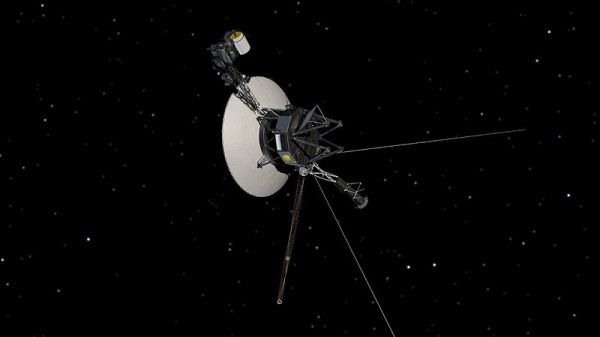
Recently the team at JPL responsible for communication with the Voyager 1 spacecraft noticed an issue with the data it was returning from the Flight Data System (FDS). Although normally the FDS is supposed to communicate with the other subsystems via the telecommunications unit (TMU), this process seems to have broken down, resulting in no payloads from the scientific instruments or engineering sensors being returned any more, just repeating binary patterns. So far the cause of this breakdown is unknown, and JPL engineers are working through potential causes and fixes.

This situation is not unlike a similar situation on Voyager 2 back in 2010 when the returned data showed a data pattern shift. Here resetting the memory of the FDS resolved the garbled data issue and the engineers could breathe a sigh of relief. This time the fix does not appear so straightforward, as a reset of the FDS on Voyager 1 did not resolve the issue with, forcing the team to consider other causes. What massively complicates the debugging is that each transmission to and from the spacecraft takes approximately 22.5 hours each way, making for an agonizing 45 hour wait to receive the outcome of a command.

We wish the JPL engineers involved all the luck in the world and keep our collective appendages crossed for Voyager 1.