Red and gold bakelite Philco farm radio on a workbench

Hacking A Heavyweight Philco Radio

There’s something magical about the clunk of a heavy 1950s portable radio – the solid thunk of Bakelite, the warm hum of tubes glowing to life. This is exactly why [Ken’s Lab] took on the restoration of a Philco 52-664, a portable AC/DC radio originally sold for $45 in 1953 (a small fortune back then!). Despite its beat-up exterior and faulty guts, [Ken] methodically restored it to working condition. His video details every crackling capacitor and crusty resistor he replaced, and it’s pure catnip for any hacker with a soft spot for analog tech. Does the name Philco ring a bell? Lately, we did cover the restoration of a 1958 Philco Predicta television.

What sets this radio hack apart? To begin with, [Ken] kept the restoration authentic, repurposing original capacitor cans and using era-appropriate materials – right down to boiling out old electrolytics in his wife’s discarded cooking pot. But, he went further. Lacking the space for modern components, [Ken] fabbed up a custom mounting solution from stiff styrofoam, fibreboard, and all-purpose glue. He even re-routed the B-wiring with creative terminal hacks. It’s a masterclass in patience, precision, and resourcefulness.

If this tickles your inner tinkerer, don’t miss out on the full video. It’s like stepping into a time machine.

Continue reading “Hacking A Heavyweight Philco Radio”

Transceiver Reveals Unusual Components

[MSylvain59] likes to tear down old surplus, and in the video below, he takes apart a German transceiver known as a U-600M. From the outside, it looks like an unremarkable gray box, especially since it is supposed to work with a remote unit, so there’s very little on the outside other than connectors. Inside, though, there’s plenty to see and even a few surprises.

Inside is a neatly built RF circuit with obviously shielded compartments. In addition to a configurable power supply, the radio has modules that allow configuration to different frequencies. One of the odder components is a large metal cylinder marked MF450-1900. This appears to be a mechanical filter. There are also a number of unusual parts like dogbone capacitors and tons of trimmer capacitors.

The plug-in modules are especially dense and interesting. In particular, some of the boards are different from some of the others. It is an interesting design from a time predating broadband digital synthesis techniques.

While this transceiver is stuffed with parts, it probably performs quite well. However, transceivers can be simple. Even more so if you throw in an SDR chip.

Continue reading “Transceiver Reveals Unusual Components”

Dismanteled Hallicrafters radio on workbench

Shortwave Resurrection: A Sticky Switch Fix On A Hallicrafters

Shortwave radio has a charm all its own: part history, part mystery, and a whole lot of tech nostalgia. The Hallicrafters S-53A is a prime example of mid-century engineering, but when you get your hands on one, chances are it won’t be in mint condition. Which was exactly the case for this restoration project by [Ken’s Lab], where the biggest challenge wasn’t fried capacitors or burned-out tubes, but a stubborn band selector switch that refused to budge.

What made it come to this point? The answer is: time, oxidation, and old-school metal tolerances. Instead of forcing it (and risking a very bad day), [Ken]’s repair involved careful disassembly, a strategic application of lubricant, and a bit of patience. As the switch started to free up, another pleasant surprise emerged: all the tubes were original Hallicrafters stock. A rare find, and a solid reason to get this radio working without unnecessary modifications. Because some day, owning a shortwave radio could be a good decision.

Once powered up, the receiver sprang to life, picking up shortwave stations loud and clear. Hallicrafters’ legendary durability proved itself once before, in this fix that we covered last year. It’s a reminder that sometimes, the best repairs aren’t about drastic changes, but small, well-placed fixes.

What golden oldie did you manage to fix up?

Continue reading “Shortwave Resurrection: A Sticky Switch Fix On A Hallicrafters”

Make Your Own Air Knife And Air Amplifier

Want to make your own air knife to cut things with? Unfortunately that’s not what these devices are intended for, but [This Old Tony] will show you how to make your own, while explaining what they are generally intended for.  His version deviates from the commercial version which he got his hands on in that he makes a round version instead of the straight one, but the concept is the same.

In short, an air knife is a laminar pressurized airflow device that provides a very strong and narrow air pattern, using either compressed air or that from a blower. Generally air knives will use the Coandă effect to keep the laminar flow attached to the device for as long as possible to multiply the air pressure above that from the laminar flow from the air knife itself. These are commonly used for cleaning debris and dust off surfaces in e.g. production lines.

As [Tony] shows in the disassembly of a commercial device, they are quite basic, with just two aluminium plates and a thin shim that creates the narrow opening through which the air can escape. The keyword here is ‘thin shim’, as [Tony] discovers that even a paper shim is too thick already. Amusingly, although he makes a working round air knife this way, it turns out that these are generally called an air amplifier, such as those from Exair and are often used for cooling and ventilation, with some having an adjustable opening to adjust the resulting airflow.

Some may recognize this principle for those fancy ‘bladeless’ fans that companies like Dyson sell, as they use essentially the same principle, just with a fan providing the pressure rather than a compressor.

Continue reading “Make Your Own Air Knife And Air Amplifier”

Over The Counter Glucose Monitor Dissected

If you deal with diabetes, you probably know how to prick your finger and use a little meter to read your glucose levels. The meters get better and better which mostly means they take less blood, so you don’t have to lacerate your finger so severely. Even so, taking your blood several times a day is hard on your fingertips. Continuous monitoring is available, but — until recently — required a prescription and was fairly expensive. [Andy] noticed the recent introduction of a relatively inexpensive over-the-counter sensor, the Stelo CGM. Of course, he had to find out what was inside, and thanks to him, you can see it, too.

If you haven’t used a continuous glucose monitor (CGM), there is still a prick involved, but it is once every two weeks or so and occurs in the back of your arm. A spring drives a needle into your flesh and retracts. However, it leaves behind a little catheter. The other end of the catheter is in an adhesive-backed module that stays put. It sounds a little uncomfortable, but normally, it is hardly noticeable, and even if it is, it is much better than sticking your finger repeatedly to draw out a bunch of blood.

Continue reading “Over The Counter Glucose Monitor Dissected”

Close up of Zenit 19 camera

Behind The Lens: Tearing Down A Rare Soviet Zenit 19

If you’re into Soviet-era gear with a techy twist, you’ll love this teardown of a rare Zenit 19 camera courtesy of [msylvain59]. Found broken on eBay (for a steal!), this 1982 made-in-USSR single-lens reflex camera isn’t the average Zenit. It features, for example, electronically controlled shutter timing – quite the upgrade from its manual siblings.

The not-so-minor issue that made this Zenit 19 come for cheap was a missing shutter blade. You’d say – one blade gone rogue! Is it lost in the camera’s guts, or snapped clean off? Add to that some oxidized battery contacts and a cracked viewfinder, and you’ve got proper fixer-upper material. But that’s where it gets intriguing: the camera houses a rare hybrid electronic module (PAPO 074), complete with epoxy-covered resistors. The shutter speed dial directly adjusts a set of resistors, sending precise signals to the shutter assembly: a neat blend of old-school mechanics and early electronics.

Now will it shutter, or stutter? With its vertical metal shutter – uncommon in Zenits – and separate light metering circuitry, this teardown offers a rare glimpse into Soviet engineering flair. Hungry for more? We’ve covered a Soviet-era computer and a radio in the past. If you’re more into analog camera teardowns, you might like this analog Pi upgrade attempt, or this bare minimum analog camera project.

Continue reading “Behind The Lens: Tearing Down A Rare Soviet Zenit 19”

Reviewing A Very Dodgy BSK-602 Adjustable Power Supply

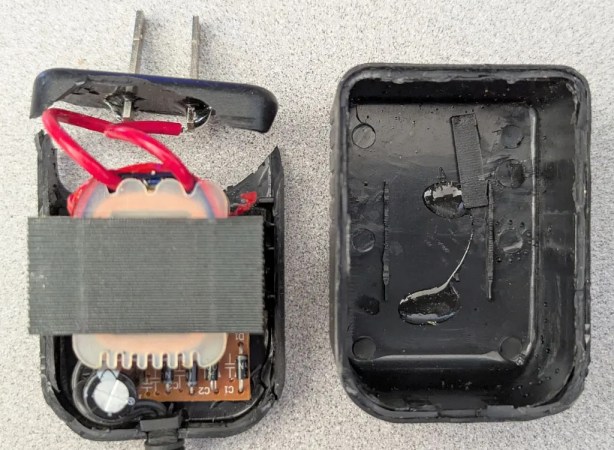
There’s no shortage of cheap & cheerful power supplies which you can obtain from a range of online retailers, but with no listed certification worth anything on them calling them ‘dodgy’ is more of a compliment. On the [DiodeGoneWild] YouTube channel an adjustable power supply by the model name BSK-602 is tested and torn down to see exactly what less than $5 off sites like Alibaba will get you.

Perhaps unsurprisingly, voltage regulation is very unstable with massive drifting when left to heat up for a few hours, even though it does hit the 3 V to 24 V DC and 3 A output that it’s optimistically rated for. After popping open the adapter, a very basic switching mode power supply is revealed with an abysmal component selection and zero regard for safety or primary and secondary side isolation. With the case open, the thermal camera reveals that the secondary side heats up to well over 150 °C, explaining why the case was deforming and the sticker peeling off after a few hours of testing.

The circuit itself is based around a (possibly legit) UC3843RN 500 kHz current mode PWM controller, with the full schematic explained in the video. Highlights include the lack of inrush protection, no EMI filtering, a terrible & temperature-dependent voltage reference, not to mention poor component selection and implementation. Basically it’s an excellent SMPS if you want to blast EMI, fry connected electronics and conceivably burn down your home.

Continue reading “Reviewing A Very Dodgy BSK-602 Adjustable Power Supply”