Jeep Power Wheels Upgrade Only Reuses Body

Power Wheels Racing Jeep

It is debatable whether [Jamie] upgraded his Power Wheels Jeep or built a beast of a mini vehicle and only added a Power Wheels Jeep body. Either way, this Racing Power Wheels Jeep is awesome. The goal of the project is to race in the Power Racing Series races held at Maker Faires.

This vehicle is no joke. It is still electric but runs on 24volts DC. It has pneumatic rubber tires for traction and disk brakes for stopping. The ‘gas’ gauge is a volt meter mounted into the dash next to the motor temperature gauge. As if that was not enough, the headlights and tail lights work. Take note of that sweet custom frame, it was mostly made from an old bed frame.

Continue reading “Jeep Power Wheels Upgrade Only Reuses Body”

Introducing The Flux Buggy — A Serious Electric Dune Buggy Conversion

Believe it or not, the writers here at Hack a Day do their own projects too, we don’t just write about yours! I’ve just started a new project, and I want your advice! A few friends and I are converting a custom-made dune buggy — to electric.

The project will be chronicled over on Hackaday.io, with (hopefully) weekly updates on our progress. If you’ve been perusing Projects, you may have noticed my Electric Car conversion from a few years ago. First year of my engineering degree, my friend and I converted a 1993 Honda Del Sol to electric, using the guts of an electric forklift.

We got it going over 100km/h on used batteries our school donated to us. Unfortunately, there was a bit too much red tape and bureaucracy for us to get it on the road legally. That and we were poor university students who couldn’t afford new batteries, or the ridiculous amount insurance companies wanted to put it on the road. The project got scrapped after sitting in the backyard for a few years.

Fast forward to today, and we’ve both graduated and are working our “cushy” engineering jobs, and for the first time in our lives, we have some disposable income. We needed a new project to work on.

Continue reading “Introducing The Flux Buggy — A Serious Electric Dune Buggy Conversion”

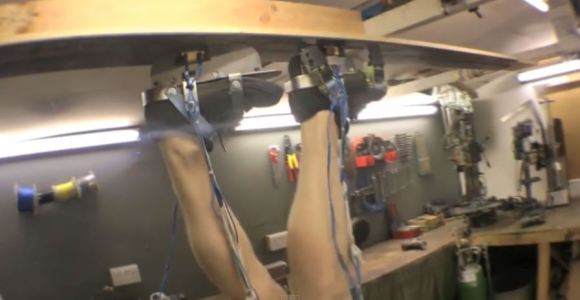
Electromagnetic Boots For All Your Upside Down Needs!

magnet boots

X-Men: Days of Future Past is making its way to theaters around the world, and [Mr. Furze] has released his second X-Men related hack — Magneto Boots.

In case you missed it, [Colin Furze] has made three projects to celebrate geekdom and a mastery of fabrication for all the comic book fans out there. He started with the fully functional pneumatic Wolverine Claws, and now he’s tackling Magneto’s powers. The third project isn’t out quite yet, but we can’t wait to see the final installment!

Now the problem with Magneto is his powers are a wee bit too… magical? Without special effects, you can’t really replicate his mutant abilities (please prove us wrong if you can!), so [Colin] decided to do the next best thing. Magnetize himself — well, his shoes.

Continue reading “Electromagnetic Boots For All Your Upside Down Needs!”

Home Depot Brand Boat Costs $29.18

hdboat

It is a common belief (or fact, depending who you talk to) that boats are money pits. Surely, it is a fun past time even for the lucky person flipping the bill, but what if you could build a boat from locally found and purchased items. [Bill] did just this and he did it for a mere $30. His creation is affectionately called Thunder Bucket.

The overall design is a pontoon-based sail boat. You’ll notice from the photo that the pontoons are made from many 5 gallon buckets attached together. The wood frame and deck come courtesy of old pallets that were taken apart. The mast is a fence post and a standard blue tarp rounds out the resourcefulness as it is used for the sail.

Admittedly, this may not be the coolest boat on the waterways but it is a boat, it’s made from non-boat-like items and it works. Believe it or not [Bill] is a professional boat builder. Sometimes ‘why not?’ is the best reason to do something.

Electric Go-Kart Made From Off The Shelf Components

Eletctric go kart
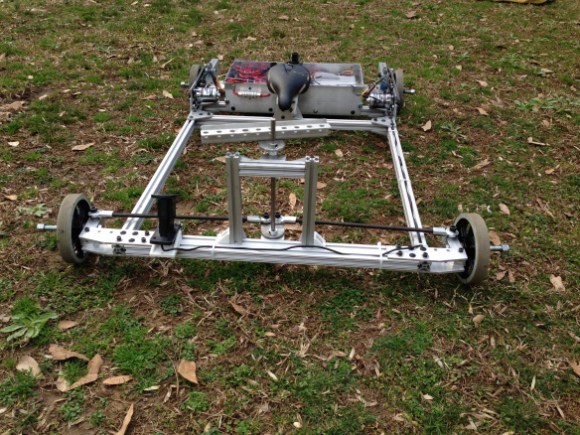
What would you do with a catalog of parts and a nice budget? [Ben Rothschild] decided to build an electric go-kart from scratch, for a contest he’s trying to win.

He designed the entire go-kart in 3D CAD using off the shelf components to speed up assembly. The frame is made of aluminum extrusion with t-bolt brackets, and he’s using modified FIRST Robotics wheels with standard #25 chain and sprockets.

Two 1850W Turnigy SK3 brushless motors make up the drive system, equivalent to almost a 5HP engine — except with a constant torque profile, meaning it’ll have no problem going up hills at 3km/h or 30km/h, no gearing necessary! To power the beast he’s using four hard-shell LiPo batteries (4S1P), which are rated for 14.8V and 5Ah. Two el cheap-o 24V 500W speed controllers (slightly concerning) provide the control system, which he may plan to upgrade in the near future.

The test drive video is a bit short, but it looks like with a bit more work this go-kart could have a lot of potential!

Continue reading “Electric Go-Kart Made From Off The Shelf Components”

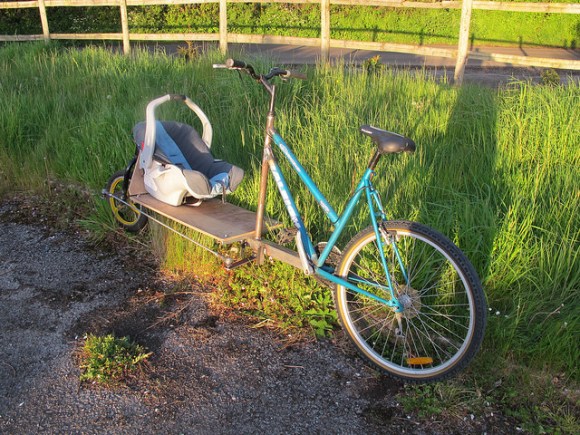
Home Made Cargo Bicycle Makes Use Of Scraps!

Recycled DIY Bicycle!

Ever heard of a cargo bike? If you need to carry a lot of stuff around (or maybe even your kid!), then they’re super handy — unfortunately, they aren’t exactly cheap — or common. So you could just make your own…

[Matthew Venn] was inspired by Tom’s cargo bikes, recently featured in issue 12 of Boneshaker magazine. He collected a few scrap bicycles, some steel, and started fabrication — lucky for him, his friend [Eric] has a full metal working shop complete with plasma cutting, MIG welding, and a lathe.

They started by cutting the front end of the bicycle off and replacing it with a much longer steering column. This connects to the only new part they had to buy — a pair of Ford Escort tie rods, which allow you to steer the tiny front wheel. They continued welding the rest of the frame together, testing it as they went — once satisfied with its handling (it still needs brakes) they built the cargo platform and called it a day.

There’s a complete gallery of the process over on [Matthew’s] Flickr, so if you’re hoping to make your own, take a gander!

Intelligent Roadways Pave Way To The Future

smart roadway with illuminated tiles

The idea of a road is relatively simple – a durable path from point A to point B. Development of roadways usable for wheeled carriages has been perfected over the centuries. The Romans, for instance, used a base layer of crushed limestone that would let water flow out, preventing clay soil from turning into mud. Some Roman roads were topped with six sided capstones, also known as pavers, many of which still exist today.

The invention of the horseless carriage necessitated roadways that could be used at high speeds. Tarmac, asphalt and concrete roads followed, and thus ends our short venture into the history of roads. Roadways simply haven’t changed much since then. Sure, we’ve painted some lines on them, even etched grooves in some to prevent accidents, but the core technology of the road is the same as it was a hundred years ago. Until now. Consider the Intelligent Roadway.

[Scott] is an electrical engineer, and had dreamed of solar powered roadways as a child. But it wasn’t until the realization of global warming did [Scott] and his wife, [Julie] start to take the concept seriously. Stick around after the break to find out just how smart [Scott’s] roadway of the future is.

Continue reading “Intelligent Roadways Pave Way To The Future”