Reverse GeoCache Puzzle Gets Downsized

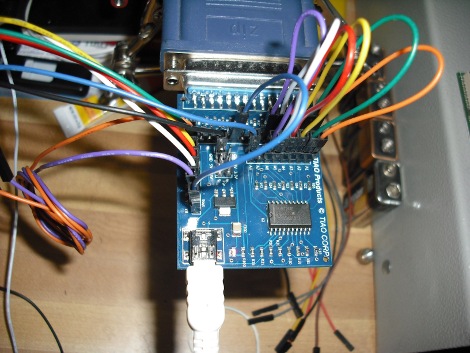
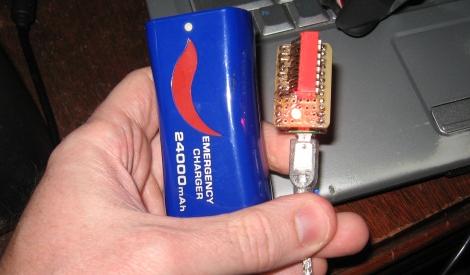
[Markus] built his own reverse geocache puzzle box but on a smaller scale than the original. His is based around a PIC 18F2520 and powered by two AAA batteries. The user interface includes one button, a 16×2 character LCD, and a piezo speaker. The box unlocks itself when the GPS module inside detects the proper location on the globe. There is also a secret code that can be tapped on the button to unlock the box prematurely, and another to show the locations in which the user attempted to open the box. This build doesn’t leave much room for a payload, but [Markus] did a great job designing the board and making the components fit as efficiently as possible.

X-Band Linear Rail SAR Imaging

[Greg Charvat] really wanted high resolution X-Band linear rail SAR imaging system. He wanted it bad enough to scrounge through parts at HAM radio swap meets until he had the bits to build one himself. The unit is used to take high resolution radar imaging. For example, the image above is constructed of push pins behind a foam wall. The synthetic aperture radar system came in at roughly  $250. Not bad at all. You may have to dig through the links a bit to find the build information. Be sure to check out the hardware gallery and the schematics(pdf).

[via Makezine]

Adjustable Tesla Coil Build

This coil has no trouble shooting sparks across four meters of empty air. [Finn Hammer] has been putting in some long hours on this labor of love, and we put in some time reading through his progress thread. He started down this path about a year ago and every step of the way he produces beautiful work. We enjoy seeing his prototyping techniques, moving from concept to hand drawing to CAD diagram before starting the physical build. Check out the demo video after the break and as you read through his thread look for the green arrows that lead to other videos and resources.

Continue reading “Adjustable Tesla Coil Build”

Gaming System For Less Than Three Bucks

[youtube=http://www.youtube.com/watch?v=r-Mdt6uzmOg]

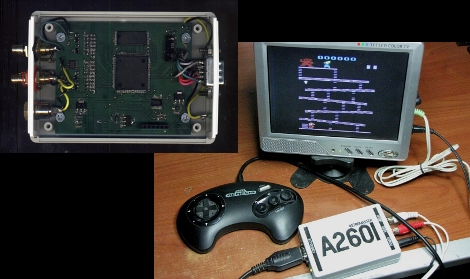
[Rossum’s] latest project just hit and as usual, he doesn’t disappoint. Using an ARM cortex M0 he built a gaming system for less than $3 in parts. The M0 is a bit underpowered for this but at $1 it can’t be beat in price. He worked some video generation voodoo to get the signal he wanted but also mentions that upgrading to a bit more expensive chip like the Cortex M3 would solve this problem. The other part of the gaming system is an analog stick (again for about $1) that is the only input for the system.

Can’t say that you remember hearing about [Rossum] before? Go back and check out his Wikipedia reader, AVR media player, and AVR iPod touch killer.

Making Liquid Nitrogen At Home

If you’ve got some time to scour eBay and $500 sitting around you can build your own liquid nitrogen plant. [Ben Krasnow] figured it all out for you and estimates he can produce a liter of the stuff for around $1.15. The process depends on a membrane to separate nitrogen from the other materials in the air around us and a cryocooler to get the gas cold enough to condense into a liquid. Other than atmospheric air, you need to pump in electricity. About 9.6 kWh per liter… yikes! Is your human hair solar panel up to that?

Anyway, once you’re up and running you can make yourself some ice cream or possibly save the world from oily destruction.

[Thanks Chris]

Building A Glue Stick Flashlight

Building an LED flashlight is simple, right? Take a battery, connect it to an LED by way of a resistor. Alright wise guy, now make one that steps up the voltage for multiple LEDs and don’t use a boost-converter IC to do so.

[fede.tft] shares a flashlight built inside of a  used glue stick case. It’s the perfect size for one AA battery (we’re always on the lookout for good battery cases), and a shape that we’re familiar with as a flashlight. The problem is that he wants two white LEDs but with just one AA cell he’s never going to have more that 1.5V available. He licked that problem, getting to 7.2V by designing his own step-up converter using one transistor, an inductor, and three passive components. To get the inductor he needs, a stock part is disassembled and rewound to suit. Maybe you just end up with a flashlight when all is said and done, but then again, the Sistine Chapel is just some paintings on a ceiling.