N8VEM Computer With A 3Km Wireless Link

pterm

[James] sent in this project in which he built a tiny computer with text based OS and a 3Km wireless link. The details are a bit scarce, but he used an N8VEM, a Propeller Pocket Term, a 4 line LCD and an RF Transceiver to build it. It runs CP/M, the text based operating system and uses less than a half of a watt, without the vga monitor. With a total cost of 145 and 4 serial ports for sensors, this thing could come in handy. Especially since its low power consumption could allow it to be solar powered.  You may recall the N8VEM from an earlier post we did.

Restoring Yellowed Computer Plastics

retr0brite1

Many of our cherished computers and consoles from the past have not stood up well over time. It’s not the hardware as much as the color. From Commodores, Apples, to Super Nintendos, the machines have slowly drifted towards a sickly yellow and even brown. The culprit appears to be the fire retardant chemicals used in the plastics. Amiga enthusiasts have spent the last year perfecting a technique that restores the plastic of these machines to its original splendor. Dubbed ‘Retr0brite‘ it’s a gel made from hydrogen peroxide, xanthan gum, glycerine, and ‘Oxy’ style laundry booster. The results are really impressive. If you do start restoring your own machines, caution should be used since it requires strong concentrations of hydrogen peroxide typically employed in bleaching hair.

[via Waxy]

BMOW: A Home Made Cpu

bmow

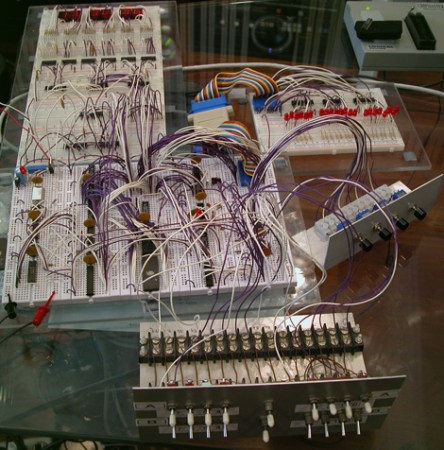
Building your own CPU sounds like quite a daunting task as it is. Building your own CPU using manual wire wrapping transcends difficult to become an art form. [Steve] has built a CPU by manually wrapping every single wire. That’s 1253 wires, or 2506 wrapped ends. Even if it didn’t work, it would be nice to look at. But it does work, you can see a demo video showing the audio functions after the break. The system is now enclosed in an Acer x-terminal case, so it isn’t as pretty, but its still quite a project. You can follow along as he builds each section, the video, sound, even the keyboard interface. It’s pretty amazing seeing it all broken down to the most basic forms.

Continue reading “BMOW: A Home Made Cpu”

SheevaPlug, Tiny Linux Server

plugserv

This little wall plug is actually a full computer with 1.2GHz cpu, with 512MB of RAM and 512MB of of flash memory. It comes with versions of linux, ported for its ARM processor. At $50, this cool system could be finding itself in a lot of homes. You can get more information from the manufacturer. What uses can you think of for it?

[thanks, everyone who sent this in]

PropIRC: Propeller Based IRC Client

propeller

Many people don’t want to miss anything in their IRC room, so they “idle” or just leave the client open to capture all the conversations. It can be annoying to have it going in the background on your computer though. To remedy this, [Harrison] built a simple computer from a propeller microcontroller that’s only purpose is to connect to IRC servers. It can take a regular PS2 keyboard and works with a standard monitor at 1024×768. It’s compact size and low power requirements make it quite a useful tool to have around if you are always on IRC. you can download the source code and schematics on the site.

[Thanks Scott]

Dell Mini 9 OSX Install

dellosx

Installing OSX on commodity PC hardware has advanced a lot since the early days of OSx86 when Apple switched to Intel. With the advent of netbooks, a new target platform has emerged; one that doesn’t have an official Apple equivalent. The small subset of models means that it’s easy to find someone else that has the same machine as you, but it still takes some forum walking to bring all the pieces together. Gizmodo has done this and compiled a comprehensive guide for the Dell Mini 9. The Mini 9 is a very nice machine and according to Boing Boing Gadgets’ chart, one of the most compatible with OSX. Earlier this week you could purchase a new one for just $200.

For Gizmodo’s install, they used a Leopard retail DVD with [Type11]’s bootloader. They’re breaking the EULA, but at least it’s not piracy. They had to use both a DVD drive and a USB hard drive because device recognition was flakey. Despite this, the actual install process doesn’t appear to be too difficult. They say all the hardware works, “The Mini 9 is a beautiful OS X machine.” Check out this Hackit to learn about netbook OSX experiences from other Hack a Day readers.

Non-von1 Supercomputer

nonvon_box_small_comp

[Chris] sent us this project, where he built a tiny supercomputer called the Non-von1. Wanting a supercomputer, but lacking space and funds, he opted to go after the supercomputers of the 80s. His system was patterned after the “Von Neumann” systems developed at Columbia university. His system has 31 8 bit processors to crunch numbers for him. The whole unit communicates with the computer using a19.2 kbps serial link.  He does talk about its limited capabilities, stating that he could use it as a way to store roughly half of his cell phone’s phonebook. This reminds us of the Basic stamp supercomputer we covered back in November.