Toshiro Kodera: Electromagnetic Gyrotropes

We’ve learned a lot by watching the talks from the Hackaday Superconferences. Still, it’s a rare occurrence to learn something totally new. Microwave engineer, professor, and mad hacker [Toshiro Kodera] gave a talk on some current research that he’s doing: replacing natural magnetic gyrotropic material with engineered metamaterials in order to make two-way beam steering antennas and more.

If you already fully understood that last sentence, you may not learn as much from [Toshiro]’s talk as we did. If you’re at all interested in strange radio-frequency phenomena, neat material properties, or are just curious, don your physics wizard’s hat and watch his presentation. Just below the video, we’ll attempt to give you the Cliff’s Notes.

Continue reading “Toshiro Kodera: Electromagnetic Gyrotropes”

Derek Schulte: Path Planning For 3D Printers

[Derek Schulte] designed and sells a consumer 3D printer, and that gives him a lot of insight into what makes them tick. His printer, the New Matter MOD-t, is different from the 3D printer that you’re using now in a few different ways. Most interestingly, it uses closed-loop feedback and DC motors instead of steppers, and it uses a fairly beefy 32-bit ARM processor instead of the glorified Arduino Uno that’s running many printers out there.

The first of these choices meant that [Derek] had to write his own motor control and path planning software, and the second means that he has the processing to back it up. In his talk, he goes into real detail about how they ended up with the path planning system they did, and exactly how it works. If you’ve ever thought hard about how a physical printhead, with momentum, makes the infinitely sharp corners that it’s being told to in the G-code, this talk is for you. (Spoiler: it doesn’t break the laws of physics, and navigating through the curve involves math.)

Continue reading “Derek Schulte: Path Planning For 3D Printers”

33C3: Works For Me

The Chaos Communication Congress (CCC) is the largest German hacker convention by a wide margin, and it’s now in its thirty-third year, hence 33C3. The Congress is a techno-utopian-anarchist-rave with a social conscience and a strong underpinning of straight-up hacking. In short, there’s something for everyone, and that’s partly because a CCC is like a hacker Rorschach test: everyone brings what they want to the CCC, figuratively and literally. Somehow the contributions of 12,000 people all hang together, more or less. The first “C” does stand for chaos, after all.

What brings these disparate types to Hamburg are the intersections in the Venn diagrams. Social activists who may actually be subject to state surveillance are just as interested in secure messaging as the paranoid security geek or the hardcore crypto nerd who’s just in it for the algorithms. Technology, and how we use it to communicate and organize society, is a pretty broad topic. Blinking lights also seem to be in the intersection. But on top of that, we are all geeks. There’s a lot of skill, smarts, and know-how here, and geeks like sharing, teaching, and showing off their crazy creations.

Continue reading “33C3: Works For Me”

Mike Szczys On The State Of The Hackaday

Hey, that’s me! I had the honor of giving a talk at the Hackaday SuperConference in November about our editorial direction over the past year and looking towards the next. At any given time we have about 20-25 people writing articles for Hackaday. We depend on their judgment, experience, and skill to keep Hackaday fresh. It would be wonderful if you would join me in thanking all of the writers and editors for a great year by leaving your well-wishes in the comments.

Take a look at the video of the talk, then join me below for a few more thoughts.

Continue reading “Mike Szczys On The State Of The Hackaday”

33C3: If You Can’t Trust Your Computer, Who Can You Trust?

It’s a sign of the times: the first day of the 33rd Chaos Communications Congress (33C3) included two talks related to assuring that your own computer wasn’t being turned against you. The two talks are respectively practical and idealistic, realizable today and a work that’s still in the idea stage.

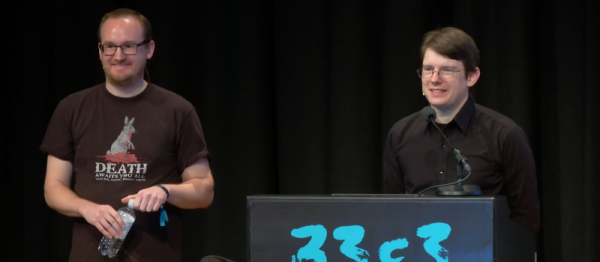
In the first talk, [Trammell Hudson] presented his Heads open-source firmware bootloader and minimal Linux for laptops and servers. The name is a gag: the Tails Linux distribution lets you operate without leaving any trace, while Heads lets you run a system that you can be reasonably sure is secure.

It uses coreboot, kexec, and QubesOS, cutting off BIOS-based hacking tools at the root. If you’re worried about sketchy BIOS rootkits, this is a solution. (And if you think that this is paranoia, you haven’t been following the news in the last few years, and probably need to watch this talk.) [Trammell]’s Heads distribution is a collection of the best tools currently available, and it’s something you can do now, although it’s not going to be easy.

Carrying out the ideas fleshed out in the second talk is even harder — in fact, impossible at the moment. But that’s not to say that it’s not a neat idea. [Jaseg] starts out with the premise that the CPU itself is not to be trusted. Again, this is sadly not so far-fetched these days. Non-open blobs of firmware abound, and if you’re really concerned with the privacy of your communications, you don’t want the CPU (or Intel’s management engine) to get its hands on your plaintext.

[Jaseg]’s solution is to interpose a device, probably made with a reasonably powerful FPGA and running open-source, inspectable code, between the CPU and the screen and keyboard. For critical text, like e-mail for example, the CPU will deal only in ciphertext. The FPGA, via graphics cues, will know which region of the screen is to be decrypted, and will send the plaintext out to the screen directly. Unless someone’s physically between the FPGA and your screen or keyboard, this should be unsniffable.

As with all early-stage ideas, the devil will be in the details here. It’s not yet worked out how to know when the keyboard needs to be encoded before passing the keystrokes on to the CPU, for instance. But the idea is very interesting, and places the trust boundary about as close to the user as possible, at input and output.

The Story Of Kickstarting The OpenMV

Robots are the ‘it’ thing right now, computer vision is a hot topic, and microcontrollers have never been faster. These facts lead inexorably to the OpenMV, an embedded computer vision module that bills itself as the ‘Arduino of Machine Vision.’

The original OpenMV was an entry for the first Hackaday Prize, and since then the project has had a lot of success. There are tons of followers, plenty of users, and the project even had a successful Kickstarter. That last bit of info is fairly contentious — while the Kickstarter did meet the minimum funding level, there were a lot of problems bringing this very cool product to market. Issues with suppliers and community management were the biggest problems, but the team behind OpenMV eventually pulled it off.

At the 2016 Hackaday SuperConference, Kwabena Agyeman, one of the project leads for the OpenMV, told the story about bringing the OpenMV to market:

Continue reading “The Story Of Kickstarting The OpenMV”

33C3: Understanding Mobile Messaging And Its Security

If you had to explain why you use one mobile messaging service over another to your grandmother, would you be able to? Does she even care about forward secrecy or the difference between a private and public key is? Maybe she would if she understood the issues in relation to “normal” human experiences: holding secret discussions behind closed doors and sending letters wrapped in envelopes.

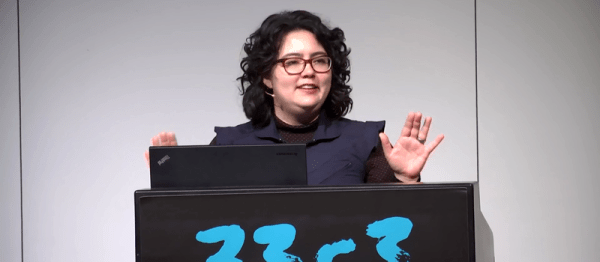
Or maybe your grandmother is the type who’d like to completely re-implement the messaging service herself, open source and verifiably secure. Whichever grandma you’ve got, she should watch [Roland Schilling] and [Frieder Steinmetz]’s talk where they give both a great introduction into what you might want out of a secure messaging system, and then review what they found while tearing apart Threema, a mobile messaging service that’s popular in Germany. Check out the slides (PDF). And if that’s not enough, they provided the code to back it up: an open workalike of the messaging service itself.

This talk makes a great introduction, by counterexample, to the way that other messaging applications work. The messaging service is always in the middle of a discussion, and whether they’re collecting metadata about you and your conversations to use for their own marketing purposes (“Hiya, Whatsapp!”) or not, it’s good to see how a counterexample could function.

The best quote from the talk? “Cryptography is rarely, if ever, the solution to a security problem. Cryptography is a translation mechanism, usually converting a communications security problem into a key management problem.” Any channel can be made secure if all parties have enough key material. The implementation details of getting those keys around, making sure that the right people have the right keys, and so on, are the details in which the devil lives. But these details matter, and as mobile messaging is a part of everyday life, it’s important that the workings are transparently presented to the users. This talk does a great job on the demystification front.