DEF CON: The Proxy For ProxyHam

Two weeks ago, news broke of an incredible abuse of power from the National Security Agency. A DEF CON talk was cancelled, and speculation raged that information was not free. This was the ProxyHam, a device that puts you miles away from any agency hunting down your IP address.

Of course, as with just about every DEF CON talk picked up by the press, ProxyHam is an ill-conceived, terrible idea. You can replicate it with parts bought from newegg, and despite using a highly directional antenna the FCC – or any other government agency – can still track you down.

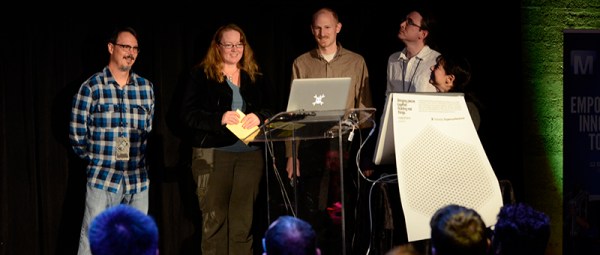
In lieu of a talk on using off-the-shelf networking hardware in the way it was intended, [Dave Maynor] and [Robert Graham] of Errata Security gave a talk at DEF CON that is the proxy to the ProxyHam. They completely debunked the outrageous speculation surrounding the cancellation of the DEF CON talk and managed to introduce a new version of Internet over radio that is actually useful for the security-minded individual.

The ‘debunking’ part of the Errata Security talk was exactly what anyone would expect; the talk was probably cancelled because the creator of ProxyHam exceeded radiated power limits, the FCC caught him, or simply because of ‘advice from counsel’. No big deal; someone was doing something illegal – encryption over ISM bands – and the things you would expect to happen in fact happened.

In the last two weeks, the guys replicated the ProxyHam build, but found a few major shortcomings. Even with a highly directional antenna, interested parties could still track you down. This led the guys at Errata Security to make this system better. They managed to do it in two weeks.

The Errata Security relies on JT65A – a radio mode made for very weak signals – to hide signals underneath the noise floor. By multiplexing data across multiple channels, this system has about the same bandwidth as a 56kbps modem from 1999. It’s not much, but it is possible to use this proxy for ProxyHam over 20 miles away from where you’re stealing WiFi from. That’s far better than ProxyHam could ever manage, and all the transmissions stay below the noise floor. The FCC and similarly equipped agencies might be able to find you, but no one with a $20 SDR dongle will.

There are no releases yet, but Errata Security plan to make the software that allows this multiplex transmissions available soon, and hope to have a Raspberry Pi-based hardware solution for this technique coming shortly. It’s a radio proxy solution that’s actually somewhat secure, and won’t immediately draw the ire of the FCC.

DEF CON Uber Badge So Hot It’s Radioactive

I went to the Opening Ceremonies of DEF CON 23 this morning to get more information on the badge challenge and I was not disappointed. The talk covered the Uber badge, which is hot in a literally radioactive sense. This badge, which is also known as the black badge, is reserved for people who are first to solve one of the official DEF CON challenges. It grants lifetime free admission and opens just about any door when listed on your resume.

Lichtenberg Figures

The triangle of acrylic itself is adorned with Lichtenberg Figures. This is a bolt of lightning on the badge. By building up extremely high voltages, the discharge leaves a unique pattern. In this case it was a 5 million volt, 150 kW particle accelerator that made the figures.

There is a medallion affixed to this triangular base-plate which is obviously part of the puzzle everyone is trying to solve this weekend. What is less clear is how the radioactive isotopes of this badge play into this challenge.

Whoa, oh, oh, oh, I’m Radioactive, Radioactive

Trinitie Photo by Shaddack -  CC BY 3.0
Trinitie Photo by Shaddack – CC BY 3.0

[LoST] took inspiration from [Richard Feynman] to a new level with this badge. [Feynman] was involved with “The Gadget” experiment which I know better as Trinity, the first detonation of a nuclear weapon. This badge contains isotopes from that detonation.

Trinitite (get it, from the Trinity explosion?) is a green glassy substance generated from a Plutonium-based bomb explosion. [LoST] made a point of explaining that the samples of Trinitite in this badge create a unique radioactive signature that not only traces back to this explosion, but actually indicates a precise distance form the epicenter of the explosion.

Also embedded in the badge are glass spheres doped with 3% Uranium 238. Tritium, used in exit signs, is a third source of radioactivity on the badge. This is joined by another marker that is a combination of Uraninite, Pitchblende, Carnotite, Gummit, and Yellowcake.

Interesting story, Tritium is highly regulated in this country but it is hypothetically possible to import it from Europe by a seller who ships it sealed inside packets of coffee. Hypothetically.

The opening ceremonies talk concluded with some inspirational remarks from [Dark Tangent]. Pictures of that as well as a few of [L0ST’s] slides are found below. If you’re working on the badge challenge, join in on the collaborative Badge deciphering we’ve started on Hackaday.io. If you’re at DEF CON, make sure to show up for breakfast with us on Sunday.

Continue reading “DEF CON Uber Badge So Hot It’s Radioactive”

Help Decipher The DEFCON Badge

The 23rd DEFCON — the Western Hemisphere’s largest hacker conference — doesn’t start until tomorrow but Thursday has become the de facto start for regulars. [Brian] and I rolled into town this afternoon and are working on gathering as much information as possible about the badge challenge.

This year the badge is a 7″ vinyl record. Traditionally the badge alternates years of electronic badges and ones that aren’t. Spend your weekend pulling your hair our trying to solve the puzzles. Check out all the pictures and information (updated as we gather it) and work together collaboratively for a solution by requesting to join the crew on the Badge Hacking page.

Hackaday Breakfast on Sunday

Iocn of Coffee CupIf you’re in town Sunday morning, come nurse your hangover with [Brian], [Eric], and me. We’re headed to Va Bene Caffè at 10:30am on 8/9/15. It’s just across the street in the Cosmopolitan. Request to join this event and I’ll send you a reminder so you don’t forget. You can also hit me up on Twitter for a reminder. See you then (and don’t forget to bring hardware to show off if you have some!).

PS- The Hackaday WiFi Hat is in play. Anyone have the chops to hack it this year?

The Right Way To Do A Hacker Conference

DEFCON is huge. Last year attendance tipped at about 16k, and we’d wager this year will be even bigger. [Brian] and I will both be among those attending (more on that below) but I wanted to take this time to show you the right way to do a Hacker Conference.

Build Your Own Badge

We met a ton of people at DEFCON 22 last year, but the Whiskey Pirates made a lasting impression. I first ran across two of their crew walking the hallways of the con with this awesome badge. How can you not stop and strike up a conversation about that? Turns out this group of friends have been meeting up here for years. This year they went all out, designing one badge to rule them all. And like any good hacker project, they weren’t able to finish it before getting to the hotel.

Set Up Your Electronics Lab

So, you didn’t stuff your boards before leaving home? For the Whiskey Pirates this is not even remotely a problem. They just brought the electronics lab to their suite in the Rio Hotel.

On the bathroom vanity you find the binocular microscope which was good for troubleshooting an LED swap on the official conference badge. An entire cart with hot-air, multiple solder stations, oscilloscopes, and more was on hand. I populated the surface mount LEDs on the badge the crew gave to me. When I was having trouble seeing my work they called the front desk for an additional lamp. You should have seen the look on the bellhop’s face when he walked in!

A bit of marathon assembly and everyone from the Whiskey Pirates (plus me) had a working badge, demonstrated in the video below. But this isn’t where the fun stops.

Continue reading “The Right Way To Do A Hacker Conference”

Maglev, Submersibles, And More At Maker Faire Detroit

This past weekend the Maker Faire returned to the motor city. While it seemed a bit smaller than previous years, the event still brought in a ton of awesome makers from the metro Detroit area and beyond.

img_8517

Although we don’t feature too many woodworking projects, there were quite a few woodworkers at the Faire with projects ranging from custom longboards pressed with a home built iron mold to DIY kayaks with elaborate wooden skeletons built by a local group of Michigan kayak builders. The kayaks were quite impressive: hand sewn nylon panels are wrapped around custom frames made from steamed white oak. It’s great to speak with the makers about the specialized skills needed for kayak building.

Continue reading “Maglev, Submersibles, And More At Maker Faire Detroit”

CommVEx 2015: What Happens When Commodore Users Gather

I’m not getting any younger, in fact I’m getting older by the day.  This fact along with the fact that this year is the 30th anniversary of the Commodore C-128 and the original Commodore Amiga prompted me to attend this year’s CommVEx in Las Vegas lest I not be around for the next significant anniversary. For those that don’t know me, I designed the C-128 at the ripe old age of 25 back in 1984-85, though I would ask that you not hold that against me as it was a very long time ago.

Also this year Dr. Leonard Tramiel, son of Commodore’s founder Jack Tramiel, was able to swing by which was an unprecedented and unforgettable event.

Continue reading “CommVEx 2015: What Happens When Commodore Users Gather”

CCCamp 2015 Rad1o Badge

Conference badges are getting more complex each year. DEFCON, LayerONE, Shmoocon, The Next Hope, Open Hardware Summit, The EMF, SAINTCON, SXSW Create, The Last Hope, TROOPERS11, ZaCon V and of course the CCC, have all featured amazing badges over the years. This years CCCamp 2015 rad1o badge is taking things several notches higher. The event will run from 13th through 17th August, 2015.

The rad1o Badge contains a full-featured SDR (software defined radio) transceiver, operating in a frequency range of about 50 MHz – 4000 MHz, and is software compatible to the HackRF One open source SDR platform. The badge uses a Wimax transceiver which sends I/Q (in-phase/quardrature-phase) samples in the range of 2.3 to 2.7 GHz to an ARM Cortex M4 CPU. The CPU can process the data standalone for various applications such as FM radio, spectrogram display, RF controlled power outlets, etc., or pass the samples to a computer using USB 2.0 where further signal processing can take part, e.g. using GnuRadio. The frequency range can be extended by inserting a mixer in the RF path. Its got an on-board antenna tuned for 2.5GHz, or an SMA connector can be soldered to attach an external antenna. There’s a Nokia 6100 130×130 pixel LCD and a joystick, which also featured in the earlier CCCamp 2011 badge known as the r0ket.

A 3.5mm TRRS audio connector allows hooking up a headphone and speaker easily. The LiPo battery can be charged via one of the USB ports, while the other USB port can be used for software updates and data I/O to SDR Software like GnuRadio. Check out the project details from their Github repository and more from the detailed wiki which has information on software and hardware. There’s also a Twitter account if you’d like to follow the projects progress.

This years Open Hardware Summit also promises an awesome hackable badge. We’ll probably feature it before the OHS2015 conference in September.

Thanks to [Andz] for tipping us off about this awesome Badge.