Social media microblogging has brought us many annoying things, but some of the good things that have come to us through its seductive scrolling are those ad-hoc interest based communities which congregate around a hashtag. There’s one which has entranced me over the past few years which I’d like to share with you; the Shitty Camera Challenge. The premise is simple: take photographs with a shitty camera, and share them online. The promise meanwhile is to free photography from kit acquisition, and instead celebrate the cheap, the awful, the weird, and the wonderful in persuading these photographic nonentities to deliver beautiful pictures.
Where’s The Hack In Taking A Photo?
Of course, we can already hear you asking where the hack is in taking a photo. And you’d be right, because any fool can buy a disposable camera and press the shutter a few times. But from a hardware hacker perspective this exposes the true art of camera hacking, because not all shitty cameras can produce pictures without some work.
The #ShittyCameraChallenge has a list of cameras likely to be considered shitty enough, they include disposables, focus free cameras, instant cameras, and the cheap plastic cameras such as Lomo or Holga. But also on the list are models which use dead film formats, and less capable digital cameras. It’s a very subjective definition, and thus in our field everything from a Game Boy camera or a Raspberry Pi camera module to a home-made medium format camera could be considered shitty. Ans since even the ready-made shitty cameras are usually cheap and unloved second-hand, there’s a whole field of camera repair and hacking that opens up. Finally, here’s a photography competition that’s fairly and squarely on the bench of Hackaday readers. Continue reading “Release Your Inner Ansel Adams With The Shitty Camera Challenge”→
We talk a lot about patent disputes in today’s high-tech world. Whether it’s Wi-Fi, 3D printing, or progress bars, patent disputes can quickly become big money—for lawyers and litigants alike.
Where we see less of this, typically, is the world of sports. And yet, a recent football innovation has seen plenty of conflict in this very area. This is the controversial story of vanishing spray.
Patently Absurd
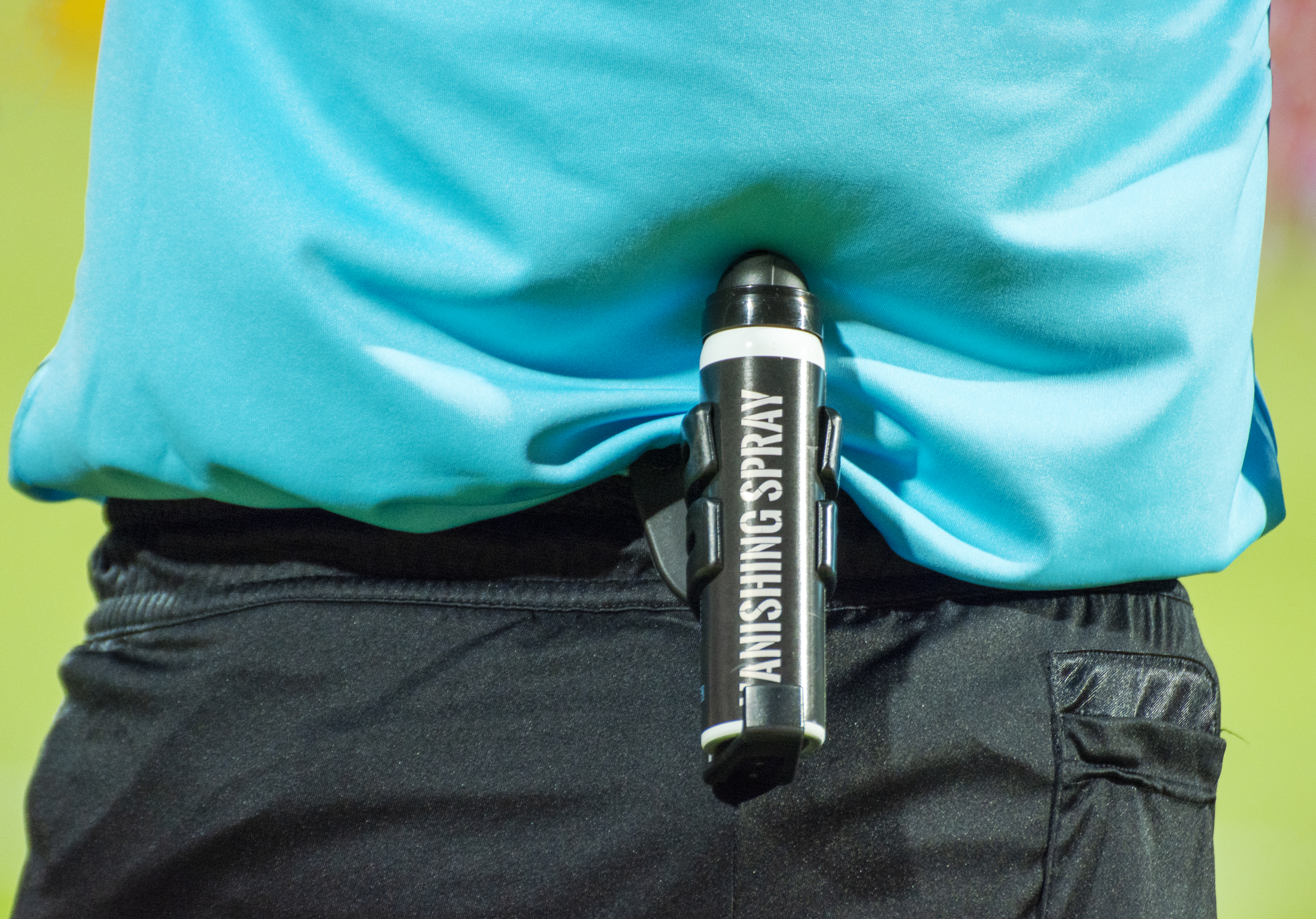
Vanishing spray has quickly become a common sight on the belts of professional referees. Credit: Balkan Photos, CC BY-SA 2.0
You might have played football (soccer) as a child, and if that’s the case, you probably don’t remember vanishing spray as a key part of the sport. Indeed, it’s a relatively modern innovation, which came into play in international matches from 2013. The spray allowed referees to mark a line with a sort of disappearing foam, which could then be used to enforce the 10-yard distance between opposing players and the ball during a free kick.
The product is a fairly simple aerosol—the cans contain water, butane, a surfactant, vegetable oil, and some other minor constituents. When the aerosol nozzle is pressed, the liquified butane expands into a gas, creating a foam with the water and surfactant content. This creates an obvious white line that then disappears in just a few minutes.
The spray was created by Brazilian inventor Heine Allemagne in 2000, and was originally given the name Spuni. He filed a patent in 2000, which was then granted in 2002. It was being used in professional games by 2001, and quickly adopted in the mainstream Brazilian professional competition.
The future looked bright for Allemagne and his invention, with the Brazilian meeting with FIFA in 2012 to explore its use at the highest level of international football. In 2013, FIFA adopted the use of the vanishing spray for the Club World Cup. It appeared again in the 2014 World Cup, and many competitions since. By this time, it had been renamed “9.15 Fair Play,” referring to the metric equivalent of the 10-yard (9.15 meter) distance for free kicks.
After its first use by FIFA, the use of vanishing spray quickly spread to other professional competitions, making its first appearance in the Premier League in 2014. Credit: Egghead06, CC BY-SA 4.0
The controversy came later. Allemagne would go on to publicly claim that the global sporting body had refused to pay him the agreed price for his patent. He would go on to tell the press he’d knocked back an initial offer of $500,000, with FIFA later agreeing to pay $40 million for the invention. Only, the organization never actually paid up, and started encouraging the manufacture of copycat products from other manufacturers. In 2017, the matter went to court, with a Brazilian ruling acknowledging Allemagne’s patent. It also ordered FIFA to stop using the spray, or else face the risk of fines. However, as is often the way, FIFA repeatedly attempted to appeal the decision, raising questions about the validity of Allemagne’s patent.
The case has languished in the legal system for years since. In 2020, one court found against Allemagne, stating he hadn’t proven that FIFA had infringed his products or that he had suffered any real damages. By 2022, that had been overturned on appeal to a higher court, which found that FIFA had to pay material damages for their use of vanishing spray, and for the loss of profits suffered by Allemagne. The latest development occurred earlier this year, with the Superior Court of Justice ruling that FIFA must compensate Allemagne for his invention. In May, CNN reported that he expected to receive $40 million as a result of the case, with all five ministers on the Superior Court ruling in his favor.
Ultimately, vanishing spray is yet another case of authorities implementing ever-greater control over the world of football. It’s also another sad case of an inventor having to fight to receive their due compensation for an innovative idea. What seems like an open-and-shut case nevertheless took years to untangle in the courts. It’s a shame, because what should be a simple and tidy addition to the world of football has become a mess of litigation that cost time, money, and a great deal of strife. It was ever thus.
Recently there was a bit of a panic in the media regarding a very common item in kitchens all around the world: black plastic utensils used for flipping, scooping and otherwise handling our food while preparing culinary delights. The claim was that the recycled plastic which is used for many of these utensils leak a bad kind of flame-retardant chemical, decabromodiphenyl ether, or BDE-209, at a rate that would bring it dangerously close to the maximum allowed intake limit for humans. Only this claim was incorrect because the researchers who did the original study got their calculation of the intake limit wrong by a factor of ten.
This recent example is emblematic of how simple mistakes can combine with a reluctance to validate conclusions can lead successive consumers down a game of telephone where the original text may already have been wrong, where each node does not validate the provided text, and suddenly everyone knows that using certain kitchen utensils, microwaving dishes or adding that one thing to your food is pretty much guaranteed to kill you.
How does one go about defending oneself from becoming an unwitting factor in creating and propagating misinformation?
The London Underground is an iconic piece of Victorian era engineering. What started in 1863 quickly became a core piece of infrastructure that would define the modern character of the British capital. It’s grown and changed immensely in the many years that have passed. Sadly, increasing patronage and more trains have created problems that the original designers never envisaged.
Deep in those London tunnels lies an engineering challenge. The Tube is literally cooking itself. Every day, millions of commuters descend into a network of tunnels that have been absorbing heat since the reign of Queen Victoria. Those clay-lined tubes have been soaking up excess thermal energy like a giant underground radiator, and now they’re giving it back with interest. The tunnels are simply too hot, and cooling them down is inordinately difficult.
The Perfect Storm of Thermal Chaos
The Tube’s heat problem isn’t just about one thing gone wrong – it’s about everything gone wrong at once. When Victorian engineers designed these tunnels, cooling wasn’t a major consideration. The tight, compact tunnels were built deep, nestled in the clay beneath London. In the early days, temperatures in the Underground were considered comfortably low.
“The Underground’s the only spot for comfort when the days are hot; it is cooler below.” – London Underground poster, 1926
Originally, the clay surrounding the tunnels sat at around 14°C, acting as a heat sink for the network. However, over the years, with more trains coming and going and more heat pouring in, the temperature has risen. It now typically sits anywhere from 19° to 26 °C. That’s just the earth around the tunnels, though. Air temperatures are worse—hitting as high as 47°C during a 2006 heatwave. The problem has been a continual bugbear of the beloved Tube, with concerns that future heatwaves could see temperatures rise ever higher. Continue reading “The London Underground Is Too Hot, But It’s Not An Easy Fix”→
With the rapidly evolving situation surrounding the Redbox vending machines still out in the wild, it’s about time somebody put together a Wiki to keep it all straight.
The unredbox wiki has information on the various different hardware revisions that Redbox put out into the wild, from the regular outdoor machines to the weird indoor blue variant. The site also has breakdowns on individual components. For example, it covers the computers inside the machines, built by Dell, Lenovo, and Premio, and bits and pieces like the DVD carousel and the modems used inside.
Basically, if you’re working with these machines and you don’t have a manual, this resource could help you out. As could the neat video below that shows the internals of a Redbox machine during the reloading process.
Yesterday, Prusa Research officially unveiled their next printer, the Core ONE. Going over the features and capabilities of this new machine, it’s clear that Prusa has kept a close eye on the rapidly changing desktop 3D printer market and designed a machine to better position themselves within a field of increasingly capable machines from other manufacturers.
While some saw the incremental upgrades of the i3 MK4 as being too conservative, the Core ONE ticks all the boxes of what today’s consumer is looking for — namely high-speed CoreXY movement with a fully enclosed chamber — while still offering the build quality, upgradability, and support that the company has built its reputation on. Put simply it’s one of the most exciting products they’ve introduced in a long time, and exactly the kind of machine that many Prusa fans have been waiting for.
Unfortunately, there’s one feature that’s ominously absent from the Core ONE announcement post. It’s easy to overlook, and indeed, most consumers probably won’t even know it’s missing. But for those of us who are concerned with such matters, it’s an unspoken confirmation that an era has finally come to an end.
With the Core ONE, Prusa Research is no longer in the business of making open source 3D printer hardware, but that doesn’t mean that the printer isn’t hackable. It’s complicated, so read on.
Remember Redbox? Those bright red DVD vending machines that dotted every strip mall and supermarket in America, offering cheap rentals when Netflix was still stuffing discs into paper envelopes? After streaming finally delivered the killing blow to physical rentals, Redbox threw in the towel in June 2024, leaving around 34,000 kiosks standing as silent monuments to yet another dead media format.
Last month, we reported that these machines were still out there, barely functional and clinging to life. Now, a company called The Junkluggers has been tasked with the massive undertaking of clearing these mechanical movie dispensers from the American retail landscape, and they’re doing it in a surprisingly thoughtful way. I chatted to them to find out how it’s going.