Stereo Amplifier With Digital Volume Control

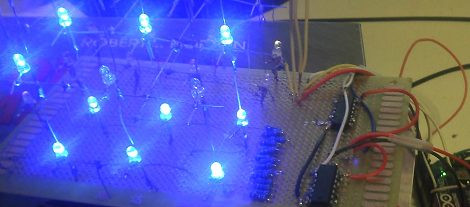
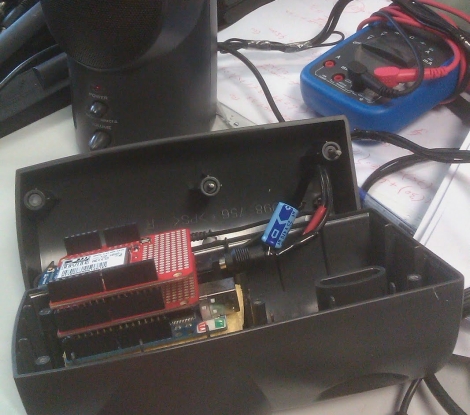
A regular Hack A Day reader sent in a tip about an LM386 stero amplifier with digital volume control. The resulting build is very professional and could easily be adapted into a slick iPod dock build.

We’ve seen a few LM386-based amplifiers over the years including one that fits inside a 9V battery, but this is the first implementation of digitally controlled volume we’ve seen. The volume control of this amp uses the DS1868 dual digital pot IC in place of the usual 10K pot providing 256 steps between zero and full volume. The DS1868 is controlled by a PIC μC with a 3-wire serial connection, although this could be implemented on any microcontroller.

Although the code provided with this build outputs volume as a linear function, it would be trivial to implement a logarithmic volume output. Because the ear perceives loudness on a logarithmic scale, this would be a great way to adjust audio volume and provide a more fine-grained control. Of course this could be implemented with a logarithmic pot, but where’s the fun in that?

Check out a video of the amp after the break.

Continue reading “Stereo Amplifier With Digital Volume Control”

Synapse Turns Your Kinect Into A Dubstep Theremin

kinect_dubstep_theremin

[Ryan Challinor] is part of a group constructing a display for this year’s Burning Man festival that includes the Kinect, Ableton Live, and Quartz Composer. As the programming guru of the project, he was tasked with creating a method for his partners to utilize all three products via an easy to use interface.

His application is called Synapse and was inspired by videos he saw online of people controlling individual Dubstep beats or sound effects with the Kinect. Synapse allows you to map multiple effects to each limb, sending joint positions, hit events, and image depth data to both Ableton and Quartz Composer via OSC. The user interface looks fairly easy to work with, enabling musicians and artists to create awesome audio/visual displays using their bodies as instruments, in a very short period of time.

Check out the pair of videos below to see a brief walkthrough of the software interface as well as a quick video demonstration of what Synapse is capable of.

[via KinectHacks]

Continue reading “Synapse Turns Your Kinect Into A Dubstep Theremin”

VU Meter Lives In A Linksys Housing

[Dillon] just finished his first project of the summer. It’s a volume units meter for his sound system and it has a few tricks up its sleeve.

He’s driving the rows of LEDs using an AN6884 LED driver chip. It has an integrated amplifier circuit which makes it the perfect part for building a VU display. He had a broken Linksys 5-port switch sitting around which he used as the enclosure for the project. It has just enough room to incorporate a speaker in case he wants to take the meter on the road with him. But when at home he can choose to use his stereo system instead with the flip of a switch. To ensure he’s making the most out of the 5-bit precision he’s included a voltage divider that can be adjusted with a potentiometer. We’ve embedded a video after the break which shows how well it works.

Looking for a bit more inspiration for your own VU meter project? Check out this RGB version.

Continue reading “VU Meter Lives In A Linksys Housing”

ChipKIT Sketch: Mini Polyphonic Sampling Synth

In our hands-on review of the Digilent chipKIT Uno32, we posed the question of what the lasting appeal might be for a 32-bit Arduino work-alike. We felt it needed some novel applications exploiting its special features…not just the same old Arduino sketches with MOAR BITS. After the fractal demo, we’ve hit upon something unique and fun…

Continue reading “ChipKIT Sketch: Mini Polyphonic Sampling Synth”

RFID Record Player

Like most of us at Hack a Day, [Bertrand Fan] has a huge collection of digital music that was all obtained through legal channels. Missing the physical process of choosing and playing an album, [Bertrand] built an RFID record player to get rid of the paradox of choice that arises when thousands of albums are at your fingertips.

The records are repurposed Christmas ornaments with RFID disk tags pasted under the label. These records are read by a RedBee RFID reader and sent to a Popcorn Hour media server, but we’re guessing this could be easily adapted to any HTPC.

The only limitation we see is the fact that the RFID chip is hard coded to individual songs. We think it would be easier to have the RFID chip store an album’s CDDB discid, but feel free to leave a comment and say how you would catalog thousands of albums on RFID tags.

We’re a little tired of skipping though our music collection like a portable CD player from 1990, so we’re pretty impressed that [Bertrand] came up with something that would get us to sit down and listen to our Terabytes of FLAC-encoded music. Check out the video after the jump for a demo of the RFID record player.

Continue reading “RFID Record Player”

Hidden Messages In Audio

[Alex] tiped us off about the evil sounding noises coming from http://www.thedarkknightrises.com/. when you go there your pretty much greeted with a wav file and if you have a quick eye on the status bar its pretty easy to get the direct link to the file and download it. Thats all great, but why would you want to?

Well if you play back the file in a program that supports spectrograms (like audacity) you will find that there is a twitter hash hidden within the audio spectrum, that presents itself as plain text in a pretty well rendered font. Of course this leads you to another part of the site where yet another puzzle awaits you.

While this is all an interesting way to stir up buzz about the upcoming (Batman) movie, we found hiding plain text in an audio file pretty wild, though its been done before or better such as the post we had not too long ago about Ham’s packing QR codes in a similar way.

Generating Pink Noise

[Miceuz] just finished his first surface mount electronics project. It’s a pink noise generator that is used for testing audio equipment (scroll down that link for the English version of his writeup).

Pink noise is somewhere in between red noise and white noise. Didn’t realize there were more colors than just white when it comes to noise? The benefit of testing with pink noise is that it the power of the audio signal is stable through each octave of sound – white noise increases in power with each additional octave which can damage the tweeters in a sound system.

The goal in this design was to build a noise generator that fit into an XLR connector. [Miceuz] started with an existing design, and altered it to suit his needs. Much like a condenser microphone, the pink noise generator uses phantom power instead of a standalone power source. For instance, the design he based this on required two 9v batteries. The size, the choice of case, and the absence of a battery all spell WIN for this project.