Animated Picture Frame Needs Charging Once Per Month

[Kyle Stewart-Frantz] took one look at a black and white photo of a mountain stream, and decided it was way too boring. How much cooler would it be if the water was moving! Like any good hacker worth his weight in 2N2222s, [Kyle] set out to make his idea a reality. After discovering some pricey options, he found a Kindle Paperwhite with a display that had decent resolution and 16 levels of grey. But would 16 levels be sufficient to produce an animation that’s pleasing to the eye?

After stumbling upon a community dedicated to hacking Kindles, [Kyle] got to work. Using a custom Amazon command called eips, he was able to access the display’s memory location and paint images to it. The next trick was to write a script that called the command multiple times to produce a GIF-like animation effect.  This… didn’t work so well. He then found some code from [GeekMaster] (thanks for the tip!) that ran a specialized video player on the Kindle that used something called ordered dithering. After a few more tweaks, he got everything working and the end result looks like something straight out of the world of Harry Potter.

The animated picture frame can run for three to four weeks between charges. This is a hack that would make a great gift and look nice in your office. If you make one, be sure to put the skull and wrenches on it first and let us know!

Continue reading “Animated Picture Frame Needs Charging Once Per Month”

Modern Wooden Houses With No Glue Or Nails

Depending where you are in the world, the techniques used to build houses can sometimes seem to be stuck in another century. Bricks and mortar, for instance, we build with them because we are used to them and have a large workforce of people trained to work with them and not much else. But in the 21st century with more advanced building technologies sitting relatively unused and looming housing crises at every turn, does it make sense to still build houses the slow and expensive way our great-grandparents did? Probably not.

Wooden houses are a promising solution to some of the problems outlined in the previous paragraph, and indeed in large parts of the world wood is the housing material of choice. It’s eco-friendly, not too expensive, and can be applied easily to multiple different types of structure. If you think of a wooden house, does the image of a log cabin come to mind, or perhaps a weatherboard house? Both construction methods that would be familiar again to your great-grandparents, so perhaps you might not call it an advanced building technology.

It’s interesting then to see an innovation from France, a system of interlocking wood sections that can be built into walls that look very similar to brick (Here’s the French language original). These are short sections of board cleverly designed with dovetailing to engage with vertical sections that interlock between different courses and leave a gap between wooden inner and outer faces of the wall that can be filled with insulation material. The effect is to create a wooden building system that can produce a vast range of structures that can be assembled in a very short time indeed. This isn’t prefabricated housing, but it delivers the speed you’d expect from it.

They have a video shoving construction of a typical house in rather idyllic French countryside, which we’ve put below the break. It has French language annotations, however for non Français speakers the context is pretty obvious.

Continue reading “Modern Wooden Houses With No Glue Or Nails”

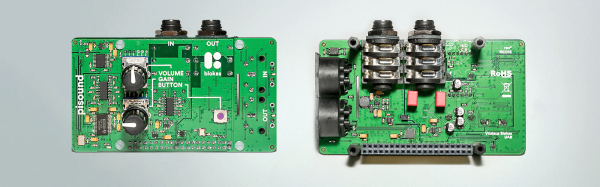
PiSound, The Audio Card For The Raspberry Pi

Kids today are being loud with their ‘drum machines’ and ‘EDM’. Throw some Raspberry Pis at them, and there’s a need for a low-latency sound card with MIDI and all the other accouterments of the modern, Skrillex-haired rocker. That’s where PiSound comes in.

Of course, the Pi already comes with audio out, but that’s not enough if you want to do some real audio processing. You need audio in as well, and while you’re messing around with that, adding some high-quality opamps, ADCs, DACs, and some MIDI would be a good idea. This is what the PiSound is all about.

[Pranciskus], the guy who has been working on the PiSound for a while now, developed this multitool for audio on a tiny Linux system. One of the killer features on the PiSound is ‘The Button’, a simple tact switch that runs a script if the button is pressed, another script if the button is held down, and two more if the button is pressed two or three times. This is actually a pretty nifty UI, and we wouldn’t mind seeing this on a few more Pi accessories.

If you’d like to see some example projects using the PiSound, there example MIDI controllers, networked audio players, and some goofing around with LV2 plugins over here.

Retrotechtacular: How Old Is The Remote?

A few weeks ago we covered a (probably) bogus post about controlling a TV with the IR from a flame. That got us thinking about what the real origin of the remote control was. We knew a story about the 38 kHz frequency commonly used to modulate the IR. We’ve heard that it was from sonar crystals used in earlier sonic versions of remotes. Was that true? Or just an urban myth? We set out to find out.

Surprise! Remotes are Old!

If you are a younger reader, you might assume TVs have always had remotes. But for many of us, remotes seem like a new invention. If you grew up in the middle part of the last century it is a good bet you were your dad’s idea of a remote control: “Get up and turn the channel!” Turns out remotes have been around for a long time, though. They just weren’t common for a long time.

If you really want to stretch back, [Oliver Lodge] used a radio to move a beam of light in 1894. In 1896, [Marconi] and some others made a bell ring by remote control. [Tesla] famously showed a radio-controlled boat in 1898. But none of these were really remote controls like we think of for a television.

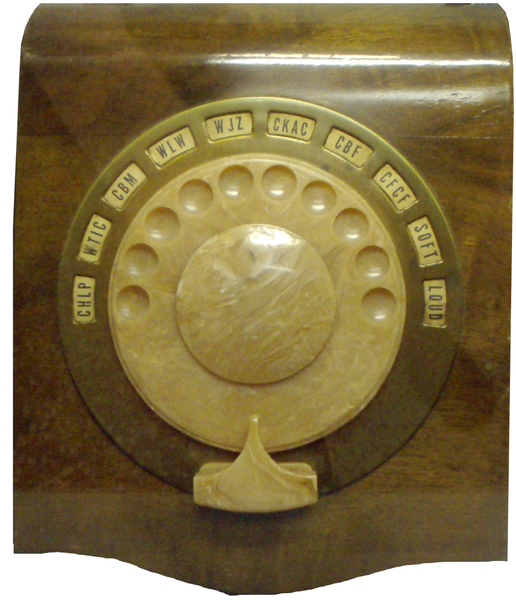
mysteryOf course, TV wouldn’t be around for a while, but by the 1930’s many radio manufacturers had wired remotes for radios. People didn’t like the wires, so Philco introduced the Mystery Control in 1939. This used digital pulse coding and a radio transmitter. That’s a fancy way of saying it had a dial like an old telephone. As far as we can tell, this was the first wireless remote for a piece of consumer equipment.

Continue reading “Retrotechtacular: How Old Is The Remote?”

Super Computing With Mini ITX Cluster

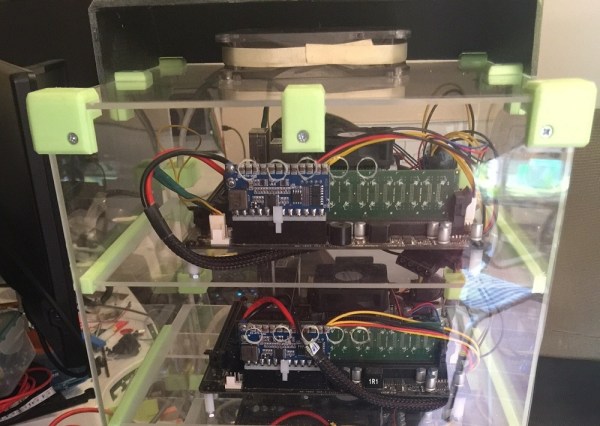
[Colin Alston] was able to snag a handful of Mini ITX motherboards for cheap and built a mini super computer he calls TinyJaguar. Named partly after the AMD Sempron 2650 APU, the TinyJaguar boasts four, yes that’s four MSI AM1I Mini-ITX motherboards, each with 4GB of DDR memory.

A Raspberry Pi with custom software manages the cluster, and along with some TTL and relays, controls the power to the four nodes. The mini super computer resides in a custom acrylic case held together by an array of 3D printed parts and fasteners.There’s even a rack-like faceplate near the bottom to host the RPi, an Ethernet switch, an array of status LEDs, and the two buttons.

With 16 total cores of computing power (including GPU), the TinyJaguar is quite capable of doing some pretty cool stuff such as running Jupyter notebook with IPyParallel. [Colin] ran into some issues getting the GPU to behave with PyOpenCL. It took a bit of pain and time, but in the end he was able to get the GPUs up, and wrote a small message passing program to show two of the cores were up and working together.

Be sure to check out [Colin’s] super computer project page, specifically the ten project logs that walk through everything that went into this build. He also posted his code if you want to take a look under the hood.

Scrap Wood And Metal Combined For DIY Mecanum Wheels

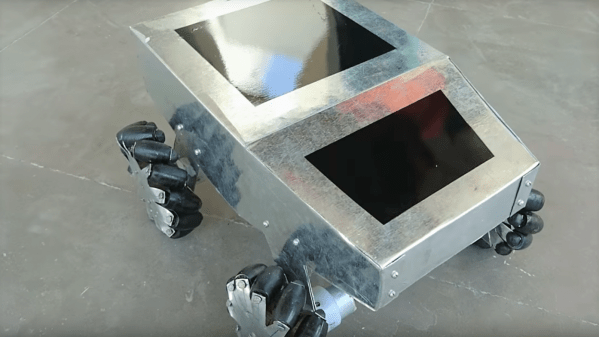
Some scrap wood, a few pieces of sheet metal, a quartet of old gear motors, and a few basic hand tools. That’s all it takes to build an omni-bot with Mecanum wheels, if you’ve got a little know-how too.

For the uninitiated, Mecanum wheels can rotate in any direction thanks to a series of tapered rollers around the circumference that are canted 45° relative to the main axle.  [Navin Khambhala]’s approach to Mecanum wheel construction is decidedly low tech and very labor intensive, but results in working wheels and a pretty agile bot. The supports for the rollers are cut from sheet steel and bent manually to hold the wooden rollers, each cut with a hole saw and tapered to a barrel shape on a makeshift lathe. Each wheel is connected directly to a gear motor shaft, and everything is mounted to a sheet steel chassis. The controls are as rudimentary as the construction methods, but the video below shows what a Mecanum-wheeled bot can do.

There’s a lot of room here for improvement, but mainly in the manufacturing methods. The entire wheel could be 3D printed, for instance, or even laser cut from MDF with a few design changes. But [Navin] scores a win for making a working wheel and a working bot from almost nothing.

Continue reading “Scrap Wood And Metal Combined For DIY Mecanum Wheels”

The BeagleBone Blue – Perfect For Robots

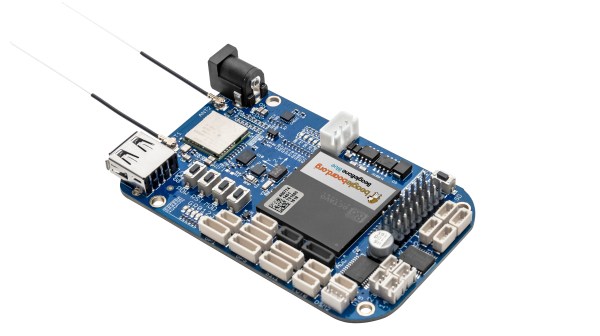
There’s a new BeagleBone on the block, and it’s Blue. The BeagleBone Blue is built for robots, and it’s available right now.

If a cerulean BeagleBone sounds familiar, you’re not wrong. About a year ago, the BeagleBone Blue was introduced in partnership with UCSD. This board was meant for robotics, and had the peripherals to match. Support for battery charging was included, as well as motor drivers, sensor inputs, and wireless. If you want to put Linux on a moving thingy, there are worse choices.

The newly introduced BeagleBone Blue is more or less the same. A 9-axis IMU, barometer, motor driver, quad encoder sensor, servo driver, and a balancing LiPo charger are all included. The difference in this revision is the processor. That big square of epoxy in the middle of the board is the Octavo Systems OSD3358, better known as a BeagleBone on a chip. This is the first actual product we’ve seen using this neat chip, but assuredly not the last – a few people are working on stuffing this chip onto a board that fits in mini Altoids tins.