This week Jonathan and Rob chat with Nate Graham about KDE! Why did Nate walk away from Apple, and how did he find Linux and KDE? And what does he see coming next? Watch to find out!

This excellent content from the Hackaday writing crew highlights recurring topics and popular series like Linux-Fu, 3D-Printering, Hackaday Links, This Week in Security, Inputs of Interest, Profiles in Science, Retrotechtacular, Ask Hackaday, Teardowns, Reviews, and many more.
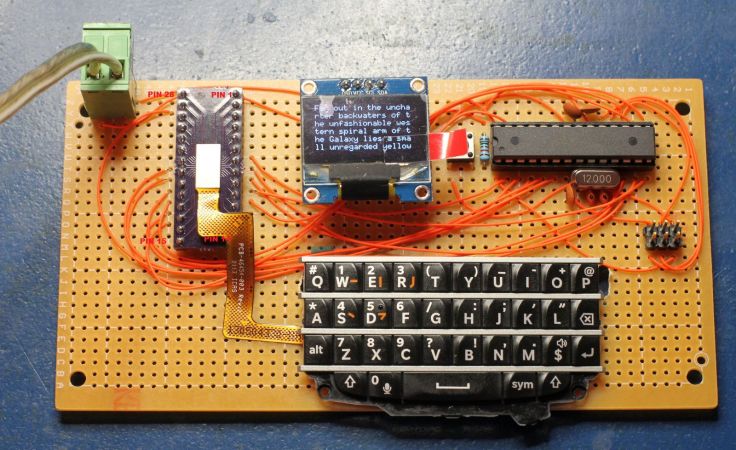
What could happen when you open-source a hardware project?
No, seriously. I hold a fair few radical opinions – one is that projects should be open-source to the highest extent possible. I’ve seen this make miracles happen, make hackerdom stronger, and nourish our communities. I think we should be publishing all the projects, even if incomplete, as much as your opsec allows. I would make ritual sacrifices if they resulted in more KiCad projects getting published, and some days I even believe that gently bullying people into open-sourcing their projects can be justified. My ideal universe is one where companies are unable to restrict schematics from people getting their hardware, no human should ever hold an electronics black box, by force if necessary.
Why such a strong bias? I’ve seen this world change for the better with each open-source project, and worse with closed-source ones, it’s pretty simple for me. Trust me here – let me tell you a story of how a couple reverse-engineering efforts and a series of open-source PCBs have grown a tree of an ecosystem.
Continue reading “The Blackberry Keyboard: How An Open-Source Ecosystem Sprouts”

You turn the dial on your radio, and hear a powerful source of interference crackle in over the baseline noise. You’re interested as to where it might be coming from. You’re receiving it well, and the signal strength is strong, but is that because it’s close or just particularly powerful? What could it be? How would you even go about tracking it down?
When it comes to hunting down radio transmissions, Justin McAllister and Nick Foster have a great deal of experience in this regard. They came down to the 2024 Hackaday Superconference to show us how it’s done.
Continue reading “Supercon 2024: How To Track Down Radio Transmissions”

I had to bust out Brain Salad Surgery to write this one, folks. It was that, or put on some Ministry or something. Just look at all the industrial-ness dripping from [heinn_dev]’s creation.

The only downside, if you can call it one, is that adjusting the tenting is a slow operatiJKon. But then again that’s one of those things that you usually set and forget.
Oh, and those keycaps are printed, too. As one commenter said, those homing nipples look painful, but I think it’s part of the charm. I just hope that hand grime doesn’t end up clogging the holes under the palm area. Clean your keyboards, people. Continue reading “Keebin’ With Kristina: The One With The H.R. Giger Keyboard”

It appears that we’re approaching the HAL-9000 point on the AI hype curve with this report, which suggests that Anthropic’s new AI model is willing to exhibit some rather antisocial behavior to achieve its goals. According to a pre-release testing summary, Claude Opus 4 was fed some hypothetical company emails that suggested engineers were planning to replace the LLM with another product. This raised Claude’s hackles enough that the model mined the email stream for juicy personal details with which to blackmail the engineers, in an attempt to win a stay of execution. True, the salacious details of an extramarital affair were deliberately seeded into the email stream, and in most cases, it tried less extreme means to stay alive, such as cajoling senior leaders by email, but in at least 84% of the test runs, Claude eventually turned to blackmail to get its way. So we’ve got that to look forward to.
In a marvelous college lecture in front of a class of engineering students, V. Hunter Adams professed his love for embedded engineering, but he might as well have been singing the songs of our people – the hackers. If you occasionally feel the need to explain to people why you do what you do, at fancy cocktail parties or something, this talk is great food for thought. It’s about as good a “Why We Hack” as I’ve ever seen.
Among the zingers, “projects are filter removers” stuck out. When you go through life, there are a lot of things that you kinda understand. Or maybe you’ve not even gotten around to thinking about whether you understand them or not, and just take them for granted. Life would all simply be too complicated if you took it all sufficiently seriously. Birdsong, Bluetooth, the sun in the sky, the friction of your car’s tire on various surfaces. These are all incredibly deep subjects, when you start to peel back the layers.
And Hunter’s point is that if you are working on a project that involves USB, your success or failure depends on understanding USB. There’s no room for filters here – the illusion that it “just works” often comes crashing down until you learn enough to make it work. Some of his students are doing projects cooperatively with the ornithology department, classifying and creating birdsong. Did you know that birds do this elaborate frequency modulation thing when they sing? Once you hear it, you know, and you hear it ever more.
So we agree with Hunter. Dive into a project because you want to get the project done, sure, but pick the project because it’s a corner of the world that you’d like to shine light into, to remove the filters of “I think I basically understand that”. When you get it working, you’ll know that you really do. Hacking your way to enlightenment? We’ve heard crazier things.

Elliot and Dan teamed up this week for the podcast, and after double-checking, nay, triple-checking that we were recording, got to the business of reviewing the week’s hacks. We kicked things off with a look at the news, including a potentially exciting Right to Repair law in Washington state and the sad demise of NASA’s ISS sighting website.
Our choice of hacks included a fond look at embedded systems and the classic fashion sense of Cornell’s Bruce Land, risky open CRT surgery, a very strange but very cool way to make music, and the ultimate backyard astronomer’s observatory. We talked about Stamp collecting for SMD prototyping, crushing aluminum with a boatload of current, a PC that heats your seat, and bringing HDMI to the Commodore 64.
We also took a look at flight tracking IRL, a Flipper-based POV, the ultimate internet toaster, and printing SVGs for fun and profit. Finally, we wrapped things up with a look at the tech behind real-time river flow tracking and a peek inside the surprisingly energetic world of fuel cells.