This Is How You Run A Hackathon: Tech Valley Center Of Gravity

What’s not to love about a hackathon? The junk food and caffeine that fuel the weekend; the highs that come with success and the lows that come when the blue smoke is released; the desperate search for inspiration as the clock ticks away; nerve-wracking pitches to the judges, hoping against hope that everything works in the demo. Hackathons are the contact sport of the hacker world, bringing in top competitors and eager upstarts, and when done well you just might attract interested “civilians” and other newbies that will catch the hacking bug from what they witness.

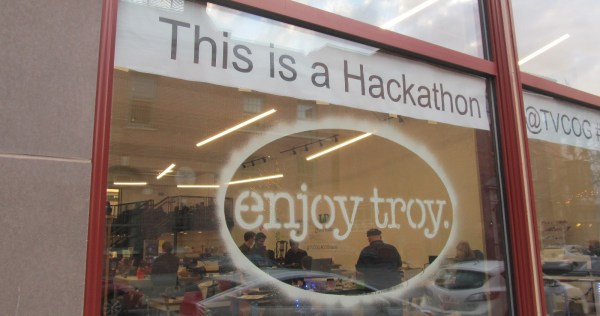
Such was the scene at the Tech Valley Center of Gravity in Troy, NY over the last weekend of January. New for 2016, the CoG is hosting a series of four hardware hackathons this year, each with a different theme. This event’s theme was “Internet of Things”, and the call went out to any and all to come compete for bragging rights and over $1,000 in prizes. Incentives to compete included some big name corporate sponsors, like AT&T, and judging and mentoring provided by the likes of SparkFun’s [Jeff Branson]. There was also a steady stream of food and drink, saturation coverage by local media outlets, and your humble Hackaday writer and his son, who made the trip up to Troy with a small passel of Hackaday swag and a curiosity to see how the CoG has fared since our last visit at the grand opening of their glorious new home. We were not disappointed.

Continue reading “This Is How You Run A Hackathon: Tech Valley Center Of Gravity”

Code Craft: Cross Compiling For The Raspberry Pi

Sometimes there’s just no place like your desktop. You’ve already got your favorite development tools and references setup or installed and it’s a pain when you’re trying to work on an unfamiliar, or simply uncustomized, system. On your desktop everything is at your fingertips. If you want to search the web, the browser is just an alt-tab away. If you need a calculator, it’s right there to run. Your editor highlights syntax in your favorite colors already.

When developing on a Raspberry Pi, you leave all these creature comforts behind unless you spend the time to configure the Pi to your liking. Then it all gets wiped when you install a new distribution, like the recent change from Wheezy to Jessie. Even then it’s frustrating to switch back and forth between the desktop and the Pi because there is always something on the other system that you need. My usual comment is, “dirty word”, literally.

Cross-developing on your desktop is a very workable solution. We’re going to walk through setting up your desktop and a Pi to do this. This means loading a Pi ARM toolchain on your desktop and a debugging server on the Pi. This’ll let you develop and debug from in the comfort of your desktop. An added advantage is when you put that Pi in a robot you can debug over a wireless link.

Continue reading “Code Craft: Cross Compiling For The Raspberry Pi”

Russian Rocket Tech Comes In From The Cold

Decades after the end of the space race, an American rocket took off from Cape Canaveral. This was a routine launch to send a communications satellite into orbit, but the situation was an historic first. The rocket in question was driven by a powerful Russian engine unlike any ever built in the States. Although this particular engine was new, the design dated back to the space age.

By the early 1960s, the Russians were leaps and bounds ahead of the United States in terms of space exploration. They had already launched Sputnik and sent Yuri Gagarin to orbit the Earth. All in all, the Russians seemed poised to send a man to the moon. Russian technology had the Americans worried enough to spy on them with satellites, and the images that came back revealed something spectacular. Out in the Kazakh desert, the Russians were building an enormous causeway and two launch pads. As it turns out, the US had every reason to be worried.

Continue reading “Russian Rocket Tech Comes In From The Cold”

Making Parametric Models In Fusion 360

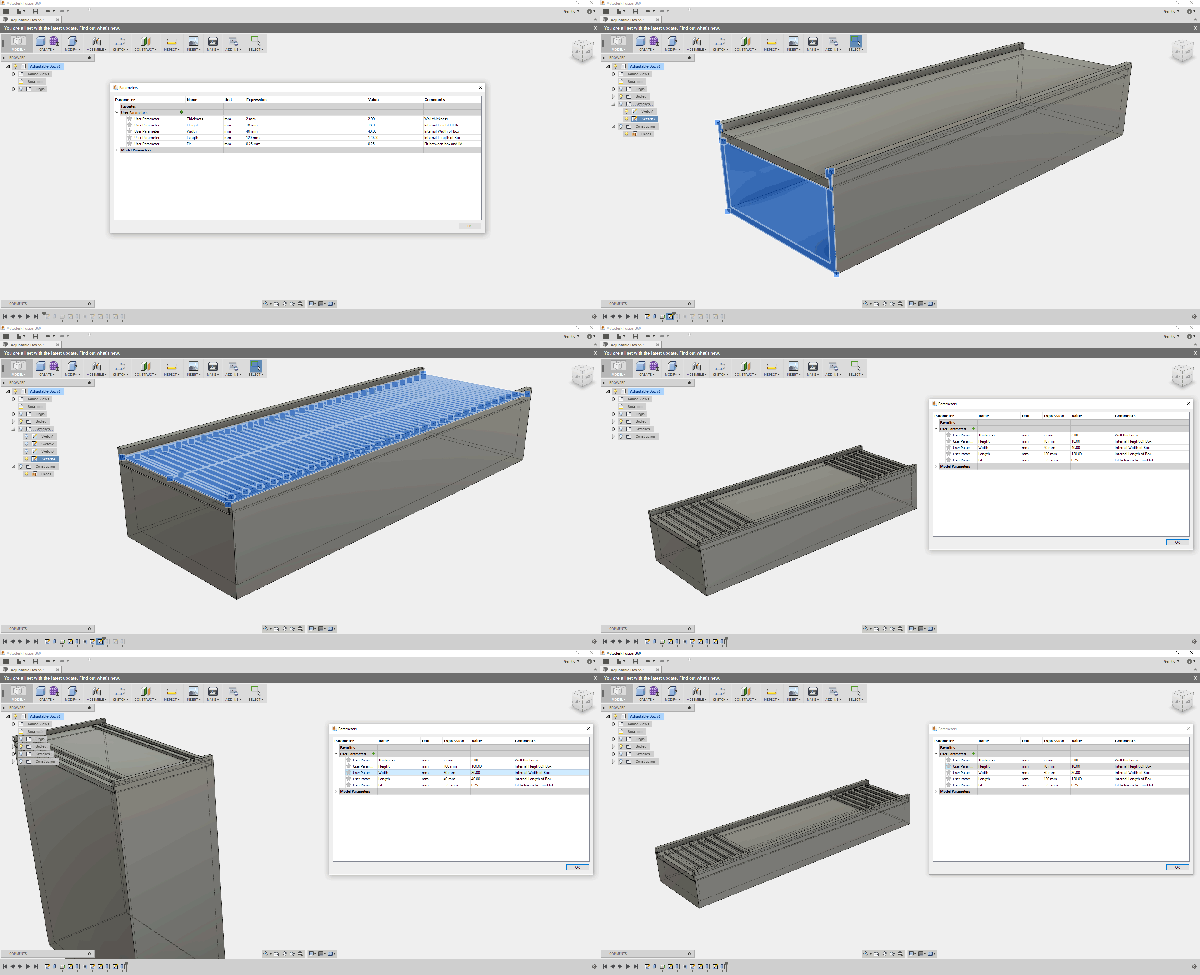
We all know and love OpenSCAD for its sweet sweet parametrical goodness. However, it’s possible to get some of that same goodness out of Fusion 360. To do this we will be making a mathematical model of our object and then we’ll change variables to get different geometry. It’s simpler than it sounds.

Even if you don’t use Fusion 360 it’s good to have an idea of how different design tools work. This is web-based 3D Modeling software produced by Autodesk. One of the nice features is that it lets me share my models with others. I’ll do that in just a minute as I walk you through modeling a simple object. Another way to describe what we’re going to learn is: How to think when modeling in Fusion 360.

Continue reading “Making Parametric Models In Fusion 360”

Experimental Gases, Danger, And The Rock-afire Explosion

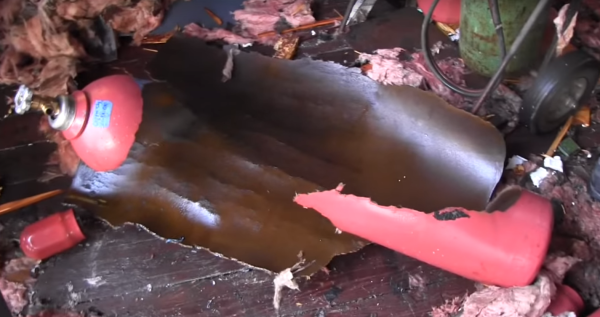
DowntownExlosion12_1On the morning of September 26th, 2013 the city of Orlando was rocked by an explosion. Buildings shook, windows rattled, and Amtrak service on a nearby track was halted. TV stations broke in with special reports. The dispatched helicopters didn’t find fire and brimstone, but they did find a building with one wall blown out. The building was located at 47 West Jefferson Street. For most this was just another news day, but a few die-hard fans recognized the building as Creative Engineering, home to a different kind of explosion: The Rock-afire Explosion.

The Inventor and His Band of Robots

rockafireMany of us have heard of the Rock-afire Explosion, the animatronic band which graced the stage of ShowBiz pizza from 1980 through 1990. For those not in the know, the band was created by the inventor of Whac-A-Mole, [Aaron Fechter], engineer, entrepreneur and owner of Creative Engineering. When ShowBiz pizza sold to Chuck E. Cheese, the Rock-afire Explosion characters were replaced with Chuck E. and friends. Creative Engineering lost its biggest customer. Once over 300 employees, the company was again reduced to just [Aaron]. He owned the building which housed the company, a 38,000 square foot shop and warehouse. Rather than sell the shop and remaining hardware, [Aaron] kept working there alone. Most of the building remained as it had in the 1980’s. Tools placed down by artisans on their last day of work remained, slowly gathering dust.



Continue reading “Experimental Gases, Danger, And The Rock-afire Explosion”

Hackaday And Adafruit Launch The Pi Zero Contest

Hackaday and Adafruit are teaming up to bring you the Pi Zero Contest. Unless you’ve been hiding out in your workshop for the past month or so, you probably already know The Pi Zero is the $5 Linux-based computer which has been taking the world by storm. Think you have the next great project for this single-board computer? Enter it for a chance to take home one of three $100 gift certificates to the Hackaday Store. We know Zeros have been hard to find, so we’ll be giving away 10 of them before the contest is over. Even if you don’t have a Pi Zero, read on!

This is all about documenting quality projects to Hackaday.io. We’re looking for well thought out, well documented builds intended for the Pi Zero. Any project submitted to this contest can also be rolled over to the 2016 Hackaday Prize. Think of it as getting a head start.

Here are the details:

  • From February 2nd, to February 20th, Lady Ada will make 10 ‘From the Desk of Lady Ada’ broadcasts focusing on this contest. During each broadcast she will present an idea for a Pi Zero Project. You don’t have to build Lady Ada’s projects, they’re starter ideas to get your wheels turning. If you don’t have a Raspberry Pi Zero, don’t worry! You can prototype with a Raspberry Pi Model B, or a Pi 2. There are also 10 Pi Zero boards up for grabs before the contest is over.
  • The deadline for winning a Pi Zero is 12:00am PST February 25th, 2016. The judges will pick the 10 most well thought out and well documented projects.
  • On February 29th, the judges will announce the winners of 10 Raspberry Pi Zero boards.
  • The grand prize for this contest is one of three $100 gift cards to the Hackaday store. The deadline to enter is 12:00 am PST March 14th, 2016.

Entering is easy.  All you have to do is submit your project. Just click the “Submit to” drop down list on your project page. Then select Adafruit Pi Zero Contest.

So fire up your soldering irons, warm up your 3D printers, and load up your favorite code editor. It’s time to start hacking!

Rumors Of Xilinx Sale Abound

The companies that design and build the chips we all use – Atmel, Texas Instruments, Microchip, NXP, Freescale, Intel, Altera, Avago, Broadcom, and On Semi are all buying each other, merging, and slowly becoming two or three gigantic semiconductor companies. The question on everyone’s mind is, ‘which company will be next?’ The answer might be Xilinx, inventors of the FPGA and designers of some really cool parts.

The Wall Street Journal and Barron’s reported a few regulatory filings from Xilinx last week. This could signal an acquisition or merger of the company When this could happen is anyone’s guess, but rumors are flooding the Internet over who would buy Xilinx.

Until recently, Xilinx’s largest competitor in the FPGA market was Altera. That is, until Intel came by with a check for $16.7 Billion. The revenue, size, and market cap of both Xilinx and Altera aren’t too different, leading the question of who would have the money to buy Xilinx and isn’t Intel. Aren’t rumors fun?

Xilinx’s portfolio include high performance, mid-range and low-cost FPGAs as well as interesting hybrid devices. One such hybrid is Zynq, an FPGA and fast ARM Cortex A9 processor in the same package. All these chips will be made for years to come in one form or another. The only question is if Xilinx will make these chips, or will the company continue on under some new branding.