Retrotechtacular: Lighting The Way For Talkie Pictures With Optical Sound Recording

This week’s Retrotechtacular is a 1943 Encyclopædia Britannica film focusing on optical sound reproduction for motion pictures. Both the sound and the images are recorded on film, which is only affected by light. Therefore, the sound waves must be converted to changes in light.

This is done the way you might expect: the sound waves hit a microphone and the changes in current are amplified and used to control the intensity of light falling on the film. Three types of soundtracks are described and wonderfully demonstrated at the end of the film.

All three types are made from a series of thin bars of light, and the corresponding current value is represented by changes in either their length or their width. In the Unilateral Variable Area recording, the bars extend from the right side of the sound track. Bilateral Variable Area recorded bars emanate uniformly toward the edges from the center. In Variable Density recording, all of the bars extend from the left to right extremes, but their thickness varies.

Variable Density recording is done with a light valve, which contains a pair of delicate metallic ribbons in a magnetic field that move like shutters when the sound current flows through them. The light coming through to the film is varied by the slot created in the space between the ribbons. The light patterns are changed back to sound through a photoelectric cell, which converts the variations in light back to changing current. These changes are amplified and run through a loudspeaker. Be sure to watch to the end to catch a demonstration of the recording methods, set to what we’re pretty sure is Camille Saint-Saëns’ Danse Macabre.

Continue reading “Retrotechtacular: Lighting The Way For Talkie Pictures With Optical Sound Recording”

Retrotechtacular: Hacking Mother Nature’s North Temperate Regions

…because they’ll tickle your insides! Seriously, don’t eat them if you happen to parachute alone into wilderness and must survive without firearms or equipment like our protagonist here. This 1955 US Navy-produced gem of a training film will show you how to recognize, procure, and prepare many kinds of nutritious plant, insect, and animal life commonly found between 45° and 70° north latitude.

While you hone your large game hunting skills, you can tide yourself over with all kinds of things that will just sit there ready to be plucked for your nourishment: many berries and fruits, nuts, moss, lichens, and the inner bark of several kinds of trees is edible. Sate your taste for savory with grubs, termites, or grasshoppers. When in doubt, eat what the birds and small animals are eating, but stay away from mushrooms. It’s too hard to distinguish the poisonous varieties.

Many edible things are found in and around bodies of water. Game such as deer, ducks, and birds are attracted to water and make their homes near it. Various kinds of traps made from twigs and vegetation will outwit rabbits and squirrels. You can fashion a bow and arrow in order to kill large quadrupeds like deer, elk, and ram. It’s best to aim for the head, neck, or just behind the shoulders as these are the most vulnerable areas.

Once you have killed a large animal, prepare it for cooking by draining its blood and removing its entrails. There are many ways to cook your spoils of survival, and most of them involve cutting the meat into small pieces first. Hopefully, you have some basic tools for starting fires.

Continue reading “Retrotechtacular: Hacking Mother Nature’s North Temperate Regions”

Retrotechtacular: Restoring A 19th Century Automaton

eyes

Made sometime in the 1790s or 1800s London, the Maillardet Automaton has a long and storied history. It was exhibited around England for several decades, brought over the Atlantic by [P.T. Barnum], nearly destroyed in a fire, and donated to the Franklin Institute in Philadelphia in the 1920s. From there, this amazingly complex amalgam of cogs, cams, and linkages eventually became the inspiration for the book – and movie – Hugo. Time hasn’t exactly been kind to this marvel of the clockmaker’s art; it has been repaired four times before receiving a complete overhaul in 2007 by [Andrew Baron].

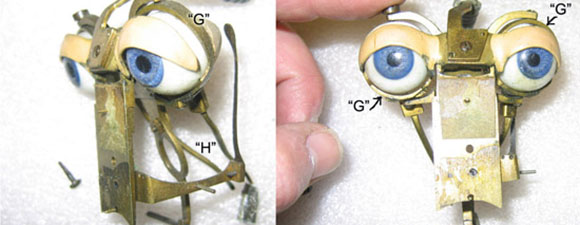
[Fran], one of Hackaday’s sources for awesome projects, recently visited the Franklin Institute and posted a series of videos on the reverse engineering of the Maillardet Automaton. Being nearly destroyed and repaired so many times didn’t make this an easy job; it’s extremely possible no one alive has ever seen the eyes of the Automaton move as originally designed.

Even though the Maillardet Automaton has one of the largest series of cams of any mechanical draftsman, that doesn’t mean it’s simply an enlargement of an earlier machine. The automaton’s pen is like no other writing device on Earth, with a stylus acting as a valve to dispense ink whenever the tip touches paper. The eyes have linkages to follow the pen as it traces a drawing. In 1800, this automaton would have been a singularity in the uncanny valley, and watching it put pen to paper is still a little creepy today.

Below you’ll find a video from [Fran] demonstrating all seven drawings the Maillardet Automaton can reproduce. You can also find a whole bunch of pics of the mechanisms along with the 2007 repair report on [Andrew Baron]’s site.

Retrotechtacular is a weekly column featuring hacks, technology, and kitsch from ages of yore. Help keep it fresh by sending in your ideas for future installments.

Continue reading “Retrotechtacular: Restoring A 19th Century Automaton”

Retrotechtacular: Where The Linux/UNIX TTY Came From

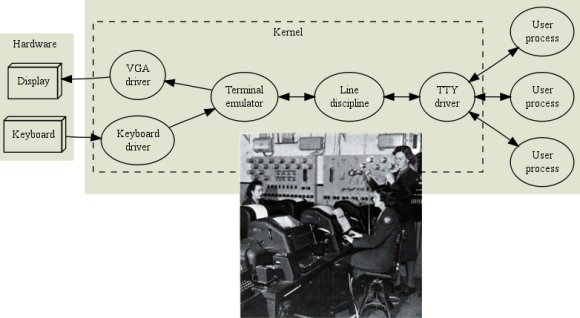
retrotechtacular-tty-demystified

From time to time we realize that sayings which make sense to us probably will have no meaning for future generations. Two of the examples that spring to mind are “hang up the phone” or in a vehicle you might “roll down the window”. And so is the case for today’s Retrotechtacular. Linux users surely know about TTY, but if you look up the term you actually get references to “Teletypewriter”. What’s that all about?

[Linus Akesson] wrote a fantastic essay on the subject called The TTY Demystified. We often feature old video as the subject of this column, but we think you’ll agree that [Linus’] article is worth its weight in film (if that can be possible). The TTY system in Linux is a throwback to when computers first because interactive in real-time. They were connected to the typewriter-mutant of the day known as a teletype machine and basically shot off your keystrokes over a wire to the computer the terminal was controlling.

This copper pipeline to the processor is still basically how the terminal emulators function today. They just don’t require any more hardware than a monitor and keyboard. We consider ourselves fairly advanced Linux users, but the noob and expert alike will find nuggets and tidbits which are sure to switch on the lightbulb in your mind.

[Thanks Chuck]

Retrotechtacular is a weekly column featuring hacks, technology, and kitsch from ages of yore. Help keep it fresh by sending in your ideas for future installments.

Retrotechtacular: Bakelite Plastics

retrotechtacular-bakelite-plastics

[ColdTurkey] sent in a really great video for this week’s Retrotechtacular. It’s a half-hour promo reel about Bakelite Plastic. There is so much to enjoy about this film, but we’ve been overlooking it because the first six minutes or so consist of an uncomfortably fake interview between a “Chemist” and “Reporter”. They are standing so close to each other that it’s violating our personal space. But endure or skip ahead and the rest of the video is gold.

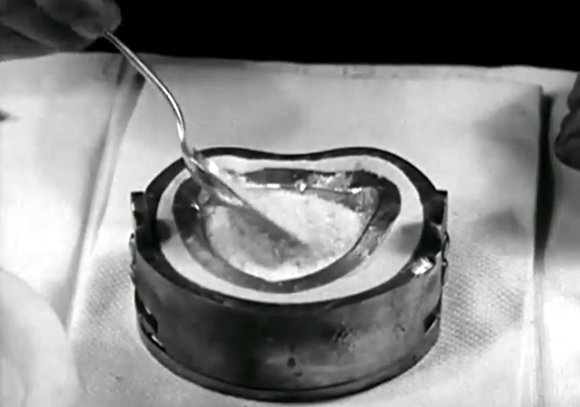
Bakelite is an early plastic, and putting yourself in the time period it’s very easy to see the miracle of these materials. The dentures being molded above are made out of phenol formaldehyde resin (to us that sounds like something you don’t stick in your mouth but what do we know?). The plastic pellets take on the shape of the mold when heated — we don’t know if this where the name comes from or if it’s a variation on the name of the chemist who discovered the material: [Dr. Leo Baekeland]. This was the first synthetic plastic, and came at just the right time as it was heavily adopted for use in the electronics and the automotive industry. Both of which were forging new ground at the time.

Continue reading “Retrotechtacular: Bakelite Plastics”

Retrotechtacular: Salvaging A Capsized Ocean Liner

salavaging-a-capsized-ocean-liner

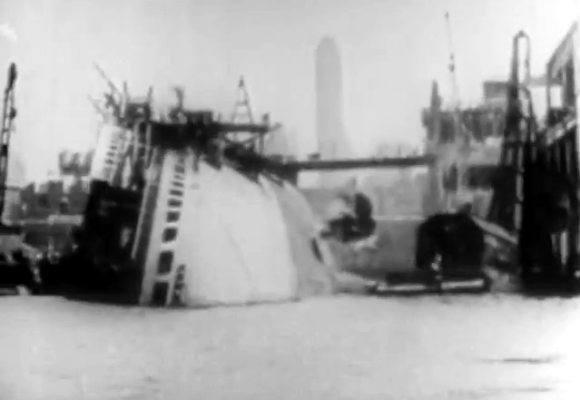
The scale of this salvage operation is nothing short of daunting. The SS Normandie was an ocean liner put into service in 1935 and capable of carrying 1,972 people across the Atlantic Ocean. The ship is still the fastest turbo-electric-propelled passenger vessel ever built, so it’s no surprise that it was seized by the US Navy during World War II for conversion to a troop carrier called the USS Lafayette. But in 1942, during retrofit operations, the vessel caught fire and capsized. The topic of today’s Retrotectacular is the remarkable salvage operation that righted the ship. Unfortunately, it was subsequently scrapped as bringing it into service was going to be too costly. Lucky for us the US Navy documented the salvage operation which makes for a fascinating 35-minutes of footage.

Continue reading “Retrotechtacular: Salvaging A Capsized Ocean Liner”

Retrotechtacular: How A Bicycle Is Made

Does your bicycle master boardwalk and quagmire with aplomb? If it was built by the Raleigh Bicycle Company, it ought to. This week’s Retrotechtacular is a 1945-era look into the start-to-finish production of a standard bicycle. At the time of filming, Raleigh had already been producing bicycles for nearly 60 years.

The film centers on a boy and his father discussing the purchase of a bicycle in the drawing office of the plant where a bicycle begins its life. The penny-farthing gets a brief mention so that the modern “safety model”—wherein the rider sits balanced between two wheels of equal size—can be compared. The pair are speaking with the chief designer about the model and the father inquires as to their manufacturing process.

We are given the complete story from frame to forks and from hubs to handlebars. The frame is forged from high-quality steel whose mettle is tested both with heat and with a strain much greater than it will receive in manufacture or use. It is formed from long pieces that are rolled into tubes, flame sealed at the joint, and cut to length. The frame pieces are connected with brackets, which are formed from a single piece of steel. This process is particularly interesting.

Continue reading “Retrotechtacular: How A Bicycle Is Made”