L2Ork – Virginia Tech Linux Laptop Orchestra

Create Digital Music Wrote a semi guide for Linux music creation and interaction after interviewing the L2Ork group. L2Ork is a Virginia Tech based Orchestra that use only laptops loaded with a custom Linux kernel, Wii remotes, and home built speaker salad bowls to produce some surprisingly amazing music. We’ve seen music creation from Wii Remotes before, but it didn’t sound anything like what L2Ork has created. The best part of the project, there are several videos and guides produced by L2Ork so you don’t have to attend Virginia Tech to produce your own music.

Four Generations Of Motion Simulators

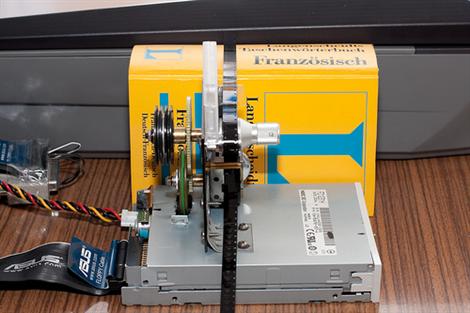
We like a good flight simulator but often find the available control schemes lacking. [Roland] not only builds his own controls, but creates full cockpits that add physical motion to the mix. He completed his third generation cockpit last year.  It’s pictured above as well as in video after the break. That design uses a belt system to move the tricked out cockpit.

Now he’s started work on prototypes for generation IV. This time he’s using three Sarrus linkages to replace the belt system.  We saw these linkages yesterday in an extruder prototype and if they can handle the load they should work well for this application. Video of the prototype is embedded after the break but be warned, the lewd thrusting motions are not for the faint-of-heart. Continue reading “Four Generations Of Motion Simulators”

2600 Game Jukebox

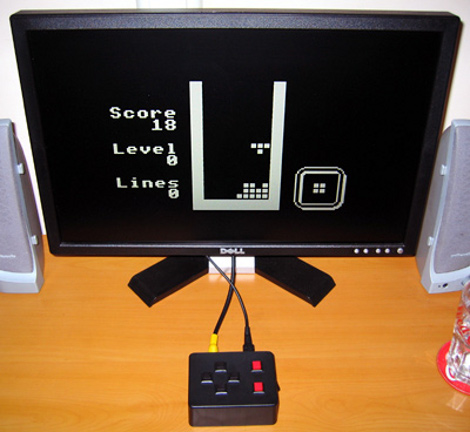
[Yuppicide] sent us a link to a photo album of an Atari 2600 modified to play ROMs stored inside. We did some digging around and have an idea of what’s going on. It seems that the creator, [Victor] has taken his Atari 2600 cartridge emulator one step further.

Previously, he had replaced the chip in an Atari cartridge with an EEPROM that he could reprogram via a ribbon cable. This new iteration places that EEPROM inside the case of the gaming console along with a PIC development board. The PIC board interfaces an SD card with somewhere around 1200 ROMs on it. Three switches added to the front of the Atari allow the user to cycle through available games and flash the desired title to the EEPROM. As you can see, a 2×16 LCD display now resides in the cartridge opening.

This seems a little more eloquent (and less legal) than the Super Genintari.

[techknott]’s Portable Dreamcast

[youtube=http://www.youtube.com/watch?v=FOZvlEOZaCg]

[Sydney] sent in this fantastic portable Dreamcast, built by [techknott], in response to the one we posted yesterday. While we agree, this one is much more polished, we want to point out why the post yesterday is more Hack A Day material. Sure, it looks more “hackish”, but that’s not what we are referring to. What we want to draw your attention to, is the lack of information. Yesterday, there was a build log. Today, there is not. Sure the other one could have had much much more information and we’re not commenting on which one is “better”. We’re just reminding you to please please please document your projects. Oh, and also, this thing is awesome.

Scan Room, Explore Virtually

[Patrick] directed us to his project for alternate realism. The final goal is to be able to walk around in a space wearing a head mounted display, exploring a virtual representation of that space. This virtual representation could be altered, stylized, augmented and modified in countless ways. It is an exploration in perception, similar to enjoying different styles of painting, we could enjoy different styles of viewing a real space. Currently, it isn’t quite real time. He has to scan a room with a somewhat bulky device, then plug into his display to explore it. Being able to scan quickly and reliably enough shouldn’t be far off. [Patrick] notes that others have done almost real time scans at home already.

IntoDream, The ‘portable’ Dreamcast

What looks like an absolute mess of wires,5 fans,3 batteries, and other miscellaneous equipment squeezed into a Tupperware box on the left? At first we didn’t believe it, but it is actually [John’s] fully functioning slick-looking portable Dreamcast on the right. The system runs Quake 3 for a little over 2 hours, not too bad considering it is also powering a VMU, rumble pad, 5 inch LCD screen, and did we mention 5 fans! All in all, it’s still smaller than the original Xbox controller, and we like that one of the greatest consoles is getting some well deserved respect. Check out the work log and a video of it functioning after the break. Continue reading “IntoDream, The ‘portable’ Dreamcast”

Make Your Own 3d Monitor

[youtube=http://www.youtube.com/watch?v=NektsV1EOic]

Don’t let this cruddy video fool you. [Sprite_tm] has done an amazing job here. He has put together a fairly simple way of creating your own 3d monitor at home. The basic principle is easy to get. You have to supply different angles of an object, on the screen, at the same time. [Sprite_tm] has done this by using transparency sheets, printed with a pattern to only show specific pixels. As you move your head, you see a different set of pixels, and therefore a different image. It’s simple, but it works. The system isn’t really new. Traditional 3d with polarized glasses uses a very similar setup. This system however seems like it is lacking in stereoscopic view however. When you move your head, you’re looking at a different angle, but still a 2d image of it. It would be really cool if he could somehow present each eye a different view, without polarizing filters and glasses. We’ve seen others do that with multiple screens, but that gets so clunky and can give most people a headache pretty quick. We also think we are about to see a flood of face tracking perspective modification, especially with project Natal and similar technology emerging.