Open Source SwitchMote Promises Easy Home Automation

[Felix Rusu] is fast becoming a big name in home automation with his clever Moteino systems. His latest is called the SwitchMote which is a super easy way to upgrade your light switches for home automation, and he’s just released the source!

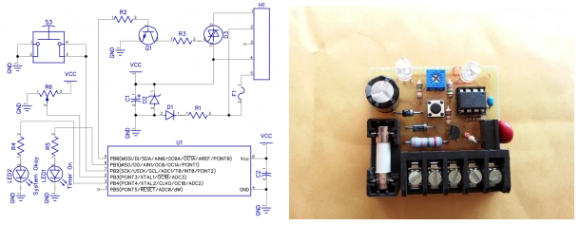
The SwitchMote is a drop in wireless light switch which lets you control a standard AC load, limited to 100W at this time. It uses a solid state relay (SSR) to perform the switching, but like any project involving mains electricity… MAKE SURE YOU KNOW WHAT YOU’RE DOING!

It makes use of a Moteino (duh) which is a wireless Arduino clone that operates over RF. We’ve seen it used before to control a Keurig coffee maker, operate a garage door over the internet, and even text you when your sump pump fails and your basement is about to flood!

Excited? Take a look at his GitHub repository, and check out how it works in the following video.

Continue reading “Open Source SwitchMote Promises Easy Home Automation”

We Asked For It — An Arduino Bowel Gauge

toilet

Well, we asked for it, and [TV Miller] delivered this hilarious and surprisingly accurate bowel gauge.

Between our recent Wiping Your Bum with an Arduino feature and how to Measure Poop for a Better Sanitation Service, we guess we should have seen this coming. And you know what? It’s pretty awesome.

He’s using an Arduino Uno with a home-made resistance sensor to “hack our bowels”. After all, how can you have a proper diet without knowing exactly what is coming out of you? Two copper or aluminum strips make up the resistance sensor with a few known resistors, a capacitor and a potentiometer for adjustment. He’s even included an LCD display as well so you can see the volume of your excrement in real-time! Classy.

To see it in action (don’t worry, not that kind of action) stick around for the following video:

Continue reading “We Asked For It — An Arduino Bowel Gauge”

Clever Use Of PVC To Make A Standing Desk At Work

IMG_3452

[Daniel] and his coworker [Chris] were interested in the concept of standing desks — unfortunately, the company wasn’t about to buy them a new desk to test it out — so they decided to modify the tables themselves!

The IKEA tables they are using have three adjustable legs — just not that adjustable for standing. The challenge was to modify these tables in such a way that it can easily be reversed — they didn’t want the facilities department to get mad at them! Originally they wanted to use steel legs for structural stability, but discovered they’d have to do quite a bit of modification to the steel tubing with tools they didn’t have. So they chose PVC instead.

[Chris] had remembered seeing a hack here on heating up PVC pipe to make it malleable — try as we might we weren’t able to find what he was referring to, but a quick search on YouTube brings up lots of tutorials on how to do it.

Continue reading “Clever Use Of PVC To Make A Standing Desk At Work”

Hacking Window Blinds To Interface With Home Automation System

dscn0248

Home automation is great, but what happens when you start mixing different systems around the house together? Follow [Bithead’s] journey of interfacing with his motorized blinds!

After having his original blinds fall apart many times, [Bithead] and his wife decided to invest in some new, motorized blinds — but [Bithead] wanted to add it to his home automation setup… Unfortunately, commercial offerings for that are very expensive, so [Bithead] knew he’d have to figure out how to interface with the system manually.

The problem is, companies don’t typically advertise the kind of in depth information us hackers would love to know about products, so [Bithead] started checking out store showrooms. Salespeople didn’t quite understand his focused attention on the control boxes!

Continue reading “Hacking Window Blinds To Interface With Home Automation System”

Hanging Table Makes Room For Activities

F2N02EOHS18CAZE.MEDIUM

[Matt Silver] usually enjoys a cup of tea in the evening. Unfortunately, this habit can be frustrating and dangerous while sitting in bed. He rectified the problem by building this awesome space-saving table, which can be stored on the ceiling of all places! Depending on the supplies you might already have, this could be a relatively cheap build of about $40 or less. [Matt’s] using pine board for everything, but notes you could save time and money by re-purposing an existing coffee table. You will, however, need to make the ceiling frame to support it.

At the heart of this build is our favorite rope—Paracord 550. [Matt] used a single piece to tie the whole thing together, which can cause the table to lower crooked, but [Matt] found he can keep it level by putting a hand on it while it descends. You also get mechanical advantage from the pulleys this way! If you’re not crazy about the potential unevenness, you could redesign the pulley and eyelet layout to allow for four ropes to ensure a reliably horizontal surface.

Why not pair this idea with the portable electronics lab we shared a few days ago? You could have a full series of drop-down tool labs in your workshop. Think of all the space saving opportunities!

Woodhouse Controls Your House, Avoids Danger Zone

woodhouse

[Pat] may not be the world’s most dangerous secret agent, but he does have Woodhouse taking care of his home. [Pat] has been upgrading his sonic screwdriver home automation system these past few months. Waking up to a chilly room led him to start hacking a thermostat interface. [Pat] found that his furnace only needed one 24VAC wire to be shorted to a common during a call for heat. [Pat] was lucky in that his thermostat was low voltage. While researching a thermostat hack, we made the painful discovery that our thermostat is 120VAC, so watch for that if you try this one at home.

[Pat] connected his thermostat leads to a relay controlled by a Raspberry Pi. The Pi would read a temperature sensor and set the relay accordingly. That was fine for a quick hack, but opening an SSH window to change the temperature isn’t the most convenient thing in the world. Enter an old Asus Transformer Prime tablet. [Pat] coded up an Android Holo style interface using AJAX along with HTML/CSS/jQuery and PHP. OpenMic+ constantly listens for voice commands, and fires them off to Tasker tasks as needed. He calls the results Woodhouse, and the interface is very slick. The tablet controls and graphs temperature, [Pat’s] media center, and his lights. Woodhouse is even [Pat’s] right hand man when getting ready for those intimate moments. We can’t wait to see what [Pat] comes up with next.

Continue reading “Woodhouse Controls Your House, Avoids Danger Zone”

Confuse The Birds With This Daylight Simulation System

F7WW1DAHQP02H5D.LARGE

Hackers love a challenge. So when [Patrick’s] father-in-law asked him to look into a daylight simulation system for his bird breeding cages, [Patrick] quickly discovered the ridiculous prices for commercial systems… so he convinced his father-in-law to let him design and build one instead.

Like any project, [Patrick] quickly listed the requirements of the system before starting anything.

  • It must brighten gradually in the morning
  • Stay constant throughout the day
  • Dim in the evening to a very low intensity

In addition to this, the lighting transition should be smooth, and the lights cannot flicker, as this can be stressful for the birds — oh, and it needs to be reliable.

To build the system, [Patrick] has chosen an Arduino Duemillenova, an RTC, a small LCD screen, some cheap LEDs from eBay and a handful of N-channel NPN transistors to provide the PWM for the LEDs. The entire system cost less than $100 — a much cheaper alternative to commercial systems.

We think the system looks great, but as a big fan of the Hack a Day community, [Patrick] would love to hear your feedback!