Automatic Water For Your Pets

If you have livestock or outdoor pets you know how important it is to keep them watered, but also know that sometimes you are not around when the trough runs dry. [Buddy] solves this inconvenience with a trip to the hardware store and some creativity.

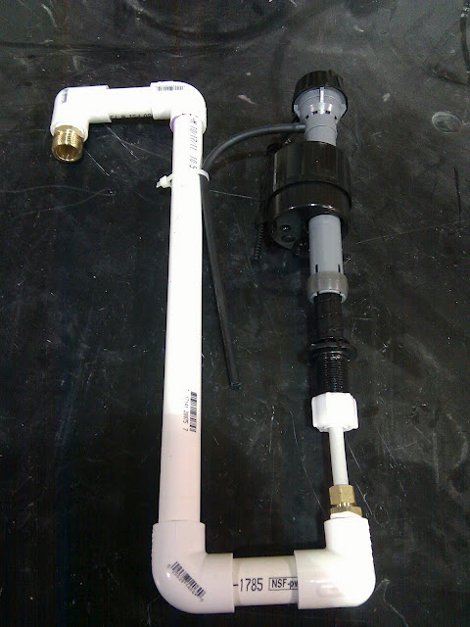
The automatic water filler is made from some PVC pipe, brass fittings, a faucet supply and a toilet float valve. The PVC is arranged into a hook shape, a fitting is put on one end for a standard garden hose. On the other end a bit of adapting is needed to convert the PVC into a faucet supply, where the toilet valve is hooked up. Now whenever your thirsty beasts get the water too low, the float lowers and tops off the watering hole with fresh H20. That sure beats running out there every day to make sure, especially with summer just around the bend.

Hidden Bookshelf Switch

So you don’t have any secret passageways in your house, but if you’ve got a bookshelf this secret switch can add some fun to your routine. [Brandon] saw a commercially available version which was out of stock when he went to order so he set out to build his own.

He’s using the switch to operate a lamp. The donor part for the hack is a lamp dimmer which you’ll find at the big box store. This is really just a pass-through wall plug with an extension cord. By cutting the dimmer module off of the extension a push button can be used to connect and disconnect one of the conductors in the line. Make sure you use a push button rated or mains voltage!

To make the push switch work with a book [Brandon] bend a bracket which will slide into the spine of a hardcover. We love his homemade press brake (angle iron, a sturdy hinge, and a chunk of 2×4) used when shaping the bracket. Once everything’s in place nobody will ever know there’s anything special about those books.

Bringing The Stars To Your Baby

[Zach] saw a stuffed animal that projected some simple stars on the ceiling. This gave him an idea that he could build a tiny star projector for his 3 month old daughter’s room.  The idea is to put an LED inside a ping pong ball with tiny holes and rotate it slowly.

The electronics are fairly strait forward. He’s using an MSP430 to control the servo and LED, allowing him to set different speeds and turn the whole thing off after a certain amount of time.  The ball took a little bit of trial and error though. He first started by drilling some holes, but found this to give poor results. The holes were just too big. He finally ended up heating up a  sewing needle and melting tiny holes in the ping pong ball. That worked perfect.

After the break you can see a video of it moving. The servo is pretty loud, which might actually be a good distraction for a 3month old, but might be something to address in the future.

Continue reading “Bringing The Stars To Your Baby”

Arduino Lawn Care Is Web-controlled

[Joe Fernandez] is fairly new to the hardware side of the hobby, but he seems to have easily found his way on this project. He wanted to build his own web-bridge for his Toro lawn sprinkler system. He pulled it off with style and shows off the spoils of his work in the clip after the break.

He started with an Android ADK, crafting some web magic to use a REST interface and JSON packets as a communications scheme. This makes it possible to control the system from anywhere as long as you have an Internet connection. The rest of the hardware evolved as his needs became clear. The first hunk was to add an Ethernet shield so that he didn’t need to have his Android phone connected to the system for it to work. From there he needed to control the solenoid valves on the system and grabbed three relay shields from Seeed Studios for this purpose.

As you can see, all of that hardware has a home on a polyethylene cutting board. The terminal blocks at the bottom keep the connections nice and neat as they interface with the sprinkler system. We were happy to hear that the stock controller still works, this add-on doesn’t permanently alter it in any way. That’s going to be important if he ever wants to sell the home.

Still using a traditional sprinkler instead of an in-ground system? Perhaps this variable range hack is for you.

Connecting A Dumb Scale To Your Smartphone

[Casainho] wanted to track his body weight using an app on his Android phone. He just needed a way to get the weight readings onto the device automatically. He ended up adding Bluetooth to a bathroom scale and hacking the app to grab data from it.

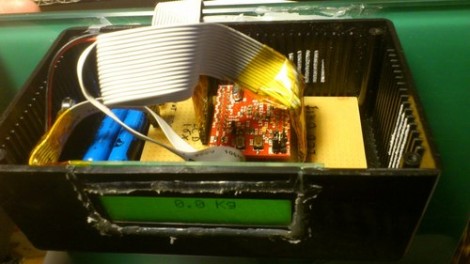
The scale which he hacked is a digital model, which makes it possible to read the weight data if you know what you’re doing. [Casainho] already completed a weight logging scale hack which stored the data on an SD card. So this was a recreation of that project but with a Bluetooth module for the output rather than the card for storage.

Now you can buy WiFi enabled scales, but that’s not nearly as fun as a hack like this. Plus one of those will cost you around $200 and the hardware for this version came it at only $75. It includes an LPC2103 dev board, $6 Bluetooth module, character display, batteries, and misc. supplies. The software end of the hack was helped greatly by the fact that the Android apps which [Casainho] is using are both open source.

Beer Mini-kegs Turned Into A Cyclonic Dust Collector

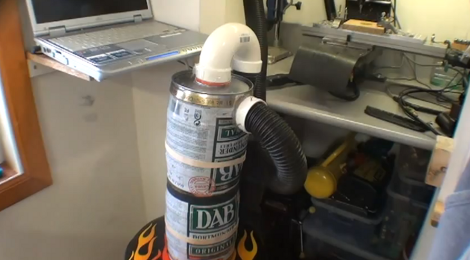
[Darrell] made his own cyclonic dust separator which connects to a shop vac. We’re amused by his poke at Dyson’s marketing machine where he mentions that the ads say it took years to perfect those vacuum cleaners and he managed to put his together in a few hours…. from trash/recyclables no less!

Two mini-kegs are used as the separating vessel. The only other parts are some PVC plumbing fittings which help to direct the air and give him a way to attach the collector to the shop vac. The top keg is where all of the magic happens. Air and debris is sucked in through the hose coming in the side wall. A 45 degree elbow directs it downward and to the side, which starts the cyclonic action. The shop vac is attached to the tube in the top, with a cylinder extending into the keg. The spinning air must make a sharp turn to get into that cylinder; it’s at this point the debris drops out into the lower keg. See for yourself in the clip after the break.

This isn’t the first time we’ve seen dust collectors that use this concept. [Darrell] pointed out this one made out of plastic cups, and this other made from a 5-gallon bucket.

Continue reading “Beer Mini-kegs Turned Into A Cyclonic Dust Collector”

Reverse Engineering An AC Signal Protocol

[Arpad] has spent quite a bit of time reverse-engineering a home automation system, and, as he is quick to point out, presents the information learned for informational purposes only. He’s really done his homework (and documented it well), looking into the US patent application, and figuring out how the protocol works.

If you’re wondering how someone is able to send a signal over an AC sine wave, at least one technique is the proprietary [Universal Powerline Bus]. This works by sending precisely times pulses in conjunction with the wave that would exist normally. Given the correct software on the other end, this can then be decoded and used for whatever data transfer is necessary.

Although as engineers and technologists, we certainly don’t condone stealing patents,  part of point of one is that others are allowed to learn your secrets in exchange for some legal protection. [Arpad]’s motivation in doing this is that the technology is only widely available in the US with our puny 120 VAC 60Hz power. With this knowledge, he’s been able to transfer it to work with European 230 VAC 50Hz.

Continue reading “Reverse Engineering An AC Signal Protocol”