8x8x8 LED Cube And The Board That Drives It

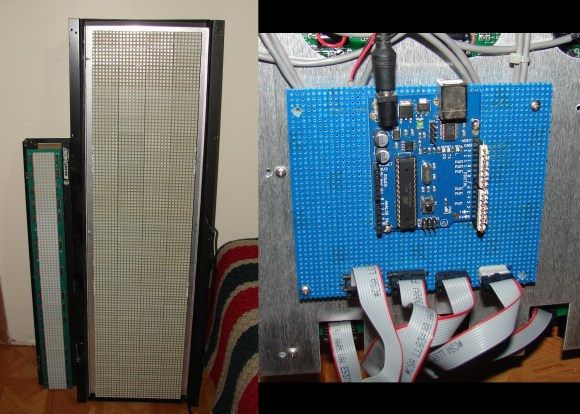
Check out the LED cube which [Thomas], [Max], and [Felix] put together. But don’t forget to look at that beautiful PCB which drives it… nice! But hardware is only part of what goes into a project like this one. After the soldering iron had cooled they kept going and wrote their own software to generate patterns for the three-dimensional display.

Looking at a clean build like this one doesn’t drive home the amount of connections one has to make to get everything running. To appreciate it you should take a look at this other 512 LED cube which has its wires showing. You can see from the schematic (available in the project repository) that all of these lines are managed by a series of shift registers. The board itself connects to a computer from which it gets the visualization commands. A Java program they call CubeControl can push letters or turn the cube into a VU meter.

The team built at least two of these. This smaller version uses red LEDs, while the larger one shown in the video after the break has blue ones.

Continue reading “8x8x8 LED Cube And The Board That Drives It”

One Dimensional PONG, Take Two

Needing a Christmas present for his 4- and 5-year-old nieces, [John] built a one-dimensional PONG game, sure to be the delight of rosy-cheeked children on a Christmas morn.

The new and improved 1D PONG game is built around a digital RGB LED strip with an LPD8806 LED controller. The speed of the ‘ball’ is controlled by a pot on one side of the game. With each player pressing their button at the right time, the ball bounces back to the other player. Missing the ball awards a point to the other team and most likely an increase in the player’s frustration, greatly increasing the risk of this game being thrown across the room.

While it’s not an obscenely long 1D PONG game like [Jason]’s previous 5 meter version, it’s more than enough to keep a pair of kids occupied for more than a few minutes, a remarkable achievement for just a microcontroller, buttons, and a piece of LED strip.

You can get [John]’s AVR code in this pastebin or just check out the video after the break.

Continue reading “One Dimensional PONG, Take Two”

POV Wheels For A Longboard

If you don’t mind working with really small components this POV wheel project for a longboard will certainly attract some attention.

The name of the game here is small and cheap. Small because the wheels are only 72mm in diameter (about 2.8 inches). Cheap because [Ch00f] wants to produce and sell them locally. He went with an ATtiny24 microcontroller driving fifteen LEDs. Obviously this will present a problem as the uC uses a 14-pin SOIC package and that’s just not enough I/O to drive the LEDs individually. Add to that the issue of storing patterns to be displayed and you start to run out of program memory very quickly.

But obvious he pulled it off. The image above shows the wheel displaying the CT logo (for ch00ftech.com) and there are several other patterns shown off in the clip after the break. The LEDs are multiplexed, but the wheel spins fast enough that this turns out to be okay. The rotation is measured by an IR reflectance sensor aimed at the stationary axle. A CR2032 powers the device, with some counterweights added to keep the wheel balanced.

Our only concern is the fragility of the exposed electronics. But if you hit the right BOM price we guess you can just replace the board as needed.

Continue reading “POV Wheels For A Longboard”

Roomba And Virtual Walls Make Up This Theme Family Halloween Costume

It figures. You spend a ton of time making a cool set of costumes and then you can’t get your kid to pose for a picture. It’s okay though, we still get the point. This themed set of costumes dresses the little one as a Roomba vacuuming robot while mom and dad are suited up as virtual walls (modules that are used to keep the bot from falling down stairs, etc.). It’s fun and unique, but had it not been for some additional electronics this would have been relegated to a links post. For safety sake each costume was outfitted with a ring of LEDs. As a challenge, the lights were given the ability to sync up patterns with each other.

Each costume has a circular frame at the top with a set of RGB LED strings attached. To get them to display synchronized patterns an IR transmitter/receiver board was designed and ordered from OSHPark. Each costume has four of these modules so no matter where the wearers are facing it should not break communications. A demo of the synchronized light rings can be seen after the break

Continue reading “Roomba And Virtual Walls Make Up This Theme Family Halloween Costume”

Birthday Badges Teach Kids How To Solder

[Ian Lee, Sr] wanted to have an educational activity at his younger son’s birthday party. These were uncharted waters for him as he doesn’t remember education taking place at his own early birthday parties. But he came up with a great idea, with was to teach soldering using interactive badges which each guest could assemble themselves. He needed about twenty, so he tried to keep the BOM as small as possible. But that didn’t mean skimping on features.

You can see the black LED-type package on the left of the assembled badge above. This is an IR receiver whose counterpart transmitter is on the right side of the board. When two of these get within 6-8″ of each other the start talking back and forth. There is no microcontroller involved, instead the system relies on a multivibrator design. One of the red LEDs at the corner of the ‘smile’ is always blinking. When it is off, the IR transmitter is powered. This is picked up by another badge’s receiver, which lights the second ‘smile’ LED. You can see this happen in the short clip after the break.

Although there are relatively few components that went into this, it would take the kids a long time to put them together as they’re just learning. [Ian] and his eldest son soldered on all of the components except for the resistors beforehand.

Continue reading “Birthday Badges Teach Kids How To Solder”

The Band’s Name In Lights, RGB LEDs To Be Exact.

A few of [michu]’s friends formed a band named Kalikut Now and needed an awesome stage show. The band made a few 80cm-high letters of their band name, cut a few pieces of acrylic, and wired them up with a few LED modules. The work of connecting these letters to a computer and programming them fell on [michu], and we’ve got to say he did a pretty good job.

You may remember [michu] from his StripInvaders and PixelInvaders projects, basically a few RGB LED modules that can communicate with an Arduino over an SPI interface. With these huge letters, [michu] ran into a problem: he had 11 meters of cabling between the clock and data lines, far beyond the maximum recommended length for any datasheet.

[michu] looked around the Internet for common problems with SPI interfaces and found a lot of good advice from a lot of very smart people. The issue with the SPI bus was eventually solved by correctly wiring the grounds of his LED modules, building a few dead-simple SPI buffers, and reducing the clock speed of the SPI bus.

After countless hours, the band’s name is in lights, and RGB LEDs to boot. Everything can be controlled with Abelton Live, and looks absolutely fantastic as seen in the video after the break.

Continue reading “The Band’s Name In Lights, RGB LEDs To Be Exact.”

Nyan Cat Built Into The Wall Of A House

You’re going to need your best negotiating skills if you want to convince your significant other to let you add your own Nyan Cat to the kids’ room. This goes a bit deeper than just mounting something on the wall. The LEDs which light up this Nyan Cat installation are actually in the wallboard itself.

Luckily, this is actually a ‘playground for grown-up kids’. [Schinken] and his fellow hackerspace members built it at their location in Bamberg, Germany. It started as a Nyan Cat scarf, which was easy enough to hang on the wall. To make it sparkle they added sixteen LEDs. But you won’t see the wires from either side. A hole was drilled at the location of each diode, with a trench chiseled between them. This makes room for the wires, and was covered with spackle before painting. It turned out to be a pretty simple way to add a focal point to the room, and it certainly has the appropriate level of geekiness for a hackerspace.