[Ian] Shops Akihabara

Hackaday alum and Dangerous Prototypes founder [Ian Lesnet] is in Japan and he’s been spending a lot of time at Akihabara Electric Town. For those that don’t recognize the name, this is an electronic components extravaganza with buildings packed full of small shops each specializing in different merchandise. For instance, we love this picture of a shop that carries every kind of protoboard, breakout board, and copper clad sheet imaginable. The stall next door might have nothing but LEDs, or be full of cords for every purpose.

We’ve been following [Ian’s] regular tweets about the trip. Luckily, he just posted a roundup of the Akihabara posts. Surprisingly, he restrained himself to purchasing just a few items. Part of this is a limit on the amount of stuff he can get back to the States with him. The other reason is that the prices are not necessarily less than you’d find in a catalog. He mentions that the nice thing is you can see the parts before buying them. This is useful for sizing knobs, transformers, cases, etc.

The most exciting thing in his bag is a half-dozen nixie-like VFD tubes for just $12. How much would you give to have this shopping attraction down the street from you?

If you’re interested in a video tour of Akihabara check out this one from the Tokyo Hackerspace.

[via @dangerousproto]

Scam-o-Matic Determines If You Bought Fake SD Cards

[Andrew] recently got scammed on an SD card purchase and put together a small tool that can help you determine if you’ve had the wool pulled over your eyes as well.

You see, he purchased a set of MicroSD cards, all of which had an advertised capacity of 4GiB. When he tried to use them, they all failed to write more than about 115MiB of data, so he knew something was up. He sat down with some tools that can be used to check the actual capacity of flash media, but he says they were unbelievably slow to scan the cards.

While he waited for one of the scans to complete, he decided to create a utility of his own that would do the same thing in a fraction of the time. His quick and dirty application, called “Scam-o-Matic”, writes random data to the card, double-checking the written region to ensure that data can be read back. If it finds errors your card is likely either a fake or damaged, but if not, it automatically prepares the media for use.

Obviously this sort of situation is relatively rare, but if you think that you have picked up some shady SD cards, be sure to check out [Andrew’s] Github repository.

Programming The 6502 One Nibble At A Time

[Quinn Dunki] keeps rolling with her 6502 based computer build. This time around she’s added some memory to store the programs, but needed a way to get that code into the device. Above is her solution, a bank of hex switches used to program the 8-bit command and 16-bit address for each line of machine code.

This is a continuation of her Veronica project. The last time we saw it she had hardwired the logic levels for the data bus, but that’s no fun since nothing can actually be computed. [Quinn] picked up an SRAM chip which will store the program. It’s compatible with the 6502’s memory bus, but needs a bit of extra circuitry for her to be able to hand program it with this switch bank. She used some tri-state buffers to switch between connections to the processor, and to the hex switches. This way, she disconnects the RAM from the processor using the buffers, uses the switches and push button to clock in the program, then patches the RAM back into the computer.

Seeing this process in the video after the break certainly gives you an appreciation for what an improvement the punch-card system was over this technique. Still, seeing this is a delight that we’d like to try! Continue reading “Programming The 6502 One Nibble At A Time”

I2C Level Converter

You’ve got several devices which communicate via the I2C protocol, but some of them can only operate at 3.3V while the rest are hungry for a 5V connection. What to do? [Linux-works] built this I2C level converter to solve the problem.

The circuit comes from an NXP app note (PDF) on the issue. You can take a quick peek at the suggested schematic from that document. The design uses two MOSFETS for each side of the adaptor. Perhaps a better way to explain this is that you need one for the higher voltage and one for the lower voltage on each of the two data lines for a total of four parts. This allows for both of the buses to communicate as one, while still having their own 3.3V and 5V pull-up resistors.

[Linux-works] concedes that there are chips designed to do this for you, but he was able to source the BSS138 MOSFETs locally and for about ten cents a piece. Not a bad alternative to putting in a parts order.

Periodic Table Of Swearing Would Even Make A Sailor Blush

periodic-table-of-swearing

If you often find yourself at a loss for words in the heat of an argument, perhaps this Periodic Table of Swearing is something you might be interested in. Built as a marketing tool for the British comic “Modern Toss”, the table features over 100 fruit machine (slot machine) buttons, each of which triggers an audio clip of the cheeky word or phrase listed.

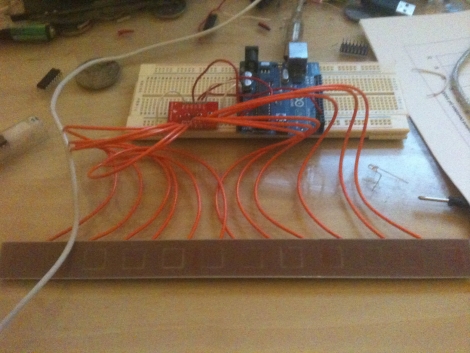
The buttons were mounted on a piece of laser-cut MDF which makes up the table’s surface, while all of the wiring and the guts of the machine are neatly tucked away underneath. Clay, the company that actually built the table, doesn’t elaborate a whole heck of a lot on the details other than stating that it includes over 100 meters of wiring, 300 solder joints, and a whole lot of swearing. We imagine it could likely be replicated with a small micro, an SD card reader, and a couple of speakers – for anyone interested in having one of their own.

While it’s not a hack in the strictest sense, we’re sure it’s a great conversation starter ender, and we did get a chuckle out of the demo video below (Warning: Language).

[Thanks, Jack]

Continue reading “Periodic Table Of Swearing Would Even Make A Sailor Blush”

Physical Computing Just Got A Lot Easier

Putting microcontrollers in everything and tying appliances into the internet has become the DIYers’ bread and butter. There’s a ton of benefits from an Internet-enabled coffee maker, but actually building these projects takes a little bit of knowledge. Enter [Dave] and [John] with Twine – a little Internet enabled box that connects physical reality to the digital world.

The hardware inside a Twine is a small board that combines WiFi, an accelerometer and temperature sensor. The Twine is programmed ‘in the cloud’ with a simple if/then condition. A Twine will send you a text, email or tweet when the condition is met. For example, you could put a Twine on a door and program the accelerometer to text you when someone comes knocking.

Twine isn’t an entirely closed system; there’s a plug for additional sensors (moisture detection, for example), and the data from sensors can be pushed out to a server. You can pick up a twine for $100 from the Kickstarter; it’s a little rich for our blood, but we’re sure it’ll be a useful device.

Exterior-grade Electrical Box As Project Enclosure

The quest for a project box is always a balance between cost, complexity, and style. We think [Pcmofo] really finds the mark with his exterior electrical box enclosures. He took the time to document his fabrication process for those that want to replicate his look.

These grey plastic boxes are meant to keep the elements away from home and commercial electrical systems. They’re easy to find and come in many different sizes (this one is 8″ square and 4″ deep). The plastic is very rigid, but still easy enough to work with simple tools.

[Pcmofo] starts by eyeballing the placement of his components. Once he has a good idea of where each should be located he grabs a caliper and uses Adobe Illustrator or Inkscape to design a template. This is attached with painter’s tape, and rough openings are made using a drill press. The holes are brought to the final size by hand using files for a nice finished edge. When it comes time to mount hardware, the plastic is strong enough to hold threads if you are careful when using the tap to cut them.

The example enclosure houses a temperature controller for fermenting beer. You can see some video of the enclosure embedded after the break.

Continue reading “Exterior-grade Electrical Box As Project Enclosure”