Analog Test Interface For Your Computer

Wanting to test the response curves on some analog parts, [Don Sauer] devised a way of using simple tools to graph analog tests on a computer. Here you can see the results of testing NPN, PNP, NMOS and PMOS transistors, but modifying the input circuitry would let you test just about anything you want.

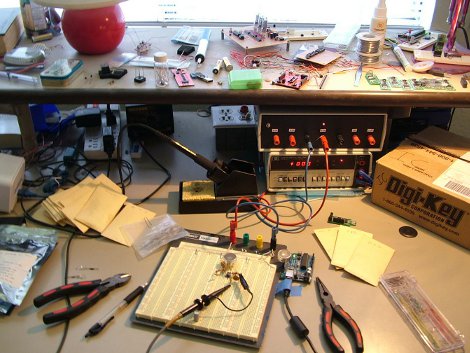
[Don] is using an Arduino as the hardware interface. He needed some additional parts, like an op-amp and some passives. Instead of building this on a breadboard, he printed the circuit out on a piece of cardboard, hot glued the components in place, then wired them up. This will let him reuse the interface in the future, but is quicker than designing and etching a PCB.

He uses a Processing sketch to capture the test data streaming in from the Arduino. Once recorded, he uses SciLab to create the graphs. He also covers a method of sifting through the data using Octave, another open source program that feels somewhat like MATLAB.

A CD Changer Made Of Wood

Although this is by no means a new hack – it was made circe 2002 – this wooden CD changer is an interesting piece of machinery. The whole thing is a simple pick-and-place device. The gripper is brilliant in it’s simplicity, using only a rubber band, wood, and a solenoid. It grips the CD by the middle hole, picks it up, and the assembly then travels to the CD tray or the stack. Everything works with DC motors and string, and several micro-switches make sure everything is picked up and dropped in the correct position.

Although we may think this is a pretty cool device, [Matthias] is quite humble about his machine’s abilities. In his estimation, although one could probably duplicate 12 CDs with relative ease, if you really wanted to duplicate a large number, it’d be best to buy one. Maybe he works in manufacturing.

Continue reading “A CD Changer Made Of Wood”

Easy To Use Automatic QR Code Generator

custom_qr_code_generator

Love them or hate them, plenty of people around the world use QR codes on a daily basis. Since he thinks they’re pretty great, Hackaday reader [falldeaf] thought it would be cool to put together an automatic QR code generator to be used on web sites.

Inspired by the custom QR logo embedding work done by our own [Brian Benchoff], his dynamic QR code generator allows you to do the same thing, but with far less work. The code requires that you have PHP and the GD library installed on your server, but other than that his code does the rest.

All you need to do is call up the page and pass along a URL, optional caption text, optional image overlay (to add your logo to the center of the code), as well as an optional hash code for tracking traffic sources. The page spits out a png image that can be used on its own, or embedded in a blog, which is what [falldeaf] plans on using it for.

If QR codes are your thing, be sure to grab a copy of his code, it will certainly be a handy tool to have around.

Contest Entry Roulette

Over 150 projects made from scrap parts (translated) have been posted for your viewing pleasure. They make up the entries in the “Make fast the scrap” project from c’t magazine. We already looked in on a toilet paper printer, but there’s a ton of other fun stuff to look at as well.

Every time you load the link at the top, the page picks a different set of entries to display. You can click through all the pages, or reload to play a little project roulette. The image above shows three that caught our eye. To the upper right is a lighbulb-man riding an old computer mouse reverse-cowgirl style. Quirky, but anyone who has access to an electroplating setup can get away with making simple objects like this into awesome desktop sculptures.

Moving clockwise we have a tiny USB drive mated with an old vacuum tube. The machine translation is a bit rough, but it looks like the LED from the thumb drive gives the tube a bit of a red glow. We just think it’s interesting to carry around a vacuum tube with you.

The final banner image shows a gyroscope for a camcorder. This is an awesome setup, which you can see in action after the break. A pair of broken hard drives provide motion stabilization for a camera. The entire assembly has a handle on the top with a universal joint. When the drives are spinning, the platform holds very still, even if the operator is swinging the unit around wildly.

Continue reading “Contest Entry Roulette”

Vintage Camera Retrofit Perfect For Trolling Strangers

vintage_camera_retrofit

[John] likes making things out of unusual junk, and decided to build something for the sole purpose of trolling others. He thought it would be funny to stuff a new digital camera into the body of an old, obsolete camera, just to see how people would react to it.

He considered several different cameras, including a bulky old Polaroid, eventually settling on a far more manageable Argus C3. The camera wasn’t quite big enough to fit his new digicam inside, so he built a mock body using black micarta. He attached the Argus’ front and back to his plastic box, then spent some time fitting his digital camera inside. He transferred knobs from the original camera to his new false body, adding to the authenticity, before taking it out for some test shots.

You can see the final result above, and we think you would be hard pressed to notice that there’s something amiss with his camera unless you spent some time taking a closer look at it. He says that it works well for the most part, and it’s definitely a conversation starter. People are always puzzled by the fact that he is using such and old camera, and doubly so when he tells them it can take about 4,000 shots before he has to “develop” his pictures.

Slick Music Synchronized Light Show Uses UV LEDs And Water

music_synchronized_light_show

[mike6789k] wanted to spice up his dorm room, so he built a cool music synchronized light show that struck us as being very well thought out. We have seen similar music-based visualizations before, but they tend to be pretty basic, relying on volume more than actual audio frequencies to trigger the lighting.

[mike6789k] didn’t want to build “just another” synchronized light show, and his all-analog approach gives a true representation of the music being played instead of just flashing lights along with the beat. Using a trio of simple filters, he broke the audio signals down into three distinct frequency bands before being driven through a high gain transistor to power a set of LEDs.

We were pretty impressed at how bright the display was given that he is using UV LEDs, but the 1W diodes seem to have no problem lighting up the place when aimed through the UV-reactive water, as you can see in the video below.

If you’re looking to make something similar for your next party, the folks over at Buildlounge were able to wrangle a schematic out of [mike6789k], which you can find here.

Continue reading “Slick Music Synchronized Light Show Uses UV LEDs And Water”

Simple Hack Reuses An Air Freshener PIR Sensor

pir_sensor_room_greeter

A year ago [Lochie] bought an Airwick automatic air freshener, and while he thought it was a cool gadget, the freshening spray and the novelty ran out in short order. The device collected dust in his room for some a while until he recently unearthed it, and noticed that a perfectly good PIR sensor was looking him in the face all this time.

He disassembled the air freshener, then set out to figure out how he could interface with the PIR sensor. After finding a helpful Instructable on the topic, he had full access to the sensor’s signals, allowing him to easily wire it up to an Arduino. He decided it would be fun to trigger some simple music any time someone entered his room, so he encoded a short bit of the Super Mario Brothers theme in RTTTL, as he explains in the video below.

It’s a simple little hack, but [Lochie] is pleased with it, and we imagine that he likely has a long list of other creative ideas in mind for his newly discovered PIR sensor.

Continue reading “Simple Hack Reuses An Air Freshener PIR Sensor”