cleaning_pcbs

Cleaning Flux From PCBs The Easy Way

While we’re all for building circuits on protoboard or constructing a deadbug circuit for a last minute project, it’s always nice to see a proper PCB now and again. We think that leftover flux can sometimes make even the nicest of circuit boards look a bit dingy, and Hackaday reader [RandomTask] wholeheartedly agrees. He wrote in to share a method he found online that he uses to get his PCBs squeaky clean after soldering.

The secret to his clean PCBs is a product called Poly Clens. It’s essentially a paint brush cleaner that does a great job at removing flux without having to resort to using a brush to scrub it off the board. [RandomTask] simply submerges his newly assembled board in a small container filled with Poly Clens, agitating it for about half a minute or so. After the flux has been removed he rinses it with water, pats it dry, then ensures the board is moisture-free with a few passes of his heat gun.

He says that the entire process takes him less than 5 minutes per board, which is far better than the old alcohol and stiff brush method he used in the past.

What tips or tricks do you have for getting your new projects cleaned up? Be sure to share them with us in the comments.

Mini-cannon Built From A BBQ Lighter Fires Airsoft Pellets

[Nighthawkinlight] has made his own palm cannon to shoot Airsoft pellets. His process, which he guides us through step-by-step in the video after the break, definitely invokes MacGyver buy using commonly available parts in a way they were not intended.

He starts with a barbecue lighter, removing the screws and plastic housing to get at the clear plastic butane reservoir which serves as the body of the cannon. The butane is carefully released from the tank, and the output valve is modified to receive the barrel. In this case the barrel from an old Airsoft gun was used, but a metal pen housing could do the trick as well. The spark igniter from the lighter is also reused, but two bolts have been screwed into the reservoir and are used as probes for the igniter wires. In order to fire this one-shot-wonder, a cotton swab soaked in 90% alcohol is inserted through the bolt on the left side. After inserting an Airsoft pellet the trigger is pulled to ignite the vapors.

Continue reading “Mini-cannon Built From A BBQ Lighter Fires Airsoft Pellets”

Beginner Concepts: Designing Transistor Control Circuits

Need to switch something on or off using a microcontroller? Using a transistor is one of the best ways to do this, but how exactly do you design properly for transistor switching? [Ben Krasnow] put together a tutorial in which he does an excellent job of explaining the ins and outs of designing transistor control circuits.

We’ve embedded his twenty-minute video after the break. In it he talks about the use of transistors, the difference between NPN and PNP transistors, and the design specifics you need to know when working with them. We think that beginners will find [Ben’s] demonstration of how to calculates Hfe, which is the base current necessary to fully switch the transistor. If this is gibberish to you, have no fear. [Ben’s] instruction is clear and easily understandable.

The one thing we missed in the video is clarification about base current protection for PNP transistors. [Ben] mentions that there’s no easy circuitry that can be used on the base of a PNP  to regulate flow from the emitter to the base, but he doesn’t elaborate. Otherwise, it’s everything we could have wanted on the topic.

Continue reading “Beginner Concepts: Designing Transistor Control Circuits”

A Big Transformer, Because It’s Cool!

[Grenadier] Had some spare wire, electrical tape, and a giant ferrite core laying about and decided to create a massive and pretty snappy looking disk shaped flyback transformer. Dubbed the Fryback, he claims that it will “revitalise your health and bring wondrous wealth and prosperity to your family”.

He chose a disk shaped transformer because they look cooler, fair enough.. (oh and they reduced inter-winding capacitance and the voltage difference between layers). The construction is fairly simple, but time consuming. Grenadier goes through the important steps on his website, but be prepared for 25 hours of winding wire if you decide to make your own.

Running at 48V the Fryback can output 8kV at a very high current, producing some nice thick 30cm long sparks. Check out the video after the break to see the Fryback in action.

Continue reading “A Big Transformer, Because It’s Cool!”

OnshouldersTV Knows How To Use OpenSCAD

Recently there’s been a increase in the popularity of OpenSCAD as the tool of choice in the 3d printing community. [Gavilan Steinman] is putting out a series of webTV shorts on the use of OpenSCAD. While it lacks a lot of the features of big CAD suits (such as the ability to generate drawings of your parts), the community has proven it’s effectiveness as a design tool. There are only two episodes out so far but they cover  OpenSCAD, mathcast, 3d printing, and a really neat robot design.  Watch them below.

Continue reading “OnshouldersTV Knows How To Use OpenSCAD”

Trick Mouse Keeps The Screen Saver At Bay

mouse_wiggler

[Jerry] wrote in to share a little device he built to solve a problem he was having at work. You see, every computer in his office has a policy-enforced idle timeout, requiring the user to enter a password in order to regain access to their desktop.

This is a huge pain, since he sporadically uses an old computer for the sole purpose of monitoring some applications running in his data center. With the computer timing out every 10 minutes, he is constantly required to enter his password in order to take a 10 second glance at the screen to ensure everything is OK.

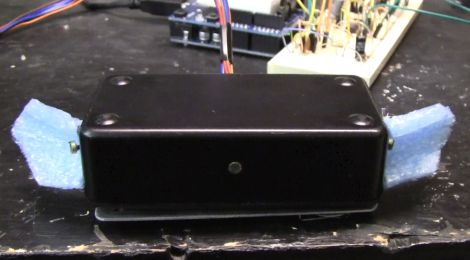
Rather than circumvent the screen saver using a local security policy or by implementing a microcontroller-based signal generator, he opted to create a mechanical solution instead. His computer’s optical mouse resides inside a wooden frame, and is periodically swept from side to side by an ATmega-controlled servo, keeping the screensaver permanently at bay.

Call it a hack, call it a kludge, call it what you will. All we know is that while we might have done it a little differently, it works just fine for [Jerry], and it generates all sorts of interesting conversation to boot.

Stick around for a quick video demonstration of his mouse wiggler box.

Continue reading “Trick Mouse Keeps The Screen Saver At Bay”

Buying, Selling, And Bartering Hacking Hardware

Regular reader [Grenadier] wrote in to let us know about his newly published hacking hardware trading post called The Junkbox. Apparently when he’s not blowing up capacitors or building his own high voltage ones, he makes time to code up a website where you can buy, sell, and barter leftover components.

We have something like this right here at Hackaday. The dollar sign icon along the right column, just underneath the featured posts banner will take you to our classifieds section which at the time of writing had a whopping nine items posts. But these things to ebb and flow. Check in on the newly posted link from time to time to see that number grow.

Whether it’s over at The Junkbox or in our classifieds section, we think the biggest problem is finding what you need when you need it. This is nothing new. If you missed it before, we’ve embedded an older episode of the EEVblog after the break where [Dave Jones] tours Apex Surplus. It’s as if a hacker who has hoarding tendencies bought a store forty years ago and just kept piling more and more merchandise to the sky.

Continue reading “Buying, Selling, And Bartering Hacking Hardware”