Robotic Berimbau Plays Itself

berimbau

If you have ever seen capoeira, you have undoubtedly heard the music of a berimbau. If you are not familiar, Capoeira is a Brazilian art form that melds martial arts, acrobatics, and music. This graceful fighting form is often accompanied by the sounds of a berimbau, a single-stringed musical instrument comprised of a gourd, a wooden bow, and a steel string.

[Ivan Monsão] and [Paulo Libonati] have constructed what is considered to be the first robotic berimbau in existence, capable of playing music without any human interaction. The robot strikes the berimbau’s metal string, mechanically muting the gourd when appropriate, and even shakes the caxixi (a rattle) in time with the music.

The builder claims that the berimbau learns songs by “listening” and repeating rather than having songs pre-programmed into the system. We can’t see any evidence of that functionality from the video, though we’d love to see the learning process in action.

While we try to find our VHS copy of “Only the Strong”, be sure to take a look at the following video of the berimbau playing itself.

[Thanks, Camilo]

Continue reading “Robotic Berimbau Plays Itself”

The ElectroAxé Full-Body Percussion Suit

Carnival in Salvador, Brazil is arguably one of the biggest and craziest parties this world has ever known.  With millions in attendance for what is already an incredible audio and visual display, performers are faced with the daunting task of continually bringing something new and fresh to the masses. One could always add more fireworks or visual displays (never a bad thing), but it will only take you so far. [Kyle McDonald] and [Lucas Werthein]’s answer: The ElectroAxé Full-Body Percussion Suit as demonstrated by Carlinhos Brown at Carnival 2011.

When most people hear the word “axe” as related to music they think of an electric guitar. “Axé” however, refers to a unique Afro-Caribbean fusion genre of music that originated in Salvador in the mid 1980’s and is a favorite at Carnival. [Carlinhos Brown] is a popular Brazilian percussionist and was looking for a creative new way to express himself through his song and dance. Instead of being stuck in one place near his instruments or carrying one or two drums around “marching-band style”, he is now able to move around the stage freely – his body has become his instrument.

In order to make the magic happen, [Kyle] and [Lucas] designed custom laser cut and cnc machined drum pads containing piezo sensors and integrated them with a full-body jump suit. When struck, these sensors send a signal to an Arduino with a Sparkfun Midi Shield housed in a custom enclosure on the performer’s waist. From there the MIDI signal is sent wirelessly and then audio is played through the existing sound system – it appears that a CMD WIDI X-8 wireless MIDI system is employed for the actual wireless transmission.

Although details are somewhat scarce, there are plenty of pictures, (more) available.  You really can’t argue with the results as you watch thousands of people jam along.

Come join in the festivities with video after the break!

Continue reading “The ElectroAxé Full-Body Percussion Suit”

Antique Light Bulb Organ

Add a retro light show to any MIDI instrument with this Antique Light Bulb Organ, twelve 30 watt antique style light bulbs correspond with the 12 notes in an octave with a simple on or off action. The organ is also monitoring the pedals, so the lights will stay on as you use the sustain. Add in the natural slow reaction time of a light bulb and the effect is quite nice.

Along with MIDI instruments , you can also connect to a PC via USB allowing for remote control either with MIDI or OSC. On the hardware end there is a Atmega324P board that handles communication, user input and of course the lights. To switch the 120v AC current required by the lights twelve Sharp PR36MF22NSZF isolated solid state relays were wired up to some screw down light sockets also fitting the retro theme.

Lastly everything is placed in a nice fold up wooden cabinet, perfect for those long road trips to prevent breakage, but it also makes a nice place to put your keyboard while on stage.

Join us after the break for a quick music video that features this good looking light organ.

Continue reading “Antique Light Bulb Organ”

Bubble Display

As hackers we have come up with some pretty wild and unique ways to display data, but that never stops us from creating even wilder ways such as this Bubble Display. Inspired by a Hackaday article called Liquid Display the bubble display started out as a one column lexan tank so the team could check out different liquids, and build methods, which gave them the opportunity to test out their wet/dry vacuum in the basement as well.

After the leaks were solved in the prototype, different fluids were tried out to see what would work best,  glycerine (though the most expensive out of the 3 items tested) gave the best performance in how the bubbles rose to the top, and the uniformity of each individual bubble.

The final tank design features (24?) channels to keep bubbles from interacting with each other and are fitted with some Parker A005-C23-2P pneumatic valves hooked up to a standard air compressor. Electrically it’s pretty standard, with the solinoid driver stuff all run by a PIC18F4455 clocked at 48MHz.

Software wise the device has 3 modes, one mode allows users to enter text or simple bitmaps from a computer using a homebrew GUI written in Visual Basic, there is also a demo loop for when you still want to show it off, but there is not someone there to constantly bang data into it, and finally a live keyboard mode which acts as a bubble music visualizer when there is a keyboard connected via MIDI. Check all 3 out in a short video after the break.

Continue reading “Bubble Display”

Wristwatch Turntables

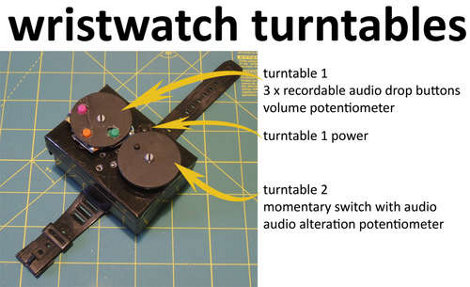
Ever wish you could DJ on the fly while using equipment that your already wearing? Well neither have we but heck now we can, cheaply and easily with the Wristwatch Turntables. While being functional and stylish, this interesting project is fairly easy to construct and if need be, even sports a full function digital watch.

The audio electronics are donated by a pair of talking / musical  greeting cards. Both, “record your own” and “just deal with what we give you” types, though which ones you choose is left up to your taste. The greeting cards are then cut apart for their hidden goodies and then a little circuit bending action is performed to monkey with the amplifier of the sound module.

Potentiometers are added, buttons are relocated, and everything gets housed in a small box, with a wristwatch ran down the middle so you can wear the whole deal and blast your funky beats anywhere you may be. Join us after the break for a quick video.

Continue reading “Wristwatch Turntables”

Audiophile Quality Headphones At A Fraction Of The Price

diy_hifi_headphones

If you are in the market for a nice pair of Hi-Fi headphones, it is not uncommon to to find price tags in the range of $300-$500. [Stacy] loves her music, but she had no desire to pay that high a price for a pair of good portable cans. Instead, she upgraded a set of cheap, knock-off headphones to near-audiophile quality for less than $50.

She starts off by explaining the technology behind the expensive headphones you see in stores, and why the sound quality is so much better. She says the orthodynamic drivers used in these products produce far better sound due to the placement of the voice coils, and their lack of delay when producing sound.

She found a pair of orthodynamic drivers for $30 and fit them into her knock-off headphones with a reasonable amount of effort. A bit of insulation and supporting plastic was added to ensure proper mounting of the drivers, then the headset was painted and reassembled.

[Stacy] claims that the end result is easily comparable to far more expensive headsets, especially when connected to a proper amplifier. If you are looking to step up your audio game on the cheap, here’s your chance.

Recycled Sound – An Art Installation Not Lacking Arduinos

[oakkar7] wrote in to show us [Ben Johansen] and [Jonathan Snow]’s  interactive art installation, Recycled Sound(Website has a virus). The exhibit will premiere  in the TWU Arts Triangle Walking Tour March 25th from 5-7pm.

Currently a work in progress, the final plan is for the outdoor installation to feature a podium in the center with a rotating top, and various islands surrounding. As the podium’s top is rotated the surrounding islands come to life with a variety of light and sound displays which vary depending on how the podium is turned. While the electronics are not recycled, the actual sculptures and music making elements themselves consist of scrap yard parts and factory waste.

The whole display runs off of 12.. yes TWELVE Atmel 328s with Arduino boot loaders! The center podium houses a transmitting circuit consisting of two atmega 328s with Arduino boot loaders sharing a crystal, an hmc 6532 magnetometer breakout board and two RF transmitters.  The Islands each contain a receiving module with, obviously,  an Arduino and RF receiver. The receiving Arduinos connect to opto isolated switching modules for motors and lighting. Check out [Ben]’s blog for in progress shots, code, and build information.

If you are looking to control some 12V motors/lights with your 5V Arduino be sure to check out the pictures in the blog. While we here at Hackaday may be quick to jump into soldering [Ben] follows the proper development progression to the letter. Each aspect is bread boarded, then refined, then transferred to a soldered perf board.

update: His site has some kind of malware going on. None of us noticed it in Firefox, but after complaints we fired up ol IE. Yup, nastyness there. You can go there at the following link if you dare.

More after the jump:

Continue reading “Recycled Sound – An Art Installation Not Lacking Arduinos”