Alien Life Form Synth Toy

space_bug_in_a_bottle

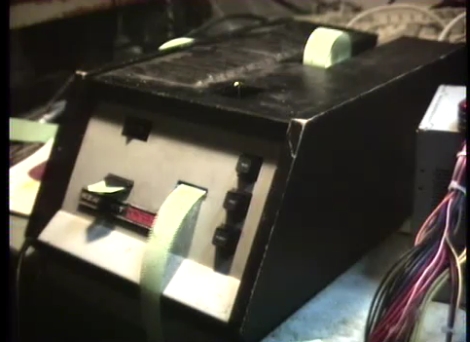
We were sent [Dr. Offset’s] most recent project, a kid’s toy that is half sculpture/half noisemaker, but 100% cool. The device uses several 555 Timers and is his entry into the 555 Design Contest, which wraps up in just a few days. To really enjoy his creation, you need to suspend disbelief for a moment, and indulge the space fantasy he creates. In other words, let yourself be a kid again, if only for a few minutes.

What he has built is a containment unit for an alien life form found during an outer space exploratory mission. The creature has fused its organic bits with electronic components in order to survive in the stark, empty world it used to call home. The containment unit allows you to zap the “bug” with various frequencies to see how it reacts. The “bug” is light sensitive, so it always offers a varying experience, day or night.

It’s definitely one of the most artistically creative entries into the 555 Design Contest we have seen yet. Continue reading to see a thorough walkthrough and demonstration of his project.

[Thanks Rich Decibels]
Continue reading “Alien Life Form Synth Toy”

Digital Wavetable Oscillator

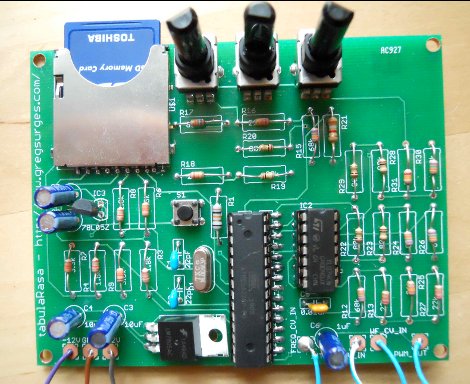
The tabulaRasa is a digital wave table oscillator, and features control of frequency, wave table selection, and interpolation. The device is split up into 2 parts. One is a pcb with a healthy amount of resistors, 3 potentiometers, ST TL074 JFET op amp, atmega328 and a SD socket.

The second part is software for your computer that allows you to edit or create your own waveforms. There are 3 different modes of control. Breakpoints, which allows you to set the waveform points and allows up to sixteen. Harmonic allows amplitude control over 16 harmonically-related sine waves, finally, the third mode lets you load in short sound clips.

Once you’re happy, save to a SD card and pop it into the board, and you’re ready to make some noise. The project page states at the end “tabulaRasa is in the last stages of development, and will be available soon.” so you cant get your hands on one just yet, but if you’re interested [Greg] has a kickstarter page setup where you can find out details on pricing.


555 Two-fer – Baby Swing Upgrade And A Headphone Tube Amp

baby_swing_tube_amp

[Jason] sent in two 555 timer driven items that were worth sharing, both of which are entries in the 555 Design Contest.

The first item is a circuit that automatically resets an infant swing. [Jay], who built both items, has an infant swing for his daughter that spins a mobile and plays music. It’s great but it only works for 7 minutes and 15 seconds before a button push is required to trigger it again. He found this limitation to be annoying, and as I have owned the same swing, I can echo his frustrations. He probed the swing and found that a 5v pulse was required to reactivate the mobile, but it had to be sent after it turned off to have any effect. He put together a simple circuit that would do the button pushing for him, as you can see in the video below.

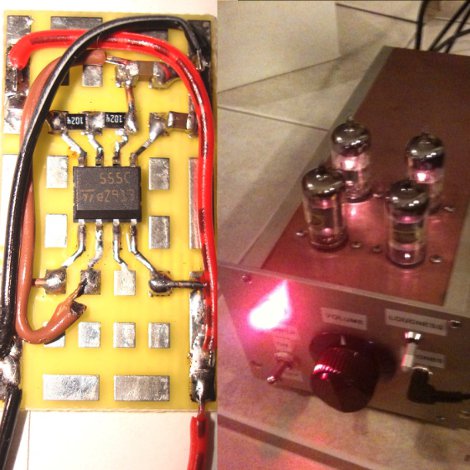
[Jay’s] other entry is a headphone tube amp using a quartet of 6DJ8 vacuum tubes. The 555 timer in the amp is used to drive a FET and the hand-wound transformer he built for the amp. You can see a video of the amp in action below as well.

The projects are lacking a thorough write-up, but he does provide schematics for both the swing reset switch and the tube amp for those looking to replicate either item.

Continue reading “555 Two-fer – Baby Swing Upgrade And A Headphone Tube Amp”

MIDI Controller Fit For An Arcade

arcade_midi_controller

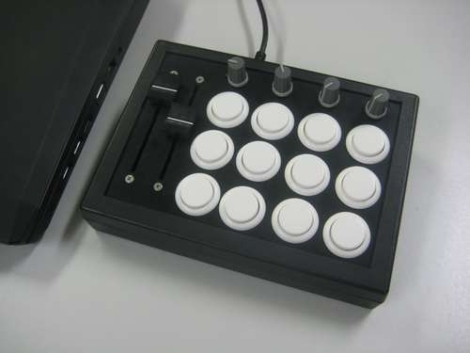
MIDI controllers can be relatively expensive depending on feature sets and requirements, so Instructables user [fraganator] went about building one on his own for just under $100. He originally wanted to replicate a commercially available MIDI controller, which used arcade buttons in lieu of the more common rubberized buttons, since they are large and have a better feel when pressed. Once he drew up plans for his MIDI clone, he realized he wanted more features in his controller than were available in the commercial version, so he started revising.

His final plan included three rows of four arcade buttons as well as four rotary and two sliding potentiometers. All of the components were mounted in a small keyboard enclosure, then wired to an Arduino clone, which manages all of the controller’s functions. The controller is connected to a PC via USB and can perform any number of operations once the buttons are mapped in MIDI-compatible software.

There are no videos of the controller in action just yet, though [fraganator] says one is forthcoming.

NES Paul Game Controller

nes_paul_complete

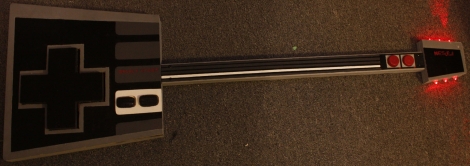
[NeoTechni] wrote in to share the new game peripheral she built, dubbed the NES Paul. The ultimate goal of the project was to build a NES-styled controller for an upcoming game she is working on, tentatively titled 8-bit Hero. The guitar is constructed primarily from wood, as well as some scrounged bits she had around the house. An Xbox 360 controller was dismantled and wired to provide input for the guitar’s buttons and D-Pad. Even the Xbox controller’s rumble packs were used in order to provide visual feedback of missed notes via LED tuning pegs on the guitar’s headstock.

The writeup is broken into several pieces as it was put together in a handful of Google Buzz posts, but it is still relatively easy to follow. We can’t wait to see how the project comes together once the game portion has been completed.

Classical’s Greatest Hits On Hardware’s Greatest Flops

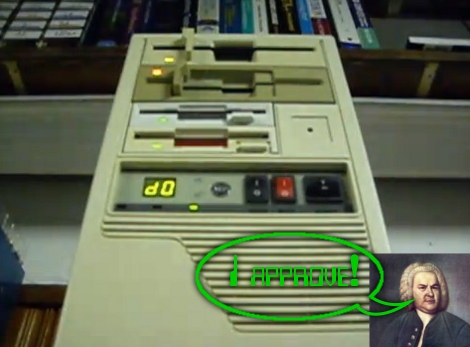
We get a lot of tips about old hardware playing recognizable tunes. But once in a while one of these projects goes above and beyond the others and this is a shining example of great hardware music. [FunToTheHead] put together a music video (embedded after the break) that shows his custom MIDI device playing Bach’s Toccata in d minor. He left some comments that clue us into the way he did it. Most obviously, he’s using the stepper motors from four floppy drives to create precisely pitched sounds. Internally, a PIC 18F14K50 acts as a MIDI-over-USB device, taking commands for all 128 MIDI notes as well as the pitch bends associated with them. The first four channels are played directly on each drive and the other twelve are triaged among the hardware by the microprocessor. But for the results heard in the video you’ll need to code your MIDI files by hand.

Bonus points to the video editor for the Phantom’s floppy-laden appearance in the video… it’s good to laugh!

Continue reading “Classical’s Greatest Hits On Hardware’s Greatest Flops”

Punch Tape Musical Synth

synthanola

[Jeri Ellsworth] sent over a 555 design contest entry that struck her as particularly interesting. The Synthanola is a three-channel music synthesizer that accepts input from an old Heathkit paper tape reader. While this hack might seem overly retro, it’s actually an extremely appropriate use of technology, as the Heathkit H-10 and the 555 timer were both popular tech in the 70’s. This retro-focused synth uses fourteen 555 timers, twelve of which are dedicated to synthesizing audio. If this entry does not win the contest, it certainly must be a strong contender for most 555 timers used.

[Thrashbarg] gives a detailed explanation of the logic used to drive the music playback from the punch tape, as well as full circuit diagrams for his entry. So far he has encoded MP3s of Bach’s Invention and Fugue in D Minor to tape, with hopefully more to come. In order to truly appreciate his efforts, the Synthanola should be seen as well as heard. Stick around for a pair of videos of the synth in action.

If you’re interested in seeing more 555 contest entries, be sure to check out some of our previously featured projects.

Continue reading “Punch Tape Musical Synth”