The 2014 Line Of MakerBots

makerbots

With the Consumer Electronics Show over, it’s finally time to take a look at the new line of MakerBot printers (here’s the press release). Unlike MakerBot’s previous offerings with a one size fits all business model, they’re branching out with a product line that can only be described as, ‘regular, small, and large’.

The new MakerBots include an updated Replicator that’s just slightly larger than the previous version. It includes Ethernet, an option for WiFi, an on-board camera, and a control panel with a 3.5″ LCD and rotary encoder. This new Replicator will retail for $2900, $700 more than the current Replicator (single extruder).

The other new MakerBots include the stripped down and small Replicator Mini. It’s a no-frills machine with a build volume of 10 x 10 x 12.5 cm (~4 x 4 x 5 in) with 200 micron resolution. Also in the new lineup is the Replicator Z18, an impressively large printer with a 30.5 x 30.5 x 45.7 cm (12 x 12 x 18 in) build volume, 100 micron resolution, plastic sides for a heated build volume, and all the bells and whistles on the new Replicator. The Mini will sell for $1375 and the Z18 is expected to sell for $6500.

The updated Replicator is available now, and the Mini and Z18 will be available sometime in the next few months.


Intel Edison: A Desktop From 1998 In An SD Card

According to the barrage of press releases hitting the Hackaday tip line, the Consumer Electronics Show is upon us with announcements of amazing new technologies such as jackets with a cell phone pocket, alarm clocks with Bluetooth, and iPhone cases with a kickstand. What an age to live in.

Among the more interesting announcements at CES is the Intel Edison, a tiny device that combines a dual core Intel SoC with ‘a Pentium instruction set’, WiFi and Bluetooth adapter, and some amount of storage into an SD card form factor. Apart from that, little else is known about the Intel Edison and the only other primary source for this announcement appears to be Intel CEO [Brian Krzanich]’s CES keynote address.

The Edison will be able to run Linux, ‘other operating systems’, and will support Wolfram, the Mathematica-esque programming language where everything is a data type. Edison will also have an app store. Because that’s a thing now, apparently.

If you can’t wait for Edison to be released sometime in the middle of 2014, we’d suggest you check out the Intel Galileo. It’s an Arduino compatible board based on the same Quark SoC found in the Edison but in a significantly more convenient form factor. The Galileo doesn’t have on board WiFi or Bluetooth, but at least you don’t have to wait for the release of the Edison and the complications of a purpose-built breakout board for whatever application you’re thinking of.

Hackaday: The Gathering

LA2014-109x180

1/21/14 – Downtown LA
Come one, come all to a party with [Brian], me, and the Hackaday readers who live in the Los Angeles area. Tickets are free, as is the beer, food, t-shirts, stickers, and other swag which you won’t find out about unless you show up in person.

This is the first official live Hackaday meetup and is open to all ages. During the summer we talked about making Hackaday a virtual hackerspace, and this event is one part of that initiative. We’ll let you in on some stuff we’ve been planning, but in return I expect you to tell us your thoughts on how the Hackaday community can get bigger and better. We’re also using the attendance at this event to judge if we should host more live events (possibly in other cities too). So if you’re in LA get your ticket now and make sure your friends do the same!

UPDATE 3: Get your name on the waiting list… Continue reading “Hackaday: The Gathering”

Geek Group Fire Update

gg-gap2

The Geek Group is in the process of cleaning up after their fire. Their small capacitor/spark gap room sustained the most damage, with the interior nearly completely incinerated, along with some structural damage to the walls and roof.  The gap room was isolated from the much larger high voltage lab by red plastic welding curtain. The curtain was fire-retardant, but when it did finally burn, it was extremely sooty. With the curtain burning, soot covered the high voltage lab. The rest of the building escaped fire damage, but nearly all of it is covered in a fine layer of soot. The group has been and are attacking the soot problem head on, with shop-vacs, rags, and elbow grease. Several of their sponsors have also promised supplies to cover the remediation.

[Chris] and [Paul] have also been doing some sleuthing as to the root cause of the fire. While the cause will never be known beyond a shadow of a doubt, they have a pretty good idea of the chain of events. Gemini, the group’s 200 kVA Tesla coil had been run about 1/2 hour before smoke was detected. The fire was concentrated in Gemini’s spark gap room. Close inspection of the rotary spark gap showed that the stationary electrodes all seemed to have sustained a mechanical impact. It appears that either while the gap was running, or as it was spinning down, one of the flying electrodes moved enough to impact the stationary electrodes. These electrodes are 3/8″ and 1/2″ tungsten, and often glowed white-hot while the gap was in operation. One set screw held each electrode in to the 12″ rotor. The set screw of one flying electrode was found to be loose, and the electrode it retained probably impacted the stationary electrodes. It’s not a far leap to guess that hot metal from these impacts could have landed in the capacitor array, smoldered, and eventually caught aflame.

A single loose screw most likely caused the entire chain of events leading up to the fire. [Chris] and [Paul] had observed the spark gap throwing out hot bits of metal even during normal operation, and had planned an encapsulation box. However, disaster struck before it was built. This is not to say that The Geek Group operates an unsafe shop. The important thing here is that no one was hurt. Everyone in the building was evacuated quickly and safely.

A quick note about the comments – we know The Geek Group and [Chris] tend to be polarizing topics. However, we’d like to at try to keep the comments constructive.

Continue reading “Geek Group Fire Update”

A Guitar From An Old Tin Box

omar-mos

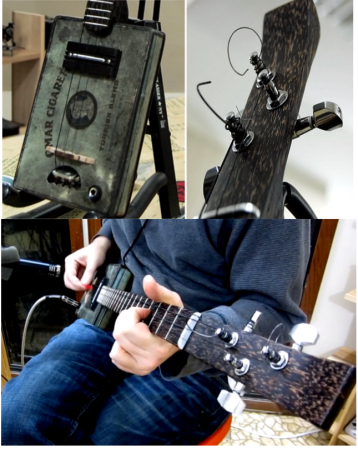
[Atdiy and Whisker], collectively known as  [The Tymkrs] have been busy honing their luthier skills. They’ve created a 10 part YouTube series about the construction of their new cigar box guitar. Instead of a cigar box though, they’ve substituted a 1920’s tin cigarette box. The Omar Cigarette company gave “Project Omar” it’s name. Like [Tymkrs] previous guitar, Omar is a three string affair. The neck was cut from Black Palm, which really shined when polished with a mixture of orange oil and beeswax. They also threw in a couple of new tricks on this build. Omar is an electric guitar, with a pickup custom wound  by [Bob Harrison]. Omar also has frets, which creates a whole new set of complications. Frets are generally installed by cutting slits in the guitar neck with a fret saw. Rather than buy a new tool, [Tymkrs] created a simple jig for their mini table saw. The jig held the guitar neck perpendicular with the saw blade. This made quick work of the many fret slits to be cut. Installed frets must also be dressed and leveled, which is a time-consuming process. 

The tin cigarette box also created a new set of problems. The thin tin proved to be a bit on the weak side when the strings were tightened down. A bit too much pressure on the box while playing would cause notes to bend, much like the tremolo or whammy bar on a standard electric guitar. [Tymkrs] were able to counteract this by adding bracing inside, and a couple of black palm braces to the back of the box.

Hum was also a problem. When [Tymkrs] first plugged in, they found they had more 60Hz mains hum than signal from their strings. Omar uses a classic single coil guitar pickup. Single coils will pick up noise from any magnetic field, including the field created by the studio electrical system. A humbucking pickup uses two coils to counteract this effect. Humbuckers also have a slightly different tone than single coils. [Tymkrs] wanted to stick with their single coil tone, so they counteracted the hum by raising the pickup closer to the strings. Higher pickups receive more signal from the strings, so this is basically a free signal to noise ratio improvement. They also grounded the entire tin box, along with Omar’s metal tail stock. The final build sounds great, as evidenced by the jam session toward the end of Video 10.

Continue reading “A Guitar From An Old Tin Box”

Fire At The Geek Group

Geek Group

The Geek Group, an absurdly large and well stocked hackerspace in Grand Rapids, Michigan caught fire yesterday.

You may recall The Geek Group from their many over-the-top projects that include a quarter shinker, a 200,000 Watt Tesla coil, enough capacitors to kill a demi-god, and a giant robot that crushes TVs. From what TGG has shown on their website and their YouTube, they have an amazing space that could still be the home of quite a few amazing builds.

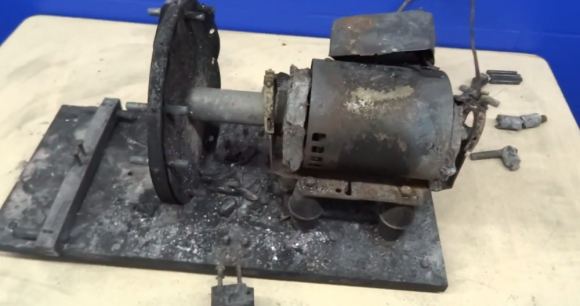
According to Geek Group head honcho [Chris], the fire was caused by an overheated electric motor. No one was at the space at the time, but the fire was hot enough to crack the exterior brick and melt porcelain insulators in their high voltage lab. To add insult to injury, this was only TGG’s second day of being open to the public.

The folks at The Geek Group are looking for volunteers for their cleanup, so if you’re around the Grand Rapids area and would like to pitch in, head on over around noon today.

DARPA Robotics Challenge Trials Wrap Up

schaft-drive

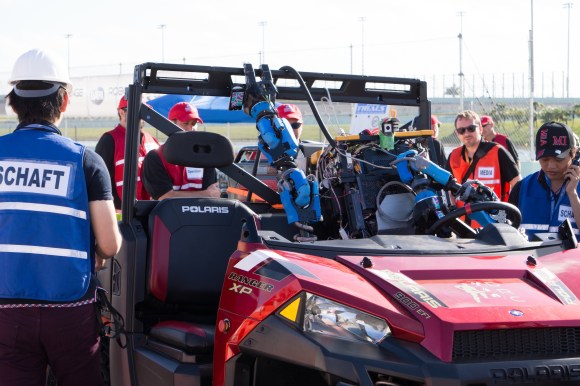
The DARPA robotics challenge trials 2013 are have finished up. The big winner is Team Schaft, seen above preparing to drive in the vehicle trial. This isn’t the end of the line for DARPA’s robotics challenge – there is still one more major event ahead. The DARPA robotics finals will be held at the end of 2014. The tasks will be similar to what we saw today, however this time the team and robot’s communications will be intentionally degraded to simulate real world disaster situations. The teams today were competing for DARPA funding. Each of the top eight teams is eligible for, up to $1 million USD from DARPA. The teams not making the cut are still welcome to compete in the finals using other sources of funding.

The trials were broken up into 8 events. Door, Debris, Valve, Wall, Hose, Terrain, Ladder, and Vehicle. Each trial was further divided into 3 parts, each with one point available. If a robot completed the entire task with no human intervention it would earn a bonus point. With all bonuses, 32 points were available. Team Schaft won the event with an incredible total of 27 points. In second place was Team IHMC (Institute for Human Machine Cognition) with 20 points. Team IMHC deserves special praise as they were using a DARPA provided Boston Dynamics Atlas Robot. Teams using Atlas only had a few short weeks to go from a completely software simulation to interacting with a real world robot. In third place was Carnegie Mellon University’s Team Tartan Rescue and their Chimp robot with 18 points.

The expo portion of the challenge was also exciting, with first responders and robotics researchers working together to understand the problems robots will face in real world disaster situations. Google’s recent acquisition — Boston Dynamics — was also on hand, running their WildCat and LS3 robots. The only real downside to the competition was the coverage provided by DARPA. The live stream left quite a bit to be desired. The majority of videos on DARPA’s YouTube channel currently consist of 9-10 hour recordings of some of the event cameras. The wrap-up videos also contain very little information on how the robots actually performed during the trials. Hopefully as the days progress, more information and video will come out. For now, please share the timestamp and a description of your favorite part with your comments.

Continue reading “DARPA Robotics Challenge Trials Wrap Up”