DARPA Robotics Challenge Trials Day 1

darpa-val1

Today was the first of two days of trials at the DARPA Robotics challenge at Homestead-Miami Speedway in Florida. Created after the Japan’s Fukushima nuclear disaster, The robotics challenge is designed to advance the state of the art of robotics. The trials range from driving a car to clearing a debris field, to cutting through a wall. Robots score points based on their performance in the trials. Much of the day was spent waiting for teams to prepare their robots. There were some exciting moments however, with one challenger falling through a stacked cinder block wall.

Pictured above is Valkyrie from NASA JPL JSC. We reported on Valkyrie earlier this month. Arguably one of the better looking robots of the bunch, Valkyrie proved to be all show and no go today, failing to score any points in its day 1 trials. The day one lead went to Team Schaft, a new robot from Tokyo based startup company Schaft inc. Schaft scored 18 points in its first day. In second place is the MIT team  with 12 points. Third place is currently held by Team TRACLabs with 9 points. All this can change tomorrow as the second day of trials take place. The live stream will be available from 8am to 7pm EST on DARPA’s robotics challenge page.

Continue reading “DARPA Robotics Challenge Trials Day 1”

Staff Update And Philanthropy

staff-update-and-philanthropy

It is my pleasure to welcome two new members of the Hackaday team. [Kevin Darrah] and [Kristina Panos] both have electronics backgrounds, and following in the tradition of the entire team they are long-time readers of Hackaday. Both are already hard at work. You can learn a bit more about them on the Staff Page.

While I have your attention the writers, editors and I would like to thank our parent company. We frequently refer to them as the “Evil Overlords” (actually, they started it!) but it’s turning out to be a really great relationship. I asked them to make a donation to Wikipedia in Hackaday’s name and they were happy to do so. Not only do we often link to Wikipedia in our articles, our writers use it constantly when researching for posts. Thanks SupplyFrame!

Developed On Hackaday: First Version Of The Hardware

mooltipass-schematic-featured

The Hackaday writers and readers are currently working hand-in-hand on an offline password keeper, the mooltipass (click to see the project description). 

Next in our Developed on Hackaday series, we present the first version of our schematics. There’s already been a lot of discussions going on in our dedicated Google group, mainly about the project’s basic functionality. Because our firmware developers wanted to get to work, we decided to send the first version of our hardware into production a few days ago. Before going through the schematics, let’s review the required list of the mooltipass’s core components:

  • an easily-readable screen
  • a read-protected smart-card
  • large flash memory to store the encrypted passwords
  • an Arduino-compatible microcontroller with USB connectivity

We’ve been drowning in component suggestions from motivated hobbyists, so we figured we’d make the mooltipass v1 as simple as possible and then move from there. Given this device is developed on Hackaday, we also wanted future users to modify it, building completely new projects based around these main components. Keep reading for our schematics…

Continue reading “Developed On Hackaday: First Version Of The Hardware”

Developed On Hackaday: Setting Up The Project’s Infrastructure

2013-12_Developed_on_Hackaday

We’re pretty sure that most of our readers already know it by now, but we’ll tell you anyway: the Hackaday community (writers and readers) is currently developing an offline password keeper. In the first post of our first DoH series, we introduced the project and called for contributors. In the comments section, we received very interesting feedback as well as many feature suggestions that we detailed in our second write-up. Finally, we organized a poll that allowed everyone to vote on the project’s name.

The results came in: the project’s name will be mooltipass. We originally had thought of ‘multipass’ but [asheets] informed us that Apple and Canon had both applied for this trademark. [Omegacs] then suggested ‘mooltipass’ as an alternative, which we loved even more. A few days ago we set up a google group which is already very active.

An often under-estimated side of a community driven project is its infrastructure and management. (How) can you manage dozens of motivated individuals from all over the globe to work on a common project? How can you keep the community informed of its latest developments?

Continue reading “Developed On Hackaday: Setting Up The Project’s Infrastructure”

Hackaday Twitter Hits 40,000 Followers!

hackaday-40k-twitter-followers

I’m not sure exactly how many readers keep an eye on our Twitter account: @hackaday. We hit a new milestone today at 40,000 followers. For those of you who have been watching the Twitter feed recently, you’ve probably noticed it’s no longer limited to simply announcing each new post as it hits the front page. Madness, right?

A little over a week ago [Mike] promoted me to the role of Community Editor; a new position here aimed at directly engaging readers. For now, that means helping to guide conversations in the comments toward a degree of helpfulness and productivity. I’ve also sent out a handful of tweets to sort of test the waters, but considering my job is to engage the community, I thought I’d just ask! What can we at Hackaday be doing differently with social media (particularly Twitter) that you would find valuable? Hit up the comments and let us know, or join the conversation on Twitter: #HaDSuggestionBox

Developed On Hackaday: First Feedback From Users

2013-12_Developed_on_Hackaday

Holy cr*p guys… we were amazed by the quantity of positive feedback that was left in the comments section of our last article. We have been featured by Slashdot ! We got plenty of project name suggestions, therefore we organized a poll located at the end of this post to let you decide which one is best. I also received many emails from people eager to start contributing to this offline password keeper project. If you missed the call and want to get involved, it’s still not too late. You can get in touch with me @ mathieu[at]hackaday[dot]com. So far, we have many beta testers, several software developers, one security assessor and a few firmware developers. Next step is to create a mailing list and a Hackaday forum category once the project’s name has been chosen.

Obviously, the very first post of our “Developed On Hackaday” series was to gauge your initial reactions to this ‘new’ project. Notice here the double quotes, as when someone has a new idea there usually are only two possibilities that may explain why it doesn’t exist in the market yet: either it is completely stupid or people are already working on it. In our case, it seems we are in the second category as many readers mentioned they wanted to work/were working/had worked on a similar product. As we’re selfish, we offered them to contribute to this new device.

To ensure that all of our readers are on the same page as to how the device will work we embedded a simple block diagram after the break, as well as a list of all new functionalities that we want to implement given the feedback we received. So keep reading to see what the future holds, as well as to vote on this new project’s name…

Continue reading “Developed On Hackaday: First Feedback From Users”

Meet The Teensy 3.1

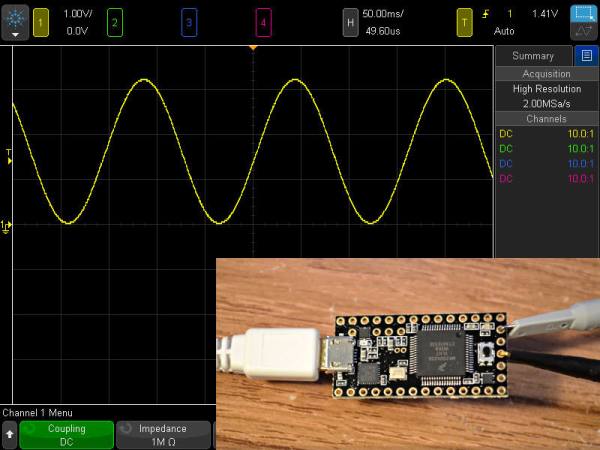
[Paul Stoffregen] just released an updated version of his Teensy 3.0, meet the oddly named Teensy 3.1. For our readers that don’t recall, the Teensy 3.0 is a 32 bit ARM Cortex-M4 based development platform supported by the Arduino IDE (using the Teensyduino add-on). The newest version has the same size, shape & pinout, is compatible with code written for the Teensy 3.0 and provides several new features as well.

The Flash has doubled, the RAM has quadrupled (from 16K to 64K) allowing much more advanced applications. The Cortex-M4 core frequency is 72MHz (48MHz on the Teensy 3.0) and the digital inputs are 5V volts compatible. Pins 3 and 4 gained CAN bus functions. The new microcontroller used even has a 12 bits Digital to Analog Converter (DAC) so you could create a simple signal generator like the one shown in the picture above. Programming is done through the USB port, which can later behave as host or slave once your application is launched. Finally, the price tag ($19.80) is in our opinion very reasonable.

Embedded below is an interview with its creator [Paul Stroffregen].

Continue reading “Meet The Teensy 3.1”