What Does The Government Think About That Drone In Your Home?

The world is buzzing about drones right now. Even we’re joining in the fun with some antics of our own. Right now, it is basically a legal free-for all since no one is enforcing regulation, but is that about to change? Should it?

Lets start off by establishing the definition of a “drone”. For this article, we’ll settle for any “unmanned aerial vehicle”, though we can all agree that that limiting this to airspace is fairly restrictive. This is the specific type that are making the news right now and quite possibly catching the eye of people who make the rules.

Continue reading “What Does The Government Think About That Drone In Your Home?”
Forget Treating Your Diabetes – Use Your Insulin Syringe As A Logic Probe

syringe-logic-probe

Hackaday reader [JumperOne] was in need of a logic probe that he could use to reliably test some tiny .5mm pitch IC pins. The probe that came with his oscilloscope was a bit too big and not near sharp enough to do the job, but he figured that a syringe might do the trick nicely.

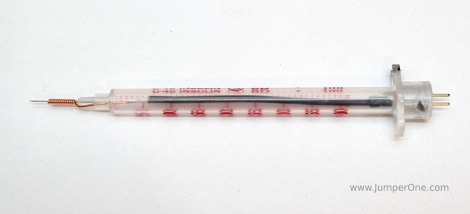
He drilled a small hole near the business end of the syringe, through which he fed a piece of stripped twisted pair cabling. [JumperOne] then soldered a pair of pins to a small piece of coaxial cable, attaching the opposite end to the twisted pair already in the syringe. After carefully coiling the thin cable around the needle, he secured the coaxial cable and its pins in place with a bit of hot glue.

[JumperOne] says that his makeshift logic probe works very well and the sharp needle would easily pierce through any oxidation or solder mask that stands in its way. One extra benefit of using a syringe as a probe is that they come complete with caps which help protect both ends of the delicate tool.

10bitworks Shows Us How To Light Up A Synchronized Swarm Of LED Jellyfish

10bitworks-led-tshirts

[Jeremy Zunker] from 10bitworks recently wrote in to share a cool build the group put together for the Luminaria 2012 festival which took place in March of this year. As you might have guessed, the fest is home to a wide array of light-themed projects, so the team at 10bitworks thought long and hard to come up with a design which would help them stand out from the other 79 featured artists.

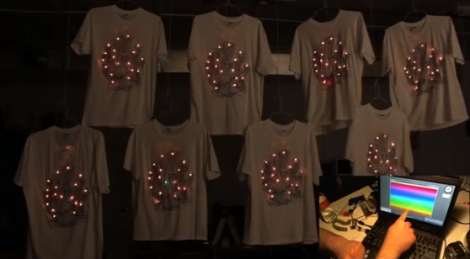
At the core of their project is a t-shirt which features a deep-sea diver surrounded by swarm of jellyfish. Each of the jellyfish is backlit by an LED module, allowing the group to create intricate light patterns on the shirt.

10bitworks brought 8 shirts to the show, each fitted with a small control pack that contained a set of batteries and a Jeenode wireless board. A ninth Jeenode and a large antenna were used as the master control unit, sending signals to each of the t-shirts in order to synchronize the light display.

The final result turned out very nicely as you can see in the video below, where [Jeremy] walks through all of the project’s finer details.

Continue reading “10bitworks Shows Us How To Light Up A Synchronized Swarm Of LED Jellyfish”

Building A Resistor Substitution Decade Box

[George] built an incredibly tidy resistor substitution decade box. These devices feature a pair of connections and a way to select the resistance between the two of them. In [George’s] case it’s a pair of banana jacks and these eight thumbwheel switches.

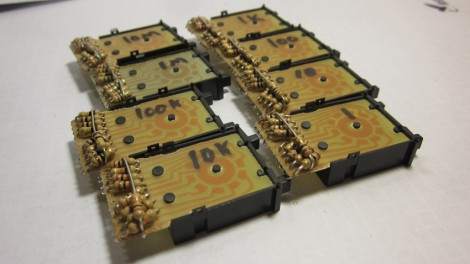
What you see above is the side of each thumbwheel switch. These are panel mount devices which show one digit with an up and down button to change the setting. As you can see, the PCB for each provides connections to which a set of resistors can be mounted. This is the difficult part which he goes to great lengths to explain.

At this point he’s got the resistor groups for each digit soldered in place, the next step is to stack the switches next to each other and connect them electrically. From there it’s off to a project box in which they will be mounted.

This project does a great job of explaining the assembly process. If you’re interested in the theory behind a substitution box check out this other project.

New And Improved Old Hackaday Store!

I am going to start off by saying our zazzle store was pretty sad. The prices were just way too high. I put that store into place because frankly, the one I was running was a pain in the butt.

The good news is that I’ve got a new system in place. It is bright and shiny and looks much easier to use. Not only that, but since we’re not using someone like zazzle, we’re keeping the cost down! Or standard shirts are $18. We have stickers too, and this time, we have both standard stickers as well as the custom cut vinyl decals everyone loved before.

Several products have not yet arrived. Since this is the grand opening and I feel a little bad about how expensive the zazzle store was, I’m running a special. $16 for shirts if they’re ordered before August 31st. 

I’m talking to other people about offering some products besides shirts and stickers in the store. Stay tuned to see what we’ve got going on!

Real Time GPS Decoding With Software Defined Radio

In case the Realtek RTL2832u-based USB TV tuner dongle isn’t useful enough, the folks behind a project to get a software defined GPS receiver off the ground successfully plotted GPS data in real-time with this very inexpensive radio.

Previously, we’ve seen these dongles grab data from GPS satellites – useful if you’re building a GPS-based clock – but this build required hours of data collection to plot your location on a map.

The folks working on the GNSS-SDR project used an RTL2832 USB TV tuner and a Garmin active GPS antenna to track up to four GPS satellites in real-time and plot a location accurate to about 200 meters.

The Google Earth plot for this post shows the data collected by the GNSS-SDR team; the antenna was fixed at the red arrow for the entirety of the test, and the  yellow lines represent a change in the calculated location every 10 seconds. Amazing work, and only goes to show what this remarkable piece of hardware is capable of.

We’re Getting An Oculus Rift Dev Kit

Before you get jealous of the massive amount of sway that hackaday must’ve tossed at these guys to get a dev kit, don’t be. We just funded the kickstarter like everyone else. This is exciting news though since, as you probably know, I’m very fond of immersive gaming and have always craved a strong VR rig.

We are expecting our dev kit some time in December. I have no idea exactly what we’ll do with it. Right now [John Carmak] has made the iD engine work with it and it ships with Doom3. They’ve stated that it will work with the Unreal engine as well. Even though I saw [Gabe Newell] from valve in the video, I don’t see any source engine compatibility in the list. I really would love to see that one added, especially since Valve released the source film maker for free.

So, who has ideas about what to do with this? I’d like to build a telepresence rig with stereo vision, possibly mounted on a radio controlled car chassis.