Stellaris Launchpad And Booster Packs Used As Frequency Analyzer

stellaris-frequency-analyzer-using-booster-packs

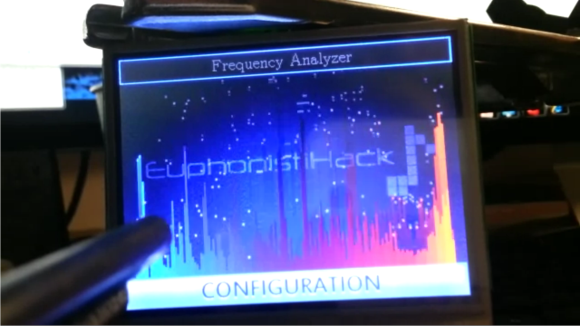
[Jordan Wills] got tired of being limited to eight pixels of resolution and having jumper wires littering his work space. He set out to upgrade his Stellaris Launchpad frequency analyzer project using booster packs. You may remember the initial iteration of the project which used an 8×8 LED matrix to map audio spectrum. With this upgrade he’s really putting the power of that ARM chip to use.

His first improvement with this project was to spin his own audio input board. It has a standard headphone jack for input and a few passive components to shift the signals to rest nicely within the ADC measurement range. The shield has two double pin headers and a group of four stand offs to serve as legs. This way it plugs into the female headers on the bottom of the Launchpad and provides a stable base for the assembly.

The second portion of the setup is an LCD booster pack for the hardware. Kentec manufactures this 3.5″ 320×240 LCD (EB-LM4F120-L35) complete with a resistive overlay making it touch sensitive. The increase in resolution, and availability of different colors gave [Jordan] plenty to work on. Since this add-on is designed for the Launchpad and has a driver library already available he was able to focus on adapting the FFT output for display and adding in new features. Don’t miss seeing what he’s accomplished in the clip after the break.

Continue reading “Stellaris Launchpad And Booster Packs Used As Frequency Analyzer”

Welding With Over A Hundred A123 Lithium Cells

a123-cell-powered-welder

[Doctor Bass] needed to do some welding on his electric bicycle. The problem is that he’s never welded before and doesn’t have any tools for it. As you can see, that didn’t stop him. He used a bicycle battery made from reclaimed DeWalt A123 cells to power his diy welding rig.

He has a huge adjustable resistor which is responsible for limiting the current. 80 Amps seems to work the best with the welding rods he’s chosen. It is worth noting that when he shows off each part of the welder (see the clip after the break) the color of the wire used for positive and negative leads is opposite of convention. His positive wiring is black while his ground connection is red.

To get the welding under way he connects a jumper-cable-like clamp to his work piece which serves as the positive electrode. To hold the welding rod he drilled a hole in a pair of vice grip pliers and bolted on the negative lead. This way the end of the welding rod can be clamped in the vice grips while his other hand guides the tip. So far he’s still practicing, but it looks like he’s nearly ready to take on the job at hand.

Continue reading “Welding With Over A Hundred A123 Lithium Cells”

Tindie Gets Fundraisers For Kickstarting And Group Buys

tindie

The etsy of electronics project, Tindie, has a brand new feature: It’s a Kickstarter-esque endeavor called a Fundraiser that allows you to sell your projects to other electron enthusiasts.

Of course the new Tindie Fundraisers may soon be just another Kickstarter clone for “exciting,” “new,” and “innovative” Arduino dev boards, something we’ve lamented before. We’re really interested in seeing Tindie used as a platform for group buys; a solution to a maker’s special hell where buying one component costs $100, but ten cost $200.

Already there are a few really cool projects up on the Tindie Fundraisers including a breadboardable Parallax Propeller dev board. Yes, someone finally made one that doesn’t cost an arm and a leg.

In addition to the new Fundraisers, [emile] also closed on $500k of seed funding for Tindie. It’s wonderful news for something that is sorely needed by the maker community. Tindie is also hiring, so if you’re a Django/Python wizard go drop everyone’s second favorite robotic dog a line.

Open Compute Project Hosts Hackathon

OCP Summit

The folks at Open Compute Project are running their annual summit in January, but this year they’ll be adding a hardware hackathon to the program. The hackathon’s goal is to build open source hardware that can be applied to data centers to increase efficiency and reduce costs.

The Open Compute Project (OCP) is a foundation that develops open hardware for data centers. This includes power supplies, motherboards, and storage disk arrays. The project started up at Facebook, but it’s now an independent foundation.

The hackathon will take place over the two day summit on January 16th and 17th, 2013 in Santa Clara. The registration is now open, and it’s free but limited to the first 100 people.

The hackathon is being put on with collaboration from Upverter, Github, and GrabCAD, who will be providing tools for the event. If you’re in the Santa Clara area and looking to do some hacking early in the new year, you might want to check this out.

Making 3D Printing Easy At The Staples Copy Center

Mcor Technologies and Staples are teaming up to provide 3D printing services via the online Staples Office Center service.

This announcement comes from Mcor, the company behind the Iris 3D printer. Unlike just about every other 3D printer, the Iris doesn’t squirt plastic onto a bed or glue powder together – it makes its models out of sheets of paper. You probably won’t be ordering working steam engines or other heavy-duty engineering models from the Staples copy center, but this system does allow for high-quality full-color models to be created very, very easily. You can see a few examples of what the Mcor Iris can print after the break.

Unfortunately, unless you live in Belgium or The Netherlands, your local Staples won’t be installing a 3D printer in their copy center anytime soon. For those of us outside these countries, we’ll have to wait until services like Shapeways and Ponoko figure out how to make their business model include a brick and mortar presence.

Continue reading “Making 3D Printing Easy At The Staples Copy Center”

Adding Node.js Based Sensors To The Parrot AR Drone

[Max Ogden] wanted the option to add sensors to his Parrot AR Drone. This a commercially available quadcopter which runs Linux. This makes it rather easy for him to use Node.js to read the sensors from an Arduino board. The use of the Arduino is merely for easy prototyping. It is only needed to bridge the drone’s serial port with a sensor’s delivery method, so just about any microcontroller could be substituted for it.

There are some hardware considerations to take into account. The manufacturer was nice enough to populate a 0.1″ pitch pin socket on the serial port (if only this kind of invitation to mess with hardware was an industry standard). But the device expects 3.3V levels so pick your hardware accordingly. There is one commenter who tried the project for themselves and found that the drone wouldn’t boot up with the Arduino already connect — he had to boot and then complete connections. Troubles aside this makes adding your own sensor payload very simple and you don’t have to wait until landing to get at the data.

Maybe we’ll have to add some shock voltage data reporting to our shockerDrone.

LEGO LP Player

This LP player is made entirely out of LEGO parts. It plays the songs encoded on each record, but not by using a stylus in a groove. Instead, each LP has a color code on the bottom of it which is interpreted by the optical sensors underneath.

In addition to its functionality [Anika Vuurzoon] made sure that the build looked the part. The horn is a nice touch, but you’ll also appreciate the rotating mini-figures on the front side of the base. To the right there is a hidden door that provides access to the NXT brick which drives the system. New records are produced using a couple of different tools. First off, the song is written using Finale, a mature musical notation program. That is exported and run through a second program which produces the colored disc design which is applied to the records. You can hear the songs for yourself in the clip after the break.

If LP playing toys are right up your alley you’ll want to check out this 3D printed record hack for a Fisher Price toy.

Continue reading “LEGO LP Player”