Hackaday Around The Web And Into The Future

Like everyone else, we’re scattered all over the web. We would be silly not to be getting our information out there in as many ways as we can manage. We promise that the site always comes first, but you can also find us on Facebook, G+ (yes, we’re approved this time), twitter, and we even have a flickr group where people post pictures of their projects!

We’ve got some stuff planned for the near future that we’re excited about too.

1.We’re working behind the scenes to bring out a new template for the site. This will allow us to clean things up a bit and hopefully make browsing a little easier (searching too!). Don’t worry, we’re not changing the logo.

2.We are also planning on starting some “show and tell” sessions on G+. We love what Adafruit has been doing with theirs, and we’re hoping to join in on the fun. We realize some of you are opposed to g+, so feel free to offer other solutions to do the show and tell, we would be happy to hear them. They will be recorded and linked on the site here, so you can follow along even if you can’t join.

3.We’re bringing back the store! This time, however, we’ll have a full spread of stuff. We’re not making it in our garages anymore. For now, it will be clothing and accessories, but we’re considering doing some electronics and tools in the near future as well.

The writers are also very busy with things on the web. We’re not always locked to our keyboards slaving away. If you want to be able to follow along with us, you can find our information after the break.

Continue reading “Hackaday Around The Web And Into The Future”

The Making Of A Vacuum Tube

With the death of Heathkit looming  in our minds it’s high time for a a heartwarming story. [Ronald Dekker] has done a wonderful job documenting the history of the E1T beam counting tube, detailing everything from the work led up to the invention of the tube to the lives of the inventors themselves.

For those who are unaware, the E1T is a rather strange vacuum tube capable counting from 0 to 9. While that’s nothing too special in itself, the tube also displays the numbers on a phosphor screen, much like a miniature cathode ray tube. In fact, this phosphor screen and the secondary emission caused by it is critical to the tubes operation. To put it bluntly, it’s a dekatron and a magic eye tube smashed together with the kind of love only a group of physicists could provide.

Now, who wants to have the honor of transposing Ronald’s story into a wikipedia article?

Amphi-Cycle Lets You Ride The Trails, The Waves, And Back Again

amphi-cycle

Hackaday regular [Berto] is always looking for new ways to get around, and wrote in to share his most recent creation, an amphibious bicycle.

He bought an off-the-shelf inflatable boat and constructed a rig that allows him to stably mount the bike on it. Once [Berto] comes across a body of water he wants to cross, all he requires is about 7 minutes time to inflate the boat and attach his bike. Using a modified version of his electric drill-based trolling motor we saw last year, the Amphi-cycle glides across the water effortlessly as demonstrated by his assistant in the video below.

Right now the boat is propelled solely by the trolling motor and a large lead-acid battery. We would love to see the amphi-cycle powered by its rider, though we don’t know how that would affect the “one boat fits all” design [Berto] is aiming for.

Continue reading “Amphi-Cycle Lets You Ride The Trails, The Waves, And Back Again”

Heathkit Closes Down, Again.

With this rather large flip flop, Heathkit has closed its doors… again. The company that so many of us remember fondly from their myriad of electronics kits originally closed its doors in 1992. Last year, there was an announcement of a revival and a call for kit submissions. Unfortunately, it looks like that just didn’t work out. While this isn’t an official announcement, the facts appear to line up to Heathkit closing their doors.

If you’d like to re-live a few fond memories, here’s a Heathkit unboxing at EMSL.

Destroying Stuff For The Good Of All Mankind

NC state’s constructed facilities laboratory is a place where things get broken for science. We’ve shared several videos lately of things being sliced, diced, sheared, exploded, and smashed, purely for the fun of it, and now we feel like we should compensate a little bit. No, we’re not going to undergo physical punishment, instead, we’ll share some educational destruction.

In the video after the break, you can see a few things pushed to their absolute limits, then a bit further. The Constructed Facilities Laboratory is a research lab that tests the limits of some of the infrastructure that we rely on daily. Bridges, roads, walls, support beams. Someone needs to figure out what they can really handle. Even more interesting than the short video below, are all the different videos in the tour that explain how the facility is constructed an how they operate. Take a few minutes and enjoy the tour.

Continue reading “Destroying Stuff For The Good Of All Mankind”

Are Your PCBs Being Tested As Claimed?

Florin ordered some PCBs from Iteadstudio, a pcb prototyping service. As part of their service, they claim that all PCBs are tested before they are delivered. However, many have been bringing this claim into question. [Florin] found a complete lack of any markings indicating actual probes had been used on his boards. Though they claim that 100% of the boards are e-tested, they replied to his inquiry somewhat cryptically.

All of the pcb’s have a stripe on the edge,it does not mean they have all been electrically tested ,it is the same as outline .

People on the Dangerous Prototypes Forum have been finding similar results. The company has commented, on this page, that that they will be responding to this soon (back in February)

Machine Learning Lets Micro Decode Your Handwriting

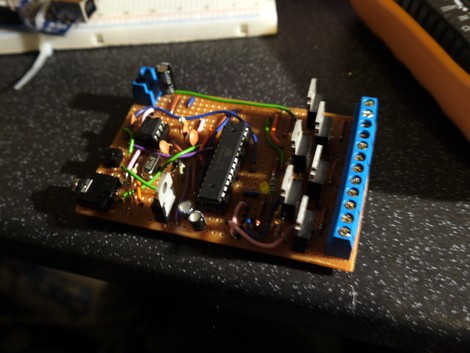
This rig will take the letters you write on the touchpad using a stylus and turn them into digital characters. The system is very fast and displays near-perfect recognition. This is all thanks to a large data set that was gathered through machine learning.

The ATmega644 that powers the system just doesn’t have the speed and horsepower necessary to reliably recognize handwriting on its own. But provide it with a dataset to compare against and you’re in business. [Justin] and [Stephen] designed a neural network algorithm that took a large volume of character handwriting samples, and boiled them down into a set of correlations that can be referenced when encountering a new entry. This set is about 88 kilobytes, too much to store in the microprocessor, but easy to reference from an external flash memory device.

There’s plenty of gritty details in the write up linked above, but you may want to start with the video overview found after the break.

Continue reading “Machine Learning Lets Micro Decode Your Handwriting”