Weekly Roundup 9/10/11

In case you missed them, here are the most popular posts from the previous week.

Our most popular post was one of our Engine Hacks about a remote control airplane built by [Bruce Simpson] that has a pulse jet attached to it. It’s noisy and fast! Want to wake up the whole neighborhood, fly one of these around early in the morning.

Next up is this post about an unique window display that [Alex] built which draws onto the glass using a pair of stepper motors and a felt tipped pen. He is using processing and an arduino to control the motors. The end effect is that this device can draw gray scale images.

After that is another one of our Engine Hack posts where we show a lawn mower that has been converted to run on steam. This one is most definitely a hack and seems somewhat dangerous to boot.

This post shows off a working PIP-Boy 3000 created by [MyMagicPudding]. If you are a fan of Fallout, this is one to check out.

Finally, this post shows off a very large 3D printer that can print items as large as 15.8″ x 15.8″ x 12.7″. This is a custom built device and has a very nice writeup showing how it is put together.

Engine Hacks – Tesla Turbines

Engine Hacks Theme banner

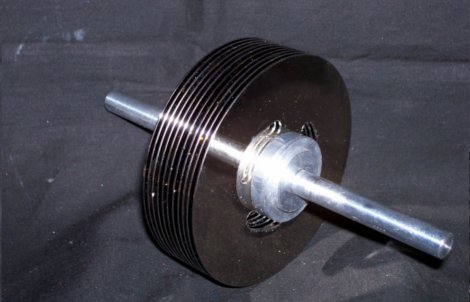
You probably weren’t expecting a project based on [Nikola Tesla’s] work to show up during the Engine Hacks theme. Most people know of him because of his pioneering work with high voltage equipment. Never the less, [Tesla] designed a device that later became known as the Tesla Turbine. Tesla turbines are made out of a series of thin disks attached to a central rotor. Air or steam is injected into the closed turbine housing at the outer edge of the disks. It swirls around through the turbine blades and eventually exits near the rotor. This type of turbine can achieve very high rotational speeds but doesn’t have a lot of torque, which limits their usefulness. Check out this instructable that shows you how to build your own Tesla turbine out of hard drive platters.

We have featured a Tesla turbine in the past on Hackaday. In this previous post, [Rick] shows us how to carve a pumpkin with a skill saw blade that is powered by one of these turbines.

DIY Portable Charger/generator

portable_charger_generator

[Glenn] from The Back Shed has built a lot of windmills and stationary generators over the years, but recently decided to try his hand at building something a bit more portable.

The charger is based of a relatively simple design, employing a 5.2 HP Kubota 4 stroke motor and a 12v car alternator to provide power. While you might be inclined to point out that his charger does exactly what an alternator and motor are built to do, there was a bit more to it than simply slapping the two parts together.

A laser cut adapter plate holds the motor and alternator together, but once [Glenn] wrapped things up and gave the motor a spin, he realized that he was driving the alternator backwards. This would eventually cause the alternator to overheat since the cooling fan was running the wrong way. He removed the fan and reversed the fins with a hammer so that he could get the cooling he needed without having to reinstall the alternator in the opposite orientation.

The whole kit was mounted on a hand truck for portability, and [Glenn] says that the charger/generator only needs to run about 5 minutes before a dead battery has enough juice to crank an engine.

[via HackedGadgets]

Need Something In A Pinch? SparkFun Products Now At Micro Center

sparkfun_available_in_microcenter

If you happen to live near a Micro Center retail store, you are now lucky enough to have another choice when it comes to purchasing DIY electronics components – SparkFun is selling their products at all Micro Center retail outlets.

While it seems SparkFun announced this change in June, we’re seeing quite a bit of buzz on the topic today. We’re pretty sure their entire catalog won’t be available in store, but they are promising a “wide-range of SparkFun products at all 23 Micro Center locations across the country.”

Known for being very DIY-friendly when it comes to building your own PC, Micro Center was a logical choice for SparkFun. There are definitely times when you need/want a part right away rather than waiting for it to ship, so this seems to be an ideal situation for hackers and makers within range of a Micro Center retail store.

This announcement definitely has us wondering if this will be one of the final nails in the Radio Shack coffin. While Micro Center doesn’t have nearly the market penetration Radio Shack does, a wider selection of components and a friendly, knowledgeable staff makes the SparkFun/Micro Center combination is a compelling one.

What are your thoughts? Let us know in the comments.

Hybrid Control Scheme Using An Xbox Game Pad And Kinect

hybrid_game_control_using_kinect

The Kinect is an interesting beast. On one hand, it’s fantastic for hacking – a purpose for which it was not designed. On the other hand, it’s “just OK” when it comes to gaming – its entire reason for being.

One of the big complaints regarding the Kinect’s control scheme is that it’s no good for games such as first person shooters, where a large majority of the action involves walking, jumping, and aiming. For his Master’s project, [Alex Poolton] put together a fantastic demonstration showing how the Kinect can be paired with a standard Xbox controller to provide hybrid gaming input.

While you might expect a simple game that shows the fundamentals of the hybrid control system, he has put together a full fledged game demo that shows how this control scheme might be implemented in a real game. [Alex] admits that it’s still a bit rough around the edges, but there’s some real potential in his design.

Continue reading to see a video demonstration of [Alex’s] project in action, and be sure to check out his blog for news and updates on the project.

Continue reading “Hybrid Control Scheme Using An Xbox Game Pad And Kinect”

Weekly Roundup 09/03/11

In case you missed them the first time, here are our most popular posts from this past week.

Our most popular post was about a ‘flashlight’ build. We are using the word flashlight loosely since this monster can draw up to 500 Watts!

Our next most popular post was about another [Jörg Sprave] project where he has built a very large slingshot that can shoot shot puts. He then proceeds to destroy a car with it.

This post describes an open-source Segway. It is built around an ATmega644 has a nice professional look to it.

If you live out in the country and have a problem with rats, this post could be for you. In this post, we look at [Snypercat’s] build where she has mounted a camcorder onto the scope for her pellet gun and also attached an infrared light source so that she can snipe rats at night.

Finally, we have a post about a custom V-12 Kawaskai Voyager. If you are looking for a great way to draw attention at your next motorcycle rally, this post might give you some inspiration.

Repairing An Old Pick And Place Machine

repairing_juki_placemat_360

Professional-grade pick and place machines are quite pricey, so when the crew at Null Space Labs picked up an old Juki Placemat 360 for only $1,200, they were stoked. When they finally got it in-house however, they realized that the seller’s definition of “working” was a bit different than theirs. The machine’s compressor is busted, and there are all sorts of other bits that require some TLC before they can get things up and running again. They have put together a “build log” showing off their work as the machine is taken from an ancient, mostly-working relic to a lean, mean, picking and placing machine.

So far, they have torn the thing down and inspected the upgrades and damage the machine has been subjected to over the years. The crew started making a few small repairs, and have even replaced the unit’s laser with machine vision, which seems to be working well thus far during testing.

While you might not have any similar machinery in your workshop, it’s still fun to watch as they tear it down and revamp it, bit by bit.