Addressing Microchip’s Open Source Problem

microchip_call_for_open_source

Hackaday alum and owner of Dangerous Prototypes [Ian Lesnet] recently wrote an editorial piece calling out Microchip on some of their less than friendly attitudes towards open source.

[Ian] and his company use PIC microcontrollers extensively in their projects, and they have quite a high opinion of their products overall. The gripe that he has (and thinks you should have too) is regarding Microchip’s approach to open source.

You see, Microchip invested in the Arduino IDE and released the chipKIT, a 32-bit Arduino compatible development board, along with big promises of “playing nice” with the open source community. The problem, according to [Ian], is that while Microchip’s compilers are based on GCC, they “keep some special sauce locked up”, which means that certain parts of the chipKIT toolchain are not open. Many in the community, including [Ian] had high hopes for the chipKIT based on the successes seen by Atmel’s open source initiatives, but many things are still locked up behind closed licenses.

An example of this unfriendly attitude towards open source can be seen in Digilent’s recently released network shield. It supports Ethernet and USB features of the chipKIT MEGA, but the TCP/IP and USB stacks are completely closed source. Digilent pushed hard to get the ability to release open drivers for the board, but it was a battle they ultimately lost. This behavior creates roadblocks for seasoned developers of open source products such as Dangerous Prototypes, as well as the curious beginner, which is why [Ian] is making a point in bringing these issues to light.

[Ian] urges Microchip to give something significant back to the community they are tapping, a result which can only be achieved by speaking up. Be sure to check out his editorial, and if after reading it you have any interest in letting your voice be heard, drop Microchip a line and let them know that their one-way relationship with the open source community is something you would like see change.


Engine Hacks: Adding Fuel Injection To A Riding Lawnmower

Engine Hacks Theme banner

Are you tired of fiddling with the engines on your lawn equipment every spring, trying to get them to run again? [jhark] was and decided to do something about it by converting his riding lawnmower over to fuel injection. After stealing a fuel injector from his van and bolting it onto the mower’s carburetor, he sprinkled in a dash of Arduino magic. With a small amount of code tweaking he was ready to roll mow. You can find a schematic and his code if you follow the forum link to the second page.

For more fuel injection goodness, check out this project where [Steve] upgrades his Austin Healey to use the fuel injection system from a General Motors vehicle. This build log is pretty comprehensive and shows each element in the system, describes what it does, and shows where it should go. If you are a car nut, this is definitely one to check out.

Finally, if you are looking to really dig into the nuts and bolts of automotive fuel injection, take a look at the Megasquirt fuel injection computer system that allows you to finely tune things to your specific car and model.

Video: Learning Eagle CAD Part I – Schematic & Custom Parts

This week we are starting in on a series of videos that are pretty different from the past few. Most hackers go through a phase where they etch their own circuit boards. This lasts for a few projects until they need to use a surface mount part, need many circuit boards to be made, or just don’t have the time needed to do everything themselves. In this video [Jack] starts a multi-part series about how to use Eagle CAD, which is a program that allows you to design your own circuit boards that you can then send out to be manufactured. Eagle CAD has a free version of their software that fits just perfectly with a beginner’s budget. There are other free layout programs out there but this one is arguably the best. Eagle CAD has a steeper learning curve than others but has some pretty powerful features to justify the extra effort that you have to expend to get going with it.

This video starts showing the schematic and library portions of the program. We have also added several supplementary videos on our YouTube channel that explain some of the tools in the tool palette in greater detail.

Hacking [Steve Jobs]: A Retrospective


steve_jobs_steps_down_as_ceo_world_panics

Provided you haven’t been toiling away in a secret lair somewhere (we’re looking at you [Jack]), odds are you may have seen the news that [Steve Jobs] stepped down as CEO of Apple this past Wednesday.

This earth-shattering news even eclipsed that of the East Coast Megaquakeapocalypse. It sent the blogosphere into a tizzy, sparking a whirlwind of news posts and retrospectives on his career. It’s been impossible to ignore the coverage (we’ve tried), and since we see everyone else writing about it, we feel the need to be at least somewhat up on our current events as well.

At the end of the day though, we don’t care how many patents [Steve] owns, how many failed products he has dreamed up over the years, or that he and [Woz] used to wear matching thongs to the beach in the 80s*.

Nope, we just care about the hacks. So here’s a trip down memory lane highlighting the Apple-related hacks we’ve seen so far in 2011, which will forever be known as the year [Steve Jobs] gave up the reigns at Apple (again).

*Bald-faced lie

XBMC on iOS Devices

Overhauling an old Apple keyboard

Mac Pro serial terminal

Taking secret photos of Apple Store patrons

Apple ][ USB keyboard conversion

Apple ][ Weather Display Parts 1, 2, 3

Raspberry Pi Might Not Be Vaporware

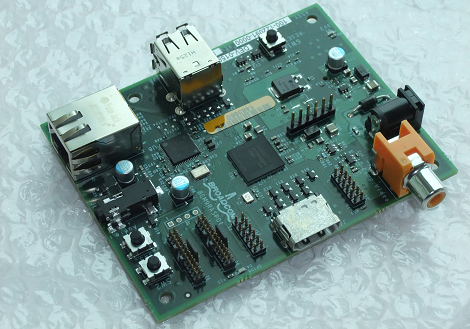
When we first covered the Raspberry Pi, we secretly wondered if the project might become vaporware. It looks like the tiny, full-fledged computer might actually be produced with the announcement of alpha boards in the Raspberry Pi HQ.

In the announcement of the Raspberry Pi last May, the board was about the size of a USB thumb drive and would cost $25. It looks like the board will be a little larger in the final revision – about the size of a business card – and production of the alpha boards were a bit over cost. That being said, these boards seem a lot more capable than what we’ve seen before. The Raspberry Pi now has 10/100 ethernet, and analog audio and video while keeping the HDMI, USB, and SD card support we saw in the original.

The Raspberry Pi team already has Debian running on these boards, so right now we’re wondering when gumstix boards will come down in price. Of course, this project is intended for use in education, but we can’t wait to see what can be done with this hardware. If you already know what you would do with this, tell us in the comments.

A Design Contest With High Odds Of Winning!

[John] wrote in to tell us about this contest hosted by Avnet. All one has to do is upload a video of their design to Avnet’s Youtube page.  There are four categories to choose from including: Solar, Communications, Transportation, and Entertainment. Four contestants can win an iPad2.

The only catch, if you can call it that, is that one would have to use at least one component from their “more than five million SKUs available.”  The thing that makes this contest more interesting than it usually would be is that there appears to be no contest entries as of August 24th. Official rules can be found on their site here.

The contest runs through the end of August, so there isn’t a lot of time to get a design together. However, it’s possible that you have something already built that fits into their product catalog. Make a 30-90 second video of it in action and you’ve got a (very good apparently) chance of winning an iPad2! Check out the contest video after the break. Continue reading “A Design Contest With High Odds Of Winning!”

Vintage Phone Has A Dirty Android Secret

android_based_vintage_phone

Instructables user [apple_fan] likes vintage telephones from the early 1900s, but while they are nice to look at, they’re clearly not too useful nowadays. He decided to change that, and retrofitted an old operator-dialed telephone with some modern amenities.

He gutted the phone, stripping out the large electromagnets and capacitor that were once used to facilitate placing and receiving calls. He added an Archos 28 tablet to the box, wiring it an IOIO board, allowing him to interface it with his Android phone. The old microphone and speaker were swapped out for updated components, and a new ringer actuator was built to replace the bulky old unit. The tablet and ringer, along with the rest of the components were then carefully hidden away inside the box as not to alter the aesthetics.

To place and receive calls, he installed CMU Sphinx on the Archos tablet, allowing him to interact with the phone using voice recognition, as if he was talking to a live operator.

It’s a pretty neat project, and while we might have opted for a small micro combined with a Bluetooth headset, [apple_fan] makes it clear why he made the hardware decisions he did. We’re always up for letting people show us a different way to get a job done, so we’re down with that.

Check out a short video demo of the phone in action after the jump.

Continue reading “Vintage Phone Has A Dirty Android Secret”