It’s A Variable Capacitor, But Not As We Know It

Radio experimenters often need a variable capacitor to tune their circuits, as the saying goes, for maximum smoke. In decades past these were readily available from almost any scrap radio, but the varicap diode and then the PLL have removed the need for them in consumer electronics. There have been various attempts at building variable capacitors, and here’s [radiofun232] with a novel approach.

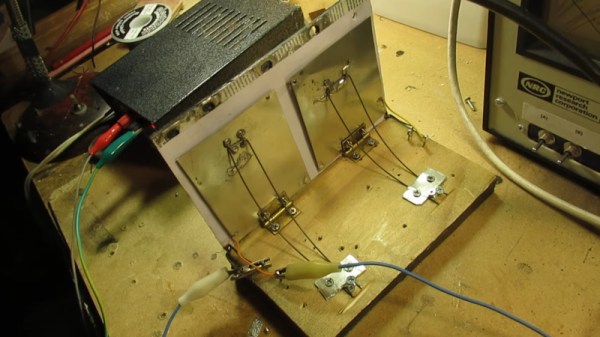
A traditional tuning capacitor has a set of meshed semicircular plates that have more of their surface facing each other depending on how far their shaft is turned. The capacitor presented in the first video below has two plates joined by a hinge in a similar manner to the covers of a book. It’s made of tinplate, and the plates can be opened or closed by means of a screw.

The result is a capacitor with a range from 50 to 150 picofarads, and in the second video we can see it used with a simple transistor oscillator to make a variable frequency oscillator. This can form the basis of a simple direct conversion receiver.

We like this device, it’s simple and a bit rough and ready, but it’s a very effective. If you’d like to see another unusual take on a variable capacitor, take a look at this one using drinks cans.

Continue reading “It’s A Variable Capacitor, But Not As We Know It”
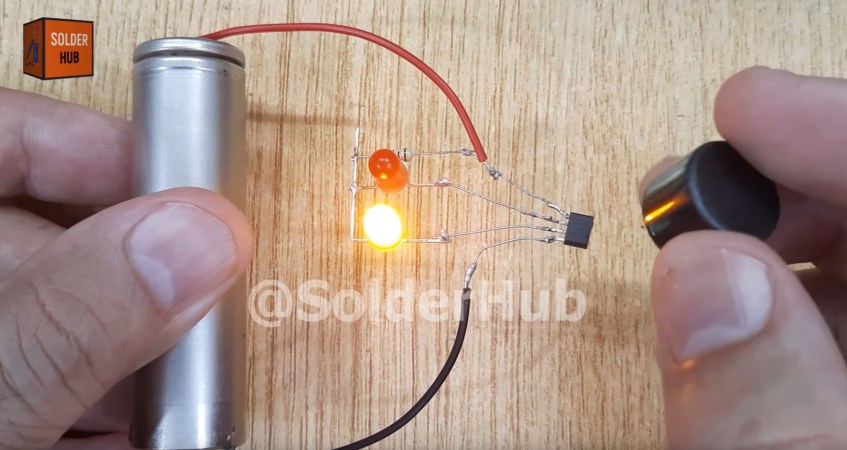
A photo of the air-wired circuit, with one LED on and the other off.

The Magic Of The Hall Effect Sensor

Recently, [Solder Hub] put together a brief video that demonstrates the basics of a Hall Effect sensor — in this case, one salvaged from an old CPU fan. Two LEDs, a 100 ohm resistor, and a 3.7 volt battery are soldered onto a four pin Hall effect sensor which can toggle one of two lights in response to the polarity of a nearby magnet.

If you’re interested in the physics, the once sentence version goes something like this: the Hall Effect is the production of a potential difference, across an electrical conductor, that is transverse to an electric current in the conductor and to an applied magnetic field perpendicular to the current. Get your head around that!

Of course we’ve covered the Hall effect here on Hackaday before, indeed, our search returned more than 1,000 results! You can stick your toe in with posts such as A Simple 6DOF Hall Effect ‘Space’ Mouse and Tracing In 2D And 3D With Hall Effect Sensors.

Continue reading “The Magic Of The Hall Effect Sensor”

Give Your Twist Connections Some Strength

We’ve all done it at some time — made an electrical connection by twisting together the bare ends of some wires. It’s quick, and easy, but because of how little force required to part it, not terribly reliable. This is why electrical connectors from terminal blocks to crimp connectors and everything else in between exist, to make a more robust join.

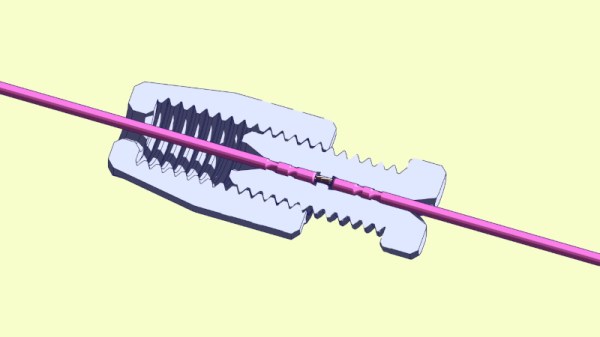
But what if there was a way to make your twist connections stronger? [Ibanis Sorenzo] may have the answer, in the form of an ingenious 3D printed clamp system to hold everything in place. It’s claimed to result in a join stronger than the wire itself.

The operation is simple enough, a spring clamp encloses the join, and a threaded outer piece screws over it to clamp it all together. There’s a pair of 3D printable tools to aid assembly, and a range of different sizes to fit different wires. It looks well-thought-out and practical, so perhaps it could be a useful tool in your armoury. We can see in particular that for those moments when you don’t have the right connectors to hand, a quick 3D print could save the say.

A few years ago we evaluated a set of different ways to make crimp connections. It would be interesting to subject this connection to a similar test. Meanwhile you can see a comprehensive description in the video below the break.

Continue reading “Give Your Twist Connections Some Strength”

Turning A $2 IKEA Lantern Into A Stylish Enclosure

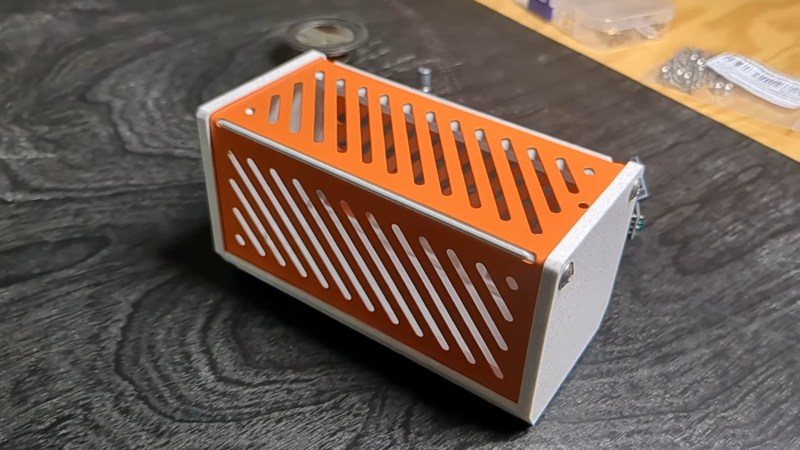
It’s fair to say that the average Hackaday reader enjoys putting together custom electronics. Some of those builds will be spaghetti on a breadboard, but at some point you’ll probably have a project that needs a permanent case. If you’re looking for a small case for your latest creation, check out [Julius Curt’s] modification of an IKEA Vårsyren lantern into a customizable enclosure!

Continue reading “Turning A $2 IKEA Lantern Into A Stylish Enclosure”

Faux Potentiometers Use Magnets, No Contacts

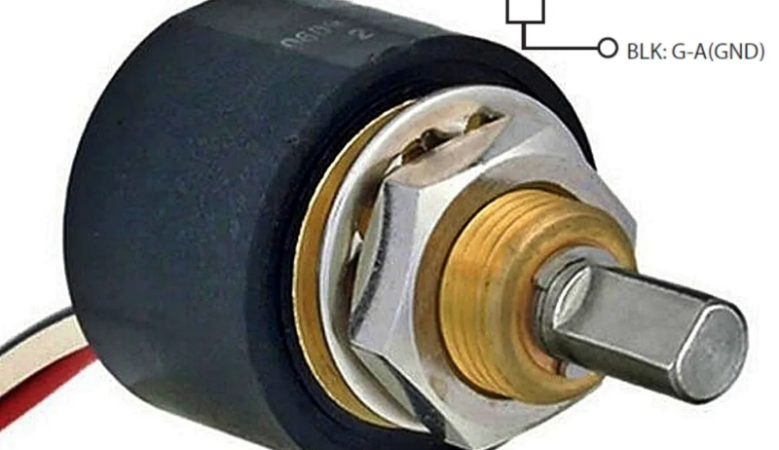
Ever tear open a potentiometer? If you haven’t, you can still probably guess what’s inside. A streak of resistive material with some kind of contact that moves across it as you rotate the shaft, right? Usually, you’d be right, but [T. K. Hareedran] writes about a different kind of pot: ones that use magnetic sensing.

Why mess with something simple? Simplicity has its price. Traditional units may not be very accurate, can be prone to temperature and contamination effects, and the contact will eventually wear out the resistive strip inside. However, we were a little curious about how a magnetic potentiometer could offer a resistive output. The answer? It doesn’t.

Really, these would be better described as rotary encoders with a voltage output. They aren’t really potentiometers. The SK22B mentioned in the article, for example, requires a 5 V input and outputs somewhere between 10% and 90% of that voltage on the ersatz wiper pin.

That makes the devices much easier to puzzle out. The linearity of a device like that is better than a real pot, and, of course, the life expectancy is greatly increased. On the other hand, we’d rather get one with quadrature or I2C output and read it digitally, but if you need a voltage, these devices are certainly an option.

[T. K.] goes on to show how he fabricated his own non-contact sensor using photosensors and a gray-coded wheel with a single track. You do need to be careful about where you position the sensors, though.

Could you make a real non-contact resistive pot? Seems like you could get close with an FET output stage, but it wouldn’t be as generally applicable as a good old-fashioned smear of carbon. If you have a better idea, drop it in the comments or build it and give us a tip.

Want a 20A-capable device? Build it. Want to see how we like to read encoders?

Flyback Converter Revealed

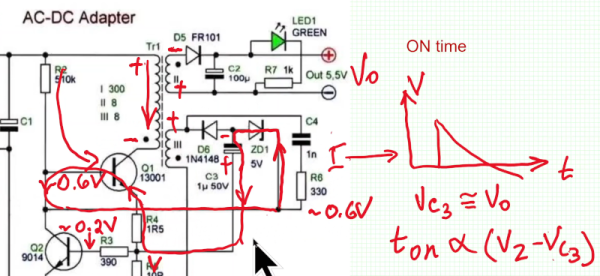
As [Sam Ben-Yaakov] points out in a recent video, you don’t often see flyback converters these days. That’s because there are smarter ways to get the same effect, which is to convert between two voltages. If you work on old gear, you’ll see plenty of these, and going through the analysis is educational, even if you’ll never actually work with the circuit. That’s what the video below shows: [Sam’s] analysis of why this circuit works.

The circuit in question uses a bridge rectifier to get a high-voltage DC voltage directly from the wall. Of course,  you could just use a transformer to convert the AC to a lower AC voltage first, but then you probably need a regulator afterwards to get a stable voltage.

Continue reading “Flyback Converter Revealed”

Continuous-Path 3D Printed Case Is Clearly Superior

[porchlogic] had a problem. The desire was to print a crystal-like case for an ESP32 project, reminiscent of so many glorious game consoles and other transparent hardware of the 1990s. However, with 3D printing the only realistic option on offer, it seemed difficult to achieve a nice visual result. The solution? Custom G-code to produce as nice a print as possible, by having the hot end trace a single continuous path.

The first job was to pick a filament. Transparent PLA didn’t look great, and was easily dented—something [porchlogic] didn’t like given the device was intended to be pocketable. PETG promised better results, but stringing was common and tended to reduce the visual appeal. The solution to avoid stringing would be to stop the hot end lifting away from the print and moving to different areas of the part. Thus, [porchlogic] had to find a way to make the hot end move in a single continuous path—something that isn’t exactly a regular feature of common 3D printing slicer utilities.

The enclosure itself was designed from the ground up to enable this method of printing. Rhino and Grasshopper were used to create the enclosure and generate the custom G-code for an all-continuous print. Or, almost—there is a single hop across the USB port opening, which creates a small blob of plastic that is easy to remove once the print is done, along with strings coming off the start and end points of the print.

Designing an enclosure in this way isn’t easy, per se, but it did net [porchLogic] the results desired. We’ve seen some other neat hacks in this vein before, too, like using innovative non-planar infill techniques to improve the strength of prints.

Continue reading “Continuous-Path 3D Printed Case Is Clearly Superior”