Hide Your Repeater And Gain A Radio

[Bradley]’s workplace was recently put into a position where they needed to install a WIFI network to operate some wireless barcode scanners, which was left open for anyone to connect to. Management thought that the people in the shop, who didn’t really need internet, would get less work done if they had access to it. So they just simply stuck the access point as far away as they could. Problem with that theory is that the signal still reaches a little bit where they don’t want it, and people in the shop really want access, so a repeater is needed.

Of course this repeater cant be just sitting out in the open. so [Bradley] decided to hide the it inside of an old radio. Searching around he finally settled on a 10$ ebay radio from the 1980’s, which is large enough to hold the guts of a WRT54G. The routers AC adapter was popped open and wired into the AC input of the radio, the main board and antennas were epoxied to the back. Once everything is buttoned back up you’re left with a hidden repeater, and a fully functional radio.

Now hopefully none of his bosses read his blog!

Hellduino: Hellschreiber Radio Transmissions From An Arduino Board

[Mark VandeWettering] was experimenting with a simple transmitting circuit and an Arduino. The circuit in the project was designed by [Steve Weber] to broadcast temperature and telemetry data using Morse Code. But [Mark] wanted to step beyond that protocol and set out to write a sketch that broadcasts using the Hellschreiber protocol.

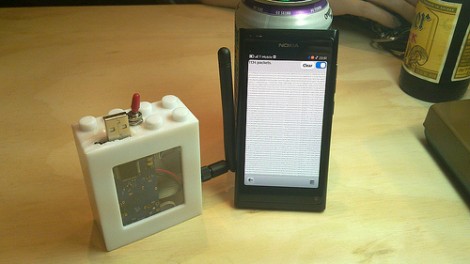
This protocol transmits glyph images, which are decoded as you see above. For some reason we can’t help but think this is like Captcha for radio enthusiasts. We have seen Hellschreiber used with AVR microcontrollers before, but this is the first Arduino implementation that we’ve come across. [Mark] does a great job of demonstrating his project in the video after the break. He mentions that the transmitter has no antenna, but is still being picked up by his receiving antenna mounted behind his house.

Since [Mark] doesn’t really cover the hardware he used, you will need to look back at [Steve’s] original design schematics for more information.

Continue reading “Hellduino: Hellschreiber Radio Transmissions From An Arduino Board”

Matchbox Launcher Reacts To Emergency Band Radio Dispatcher

[Jeff] and his wife put together a firefighter themed birthday celebration for their son. As he’s not entirely handy in the kitchen, [Jeff] decided not to lend a hand with the baking or cake decorating. But he didn’t forego the opportunity to combine a couple of different projects to make a Matchbox car launcher that responds to emergency band radio.

Since he’s an amateur radio enthusiast he already had a scanner to monitor the air waves. Apparently there’s a band just for relaying dispatch messages to emergency vehicles. He set the radio equipment to only monitor that channel. An Arduino was added to the mix, taking measurements of the voltage level on the scanner’s audio output. When it’s driven high enough the Arduino trips the toy car launcher.

The car launcher itself is a pretty nifty setup. There are five chutes at the top of a ramp that each fit a car. A sliding gate holds them in place, but can be removed one slot at a time by a geared motor. The addition of a poster board facade and two flashing red LEDs makes the setup look right at home with the other party decorations.

See a call come into the station in the clip after the break. We don’t have a category called “fun parenting” so “toy hacks” will have to do.

Continue reading “Matchbox Launcher Reacts To Emergency Band Radio Dispatcher”

Using Mains Wiring As An Antenna

Make sure to brush up on your safety protocol if you undertake this project. The penalty for messing up when using live wiring as a radio receiver antenna is rather severe. But after reading about it in some old books [Miroslav] decided to give this technique a try.

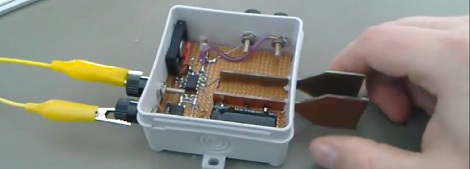
We love the old-school chalk board he used to map out his test circuit. With safety in mind, he uses two high voltage capacitors in series. If these should somehow fail, there is also a fuse which would blow, disconnecting the apparatus from mains. But just to be sure, he isolated the circuit using a two coils. These step down the voltage, but would also burn out if hit with a voltage spike.

You can see the results he gets using the setup as an AM radio receiver in the video after the break. He tested against a meter long antenna and found that his setup far outperforms it. Actually, he found that a six foot extension cord which is not plugged into the wall will also outperform the 1m antenna. Something to keep in mind the next time the ball game isn’t coming in as clear as you would like.

Continue reading “Using Mains Wiring As An Antenna”

Scratch-built Software-Defined Radio

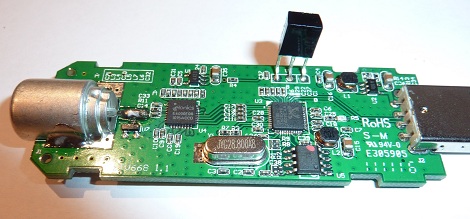
[Ben] is showing off some results from his Software-Define Radio project. The board seen above, which he designed from the ground up, is receiving a WWV radio broadcast. This is the atomic clock signal from Fort Collins, Colorado. The audio heard in the clip after the break is a bit noisy, but since he’s about 2000 miles from the origin of the signal we think he’s done really well!

The seed for this build was planted in [Ben’s] head back in July when he saw [Jeri Ellsworth’s] SDR project. He’s posted some of the build details up in a forum post. The approach is similar to [Jeri’s] but there are several key differences. He’s using a DS1085 programmable oscillator where she chose an FPGA for that purpose. Once his hardware demodulates and filters the incoming signal, a PIC32 does the rest of the work and outputs a PWM signal to an Op-Amp to generate audio.

Continue reading “Scratch-built Software-Defined Radio”

Eight-dollar Airplane For Really Bad Pilots

Have a habit of hitting the bottle before getting into the cockpit? Find that your mind wanders mid-flight? Lack the hand-eye coordination to keep that RC creation of yours in the air? Worry not, you can build this flyer and crash it with impunity.

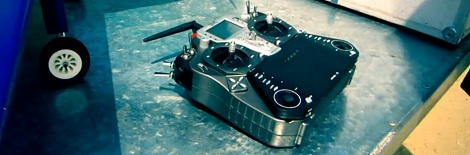
[HammyDude] built the RC aircraft out of laminated foam board. He’s had it for years and it’s survived multiple crashes. You can see the one real injury suffered, a snapped fuselage at the leading edge of the wings. He repaired it with popsicle sticks and it’s been going strong ever since.

In addition to the wooden reinforcements he’s covered the fuselage with fibrous packing tape (you know, the stuff with the strings running in it). There’s also a carbon fiber tube at the leading edge of each wing. It’s light, strong, and robust (with the exception of the propeller of which he’s broken about 10).

Check out the video after the break for an explanation of the aircraft, list of materials, and HD images of the patterns you need to make them yourself. The only thing you won’t see is flight footage.

Continue reading “Eight-dollar Airplane For Really Bad Pilots”

Grab Your Own Images From NOAA Weather Satellites

Can you believe that [hpux735] pulled this satellite weather image down from one of the National Oceanic and Atmospheric Administration’s weather satellites using home equipment? It turns out that they’ve got three weather satellites in low earth orbit that pass overhead a few times a day. If you’ve got some homebrew hardware and post processing chops you can grab your own images from these weather satellites.

The first step is data acquisition. [hpux735] used a software defined radio receiver that he built from a kit. This makes us think back to the software-radio project that [Jeri Ellsworth] built using an FPGA–could that be adapted for this purpose? But we digress. To record the incoming data a Mac program called DSP Radio was used. Once you do capture an audio sample, you’ll need something to turn it into an image. It just so happens there’s a program specifically for weather image decoding called WXtoImg, and another which runs under Linux called WXAPT. Throw in a little post processing, Robert’s your mother’s brother, and you’ve got the image seen above.

[Hpux735] mentioned that he’s working on a post about the antenna he built for the project and has future plans for an automated system where he’ll have a webpage that always shows the most current image. We’re looking forward hearing about that.