AM/FM SOS Beacon Saves Your Bacon

bacon_beacon_breadboard

[BadWolf] sent us a device called the “Bacon Beacon“, which is his 555 Design Contest entry. In short, it’s a life-saving device that emits an S.O.S. signal in Morse code over both the AM and FM bands. The device uses five 555 timers to get the job done, each of them dedicated to a specific task. Three of the timers are used for clocking and Morse generation, while the remaining two are used to produce and transmit an audible signal over the air waves. Currently, the signal can be received about a mile away from the source, which would theoretically allow for a search and rescue team to locate you with a simple radio and directional antenna.

The current design is still a bit rough around the edges, but the final plans would have the circuit built into a flashlight-like device equipped with red and green signaling LEDs. It’s a clever project and would make for a great tool if you got lost while hiking, or in the event of a zombie apocalypse.

Stick around for a quick video of the Bacon Beacon in action, and swing by [BadWolf’s] site if you want to know why his project has such a strange moniker (hint: it’s not because it can “save your bacon”).

Continue reading “AM/FM SOS Beacon Saves Your Bacon”

All-band Receiver Hides In Plain Sight

This handheld radio has a little secret. You’re not going to be able to listen to Limbaugh since the original FM tuning circuit has been removed and replaced by a diode detector. Now [Miguel A. Vallejo] a discreet way to look for interesting radio signals in public.

The first step that he took was to remove the circuit board from the case and depopulate the tuning circuit while leaving the audio amplifier hardware. Next he referenced a proven design and built the diode detector circuit on a piece of protoboard. Finally he patched the new circuit into the original audio amplifier (seen in the image above) and put everything back in the case. Now he can listen in on data burst from a keypress on a computer keyboard, RF data communications, and slew of other noise sources.

This would be really handy for tracking down the electrical noise that’s screwing up your project.

[Thanks Superlopez]

Hear That? It’s A 555 Timer AM Radio

555_timer_am_radio

[Eric] recently built an AM radio based on a 555 timer, and posted a few pictures to the Hack-a-Day Flickr pool. He used the 555 timer as an AM demodulator and power amplifier in order to drive the speaker. A hand-wound inductor is used to tune the signal which is then superimposed over the ramp signal produced by the circuit he built. [Eric] points out that he chose a CMOS 555 timer because of its superior performance in this particular application since the timer is used in a bit of a nontraditional manner. He shared his circuit diagram as well as a great video walking through each part of his design, finishing off with a demonstration of the radio, which can be seen below.

This is yet another great project that will be entered in the 555 Design Contest – simple and elegant. We love seeing these, so keep them coming!

If you want to see more cool projects made by Hack-a-Day readers, be sure to check out our Flickr pool as well as the forums.

Continue reading “Hear That? It’s A 555 Timer AM Radio”

Launchpad Serial Morse Code Transmitter

LaunchPad-Serial-Morse-Transmitter

LaunchPad dev boards from Texas Instruments are cheap and easy to program, making them a great Arduino alternative if you can do without some of the bells and whistles. [ech0s] put his to good use by constructing a Morse code transmitter with dual operating modes. The transmitter can not only encode and transmit messages entered in a terminal client, it also allows the user to send messages by manually operating the key switch. Inspired by the high altitude balloon transmitter we featured last summer, this project uses similar components for signal amplification and transmission. Text can be entered in a Putty terminal window, which then is encoded into Morse by the MCU before transmission. At the moment, the speed of the radio transmission is about 15 WPM, which is reasonably quick. Even though his system performs quite well [ech0s] has some improvements planned, including having a proper PCB built as well as some software tweaks to improve buffering and bandwidth. Be sure to check out his video of the transmitter in action after the jump.

Continue reading “Launchpad Serial Morse Code Transmitter”

Building A Better Spectrum Analyzer For Radio Enthusiasts

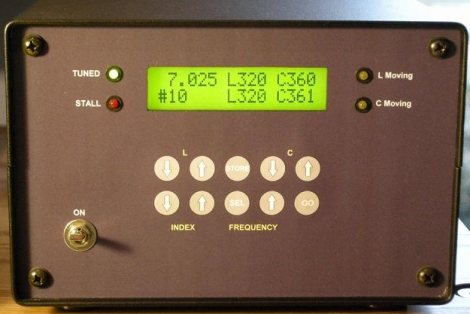
This spectrum analyzer project seeks to improve the quality of tools available to amateur radio operators. A lot of thought has gone into the design, and those details are shared in the verbose project log. The case was originally a CATV link transmitter, but most of the controls seen above have been added for this build, with unused holes filled and finished to achieve the clean look.

One noteworthy part of the build is the time that went into building a rather complicated-looking 1013.3 MHz cavity bandpass filter. Despite the effort, the filter didn’t work. Details are a bit sketchy but it seems that some additional tuning brought it within spec to complete that portion of the device.

This certainly makes other toy spectrum analyzers look like… toys.

[Thanks William]

Sniffing RF Hardware Communication Packets

[Travis Goodspeed] put together a proof of concept hack that sniffs wireless keyboard data packets. He’s using the Next HOPE badge that he designed as the hardware platform for these tests. It has an nRF24L01+ radio on-board which can easily communicate with 2.4 GHz devices.

The real trick comes in getting that radio to listen for all traffic, then to narrow that traffic down to just the device from which you want data. He covers the protocol that is used, and his method of getting around MAC address verification on the hardware. In the end he can listen to all keyboard data without the target’s knowledge, and believes that it is possible to inject data using just the hardware on the badge.

Building Linear Amplifier Prototypes

We know way too little about this subject but hopefully [Bob4analog] helped us learn a little bit more this time around. He’s building his own linear amplifiers on what looks like sheets of MDF. This is an evolving design and the two videos after the break show two different iterations. He’s salvaged several components, like transformers from microwaves, as well as built his own components like the plate choke to the right of the tubes in the image above. In standby, the amp sits at 2800 volts, warming the filament before the unit is switched on.

So what’s he got planned for this? Good question, but it appears that there’s more than enough power to drive a long-range transmitter.

Continue reading “Building Linear Amplifier Prototypes”