Wardriving For Zigbee

Wardriving started out as a search for unprotected WiFi access points before hot spots were prevalent. And so this ZigBee protocol wardriving hardware which [Travis Goodspeed] put together really gives us a sense of nostalgia for that time. Don’t get us wrong, we love our pervasive WiFi access and don’t wish to go back to simpler times. But if the radio signals your looking for are scarce, locating them provides a challenge.

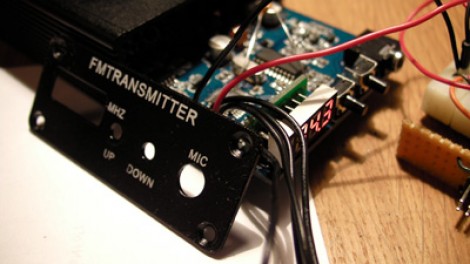
Regular readers will recognize that [Travis] is interested in all things RF. One of his projects included sniffing wireless keyboard packets out of thin air and displaying them on the screen of his Nokia N900. This is right along those lines but he’s upgraded to an N9 phone for the display hardware. He switched up the RF hardware, using a TelosB (a board he’s already familiar with) to get on the 802.15.4 ZigBee spectrum. This dev board has an expansion port which let him use an RN42 module for wireless communications with the phone. This means the sniffing hardware can be hidden away in a backpack or jacket. After all, nobody will question someone walking around staring at a smart phone.

Passive Filters, Data Transmission And Equalization Oh My!

[Shahriar] is back with a new “The Signal Path” video. It has been a few months but it is okay because his videos are always packed full of good information. Some new equipment has been added to his lab and as an added bonus a quick tour of the equipment is included at the start, which is great if you like drooling over sweet machines.

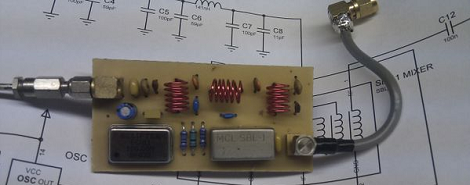
The real focus of the video is high speed data communications, getting up into the GHz per second range. [Shahriar] covers filtering techniques from simple RC low pass filters to pretty complex microwave filters. Explaining frequency and time domain measurements of a 1.5Gbps signal through a low bandwidth channel. He also shows how equalization can be used to overcome low bandwidth limitations.

It is an hour long video jam packed with information, so you might want to set aside some time and have a pencil on hand before going in. It is well worth it though, so join us after the break.

Continue reading “Passive Filters, Data Transmission And Equalization Oh My!”

Designing A Smarter RF Transceiver

Two  months ago we featured a transceiver based on the Microchip MRF49XA, and a lot of feedback was sent to [hpux735] requesting that some brains be added onto the system. [hpux735] decided that if he was going to do it, might as well go the distance and make a make a native USB transceiver.

The prototype model is designed for use with the Atmel AT90USBKey, and uses the LUFA USB framework. The protocol and packet format was revised, and a Hamming Code implementation was built using look-up tables to give error control. Finally once the prototype was ready to go [hpux735] created some awesome little PCB’s that contain the AVR, radio, antenna hookups, and blinky lights (no project is complete without blinky lights) are all ready to go when you are.

This project has come quite a long way, covers 3 blog pages, uses a fair bit of ribbon cable, but you just got to love when a plan comes together.

[Sprite_tm]’s Three-component FM Transmitter

When the Regency TR-1 transistor radio came out onto the market in the 1950s, it was hailed as a modern marvel of microelectronics. With only four transistors and a handful of other components, the TR-1 was a wonder of modern engineering. [Sprite_tm] may have those old-timers beat, though. He built an FM transmitter with the lowest parts count of any transmitter ever.

Like most of [Sprite_tm]’s builds, it’s an unimaginably clever piece of work. [Sprite] overclocked the internal RC oscillator of an ATtiny45 to 24 MHz. After realizing the PLL running at four times the frequency of the oscillator was right in the middle of the FM band, he set about designing a tiny FM transmitter.

[Sprite_tm] remembered his work on MONOTONE and made a short song for hit ATtiny. The firmware for the build takes the notes from his song and varies the 96 MHz PLL frequency a tiny bit, thereby serving as a tiny FM transmitter.

Does it work? Well, if you want to compare it to a Mister Microphone, the range is incredibly limited. That being said it works. It’s an FM transmitter built out of a microcontroller and a battery, and that’s very impressive. Check out [Sprite_tm]’s demo after the break.

Continue reading “[Sprite_tm]’s Three-component FM Transmitter”

Hide Your Repeater And Gain A Radio

[Bradley]’s workplace was recently put into a position where they needed to install a WIFI network to operate some wireless barcode scanners, which was left open for anyone to connect to. Management thought that the people in the shop, who didn’t really need internet, would get less work done if they had access to it. So they just simply stuck the access point as far away as they could. Problem with that theory is that the signal still reaches a little bit where they don’t want it, and people in the shop really want access, so a repeater is needed.

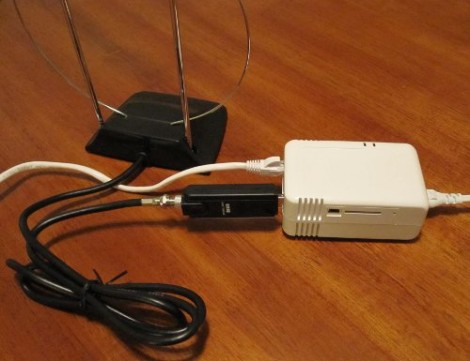
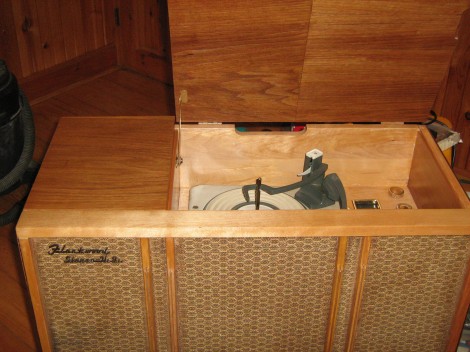
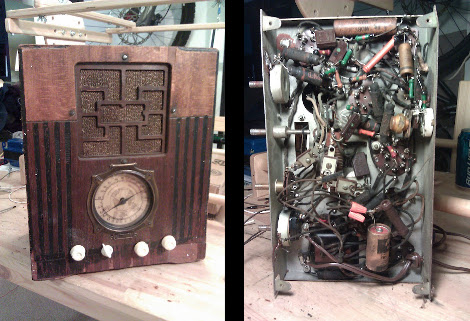
Of course this repeater cant be just sitting out in the open. so [Bradley] decided to hide the it inside of an old radio. Searching around he finally settled on a 10$ ebay radio from the 1980’s, which is large enough to hold the guts of a WRT54G. The routers AC adapter was popped open and wired into the AC input of the radio, the main board and antennas were epoxied to the back. Once everything is buttoned back up you’re left with a hidden repeater, and a fully functional radio.

Now hopefully none of his bosses read his blog!

Hellduino: Hellschreiber Radio Transmissions From An Arduino Board

[Mark VandeWettering] was experimenting with a simple transmitting circuit and an Arduino. The circuit in the project was designed by [Steve Weber] to broadcast temperature and telemetry data using Morse Code. But [Mark] wanted to step beyond that protocol and set out to write a sketch that broadcasts using the Hellschreiber protocol.

This protocol transmits glyph images, which are decoded as you see above. For some reason we can’t help but think this is like Captcha for radio enthusiasts. We have seen Hellschreiber used with AVR microcontrollers before, but this is the first Arduino implementation that we’ve come across. [Mark] does a great job of demonstrating his project in the video after the break. He mentions that the transmitter has no antenna, but is still being picked up by his receiving antenna mounted behind his house.

Since [Mark] doesn’t really cover the hardware he used, you will need to look back at [Steve’s] original design schematics for more information.

Continue reading “Hellduino: Hellschreiber Radio Transmissions From An Arduino Board”

Matchbox Launcher Reacts To Emergency Band Radio Dispatcher

[Jeff] and his wife put together a firefighter themed birthday celebration for their son. As he’s not entirely handy in the kitchen, [Jeff] decided not to lend a hand with the baking or cake decorating. But he didn’t forego the opportunity to combine a couple of different projects to make a Matchbox car launcher that responds to emergency band radio.

Since he’s an amateur radio enthusiast he already had a scanner to monitor the air waves. Apparently there’s a band just for relaying dispatch messages to emergency vehicles. He set the radio equipment to only monitor that channel. An Arduino was added to the mix, taking measurements of the voltage level on the scanner’s audio output. When it’s driven high enough the Arduino trips the toy car launcher.

The car launcher itself is a pretty nifty setup. There are five chutes at the top of a ramp that each fit a car. A sliding gate holds them in place, but can be removed one slot at a time by a geared motor. The addition of a poster board facade and two flashing red LEDs makes the setup look right at home with the other party decorations.

See a call come into the station in the clip after the break. We don’t have a category called “fun parenting” so “toy hacks” will have to do.

Continue reading “Matchbox Launcher Reacts To Emergency Band Radio Dispatcher”