Radar Gun Teardown

[Jeri Ellsworth] is at it again, this time she takes apart a hot wheels speed gun and in the process she does a good job of  explaining how radar can be used to measure speed.  She also demonstrates a way to determine if an object is approaching or receding from the radar gun.

The Doppler shift is one way to remotely measure the speed of an object. It works by measuring the change in frequency of a wave after it strikes an object. Rather than measuring the Doppler shift of the returning wave most radar guns use the phase shift. The reason is that the frequency shift of a relativly slow object (60mph), to a relitivly high frequency signal(10GHz) is small (about 0.893Hz), where the phase shift varies based on the distance of the object.  This is all just a stepping stone in her quest to build a crude TSA body scanner.

Barcode Challenge For Radio Operators

[Scott Harden] came across a few posts about QR code matrix barcodes coming through on the 40m baud radio band. A few operators had captured the signals and assembled them into the code block seen above but they weren’t able to get a clear enough shot for a smartphone to decode the image. [Scott] took on the challenge and decoded the mysterious message himself. He tried some graphic editing to separate and enhance the color channels in order to up the contrasts of the image. This helped, but still couldn’t be read automatically. In a move similar to those seen in Hackaday’s own barcode challenges he dropped the image into Inkscape so that he could manually clean it up. Once it was overlaid on a grid the job was pretty simple. the left side did require some more image manipulation and precision”squinting” to eliminate interference from the vertical banding, but he managed to get the message. We won’t spoil it here in case you want to take on the challenge yourself. Good luck!

Ubertooth Board For Bluetooth Experimentation

Ubertooth Zero is the first offering in [Michael Ossman’s] quest for a Bluetooth sniffing and hacking hardware platform. We’ve seen some of his hacks in the past, like the build-in guitar tuner and some pink pager fiddling. The Ubertooth dongle is his original design based around an LPC1758 ARM Cortex-M3 processor paired with a Texas Instruments 595-CC2400-RTB1 to handle the 2.4 GHz RF communications. Looking at the bill of materials shows a very low cost for the components at just under $30 (if you can get your hands on a PCB to mount them on). He’s written firmware as well as host code to help you up start pulling Bluetooth packets out of the air as quickly as possible.

What can you do with this? That’s up to you, but whatever it is you accomplish, we’d like to hear about it.

FM Bug Using Salvaged SMD Parts

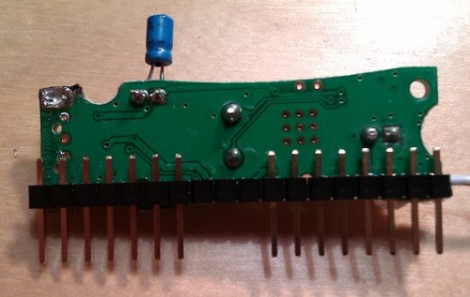
If you’re a soldering ninja this FM transmitter bug is for you. It’s quite similar to the one we looked at yesterday, but this uses 100% salvaged parts. Two phones donated components; a Nokia 3210 for its voltage-controlled oscillator and a Nokia 1611 for the rest of the parts. The bad news is that mobile technology like cellphones use some of the smallest surface mount packages known to man. That’s where the soldering skill come into play. The good news is that if you’ve been scavenging for discarded phones in order to reuse their LCD screens you already have these parts on hand.

[Thanks George]

Tiny FM Transmitter Bugs Rooms

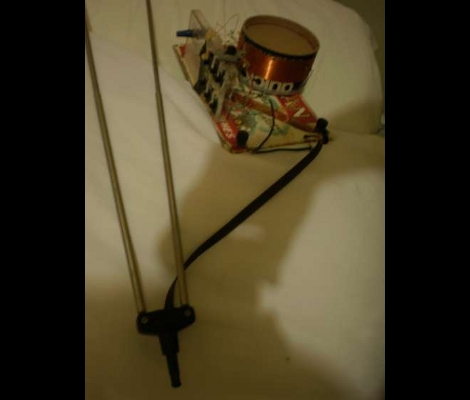
Lucid Science delves into spy-tech once again with this tiny FM transmitter. Their post demonstrates a bit larger version than seen above, using a 9-volt battery and protoboard sized to match which makes for easier soldering. The design uses a microphone, two transistors, enameled wire for the coil, as well as various resistors, capacitors, and a potentiometer. What you end up with is an amazingly clear audio signal that can be picked up with a normal FM radio.

This would make a great project to do with the kids. You can talk about circuit design, practice soldering, and when finished they’ve got an almost miraculous toy to play with. Just be careful what you say around the house, the room might be bugged!

Building A Crystal Oven

Radio communications depend on stable oscillator frequencies and with that in mind, [Scott Harden] built a module to regulate temperature of a crystal oscillator. The process is outlined in the video after the break but it goes something like this: A small square of double-sided copper-clad board is used as a base. The body of the crystal oscillator is mounted on one side of this base. On the other side there is a mosfet and a thermister. The resistance of the thermister turns the mosfet on and off in an attempt to maintain a steady temperature.

This is the first iteration of [Scott’s] crystal oven. It’s being designed for use outdoors, as his indoor setup uses a styrofoam box to insulate the oscillator from ambient temperatures. He’s already working on a second version, and mentioned the incorporation of a Wheatstone bridge but we’ll have to wait to get more details.

Continue reading “Building A Crystal Oven”

A Simple FM Transmitter

Here is a low component count FM transmitter. It sacrifices some features, like the ability to adjust the frequency, for simplicity’s sake. The build method is fairly common with amateur radio but we don’t see it around here too much. Each component gets a 5mm-by-5mm copper clad pad which is super glued to the ground plate as an insulator. There’s even a pictorial example of this method if you need some help with visualization.

One of the schematics included in the article shows how to incorporate a condenser microphone into the unit. We guess that makes it pretty easy to add an FM ‘bug’ to your arsenal of covert listening devices. Just make sure to check your local laws before building and using this. We’re not sure what the FCC would think of it here in America so we’re hoping some well-informed readers will educate us with a comment.

[Thanks Bart]