3D Print Your Next Antenna

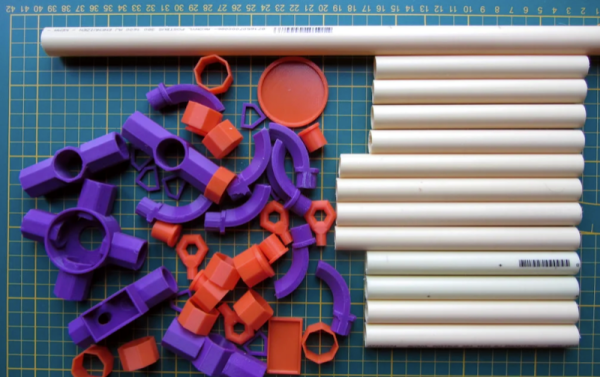
Building antennas is a time-honored ham radio tradition. Shortwave antennas tend to be bulky but at VHF frequencies the antenna sizes are pretty manageable. [Fjkaan’s] 2 meter quadrifilar helicoidal antenna is a good example and the structure for it can be created with 3D printing combined with electrical conduit.

Many people, including [G4ILO] use PVC pipe for the structure, and that design inspired [Fjkaan]. Despite being a bit less substantial, the conduit seems to work well and it is easy to cut. The helical design is common for satellite work owing to its circular polarization and omnidirectional pattern.

Continue reading “3D Print Your Next Antenna”

Your Own 11.2 GHz Radio Telescope

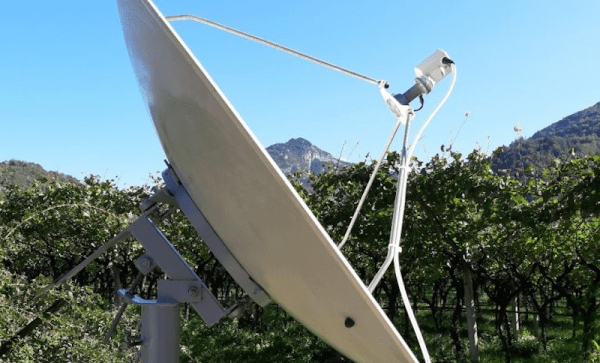
Modern life has its conveniences. Often, those conveniences lead to easier hacks. A great example of that is the rise of satellite television and the impact it has had on amateur radio telescopes. There was a time when building a dish and a suitable low noise amplifier was a big deal. Now they are commodity parts you can get anywhere.

The antenna in use is a 1.2-meter prime focus dish. Some TV dishes use an offset feed, but that makes it harder to aim for use in a radio telescope. In addition to off-the-shelf antenna and RF components, an AirSpy software-defined radio picks up the frequency-shifted output from the antenna. There is more about the software side of the build in a follow-up post. We liked that this was a pretty meaty example of using GNU Radio.

Continue reading “Your Own 11.2 GHz Radio Telescope”

1938 Radio Has Awesome Dial

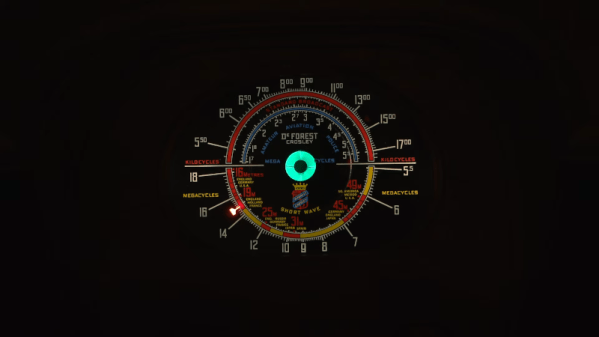
[Mr. Carlson] is truly an old radio surgeon. The evidence? He recently restored an 83-year-old DeForest radio by transplanting an identical chassis from another similar radio. The restoration is fun to watch, but the 7D832 radio dial looks amazing. The dial is very colorful and the wooden knobs and preset selector are beautiful. To seal the deal, the center of the dial has a magic eye tube, giving the radio a retro high tech look.

The donor chassis needed some work before the surgery. In addition, [Carlson] makes some improvements along the way. The radio showed signs of previous service work, which is not surprising after 83 years.

Continue reading “1938 Radio Has Awesome Dial”

The $50 Ham: Digital Modes With WSJT-X

As it is generally practiced, ham radio is a little like going to the grocery store and striking up a conversation with everyone you bump into as you ply the aisles. Except that the grocery store is the size of the planet, and everyone brings their own shopping cart, some of which are highly modified and really expensive. And pretty much every conversation is about said carts, or about the grocery store itself.

With that admittedly iffy analogy in mind, if you’re not the kind of person who would normally strike up a conversation with someone while shopping, you might think that you’d be a poor fit for amateur radio. But just because that’s the way that most people exercise their ham radio privileges doesn’t mean it’s the only way. Exploring a few of the more popular ways to leverage the high-frequency (HF) bands and see what can be done on a limited budget, in terms of both cost of equipment as well as the amount of power used, is the focus of this installment of The $50 Ham. Welcome to the world of microphone-optional ham radio: weak-signal digital modes.

Continue reading “The $50 Ham: Digital Modes With WSJT-X”

3D Printer Makes Ham Antenna Portable

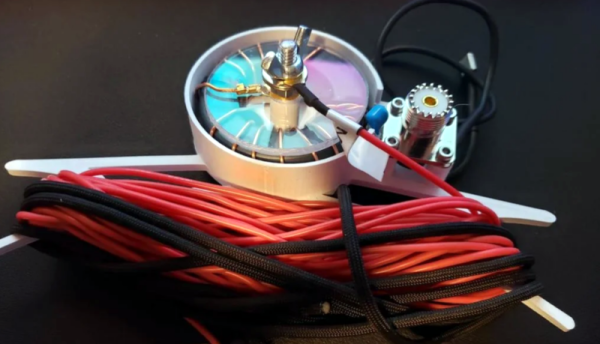
You don’t normally think of a 3D printer as a necessity for an antenna project. However, if you are interested in making a handy portable antenna, you might want to melt some plastic. [N2MXX] has an end fed antenna winder design that also contains the necessary matching toroid. This would be just the thing to throw in your backpack for portable operation.

The end-fed configuration is handy for portability too, because you can easily secure one end and feed the other end. Compare that to a dipole where you have to feed a high point and secure both ends.

Continue reading “3D Printer Makes Ham Antenna Portable”

The Last Few Analogue TV Stations In North America

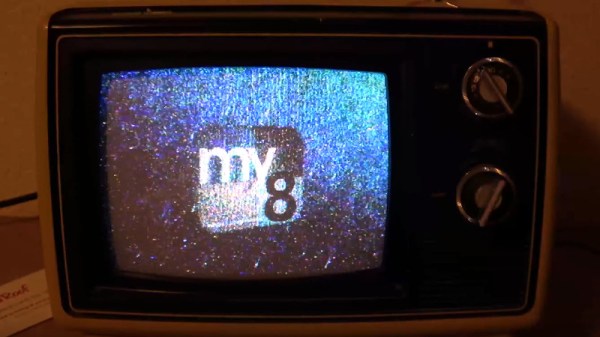
Analogue TV is something that most of us consider to have been consigned to the history books about a decade ago depending on where in the world we are, as stations made the transition to much more power and frequency efficient digital multiplexes. However some of them still cling on for North American viewers, and [Antenna Man] took a trip to Upstate New York in search of some of them before their final switch-off date later this year.

What he reveals can be seen in the video below the break, an odd world of a few relatively low-power analogue TV stations still serving tiny audiences, as well as stations that only exist because their sound carrier can be picked up at the bottom of the FM dial. These stations transmit patterns or static photographs, with their income derived from the sound channel’s position as an FM radio station. While his journey is an entertaining glimpse into snowy-picture nostalgia it does also touch on some other aspects of the aftermath of analogue TV boradcasting. The so-called “FrankenFM” stations sound much quieter, we’re guessing because of the lower sound carrier deviation of the CCIR System M TV spec compared to regular FM radio. And we’re told that there are more stations remaining in Canada, so get out there if you still want to see an analogue picture before they’re gone forever. Where this is being written the switch to DVB was completed in 2013, and it’s still a source of regret that we didn’t stay up to see the final closedown.

Does your country still have an analogue TV service? Tell us in the comments.

Continue reading “The Last Few Analogue TV Stations In North America”

What Makes A Good Antenna?

It sometimes seems as though antennas and RF design are portrayed as something of a Black Art, the exclusive preserve of an initiated group of RF mystics and beyond the reach of mere mortals. In fact though they have their difficult moments it’s possible to gain an understanding of the topic, and making that start is the subject of a video from [Andreas Spiess]. Entitled “How To Build A Good Antenna”, it uses the design and set-up of a simple quarter-wave groundplane antenna as a handle to introduce the viewer to the key topics.

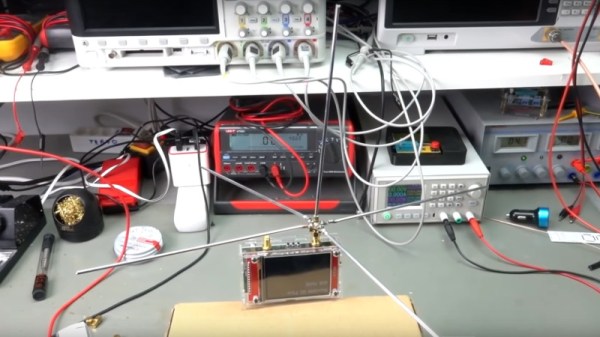
What makes this video a good one is its focus on the practical rather than the theoretical. We get advice on connectors and antenna materials, and we’re introduced to the maths through online calculators rather than extensive formulae. Of course the full calculations are there to be learned by those with an interest, but for many constructors they can be somewhat daunting. We’re shown a NanoVNA as a useful tool in the antenna builder’s arsenal, one which gives a revolutionary window on performance compared to the trial-and-error of previous times. Even the ground plane gets the treatment, with its effect on impedance and gain explored and the emergence of its angle as a crucial factor in performance. We think this approach does an effective job of breaking the mystique surrounding antennas, and we hope it will encourage viewers to experiment further.

If your appetite has been whetted, how about taking a look at a Nano VNA in action?

Continue reading “What Makes A Good Antenna?”