An odd looking apparatus for cleaning floppy disks. A neon green disk tray is suspended on metal linear rails in a vertical orientation. It can move back and forth through a set of cleaning heads and a set of drying fans. There are some control buttons on the font as well as a string of addressable LEDs and two speakers.

Rube Goldberg Floppy Disk Cleaner

Floppies were once the standard method of information exchange, but decades of storage can render them unreadable, especially if mold sets in. [Rob Smith] wanted to clean some floppies in style and made a Disco Rube Goldberg-Style device for the job.

Starting with a disk caddy on linear rails, [Smith] has a track for the floppy to follow. First it goes through a set of pads with cleaning solution on them, and is then dried off with heating elements. To make it more fun, the device has LEDs and a set of speakers at the bottom to treat the disk to a more complete car wash-esque experience.

Cotton swabs and a cleaning solution are all you really need to do the job by hand, but if you have a lot of floppies, that can get tedious quickly. [Smith] compares his machine’s performance to doing it by hand with both IPA and a dish soap solution showing that his machine does indeed clean the disks and usually makes them more readable than they were before. He cautions that it might be best to make multiple copies of the disk during the cleaning process as it isn’t always constructive though.

Thinking about archiving that stack of floppies under your workbench? While Linux doesn’t support the drives anymore, we’ve covered a couple different methods in the past and the importance of reading the flux.

Continue reading “Rube Goldberg Floppy Disk Cleaner”

A Look Inside The Super Nintendo Cartridges And Video System

Despite being effectively sold as a toy in the 1990s, the Super Nintendo Entertainment System (SNES) was pretty bleeding-edge as far its computing chops were concerned. This was especially apparent with its cartridges, such as in this excellent summary article by [Fabien Sanglard].

In addition to the mask ROM that stored the game data and (optionally) battery-backed SRAM to store save data, a wide range of enhancement processors existed that upgraded the base SNES system with additional processors for more CPU performance, enhanced graphics and so on. Imagine sticking a game cartridge in a PlayStation 4 today that boosted CPU speed by 5x and gave it a much better GPU, this was the world of SNES games.

On the other side of the video game cartridges was the video output system, which seems easy enough in today’s world of digital HDMI and DisplayPort output. In the 90s video output did however mean NTSC and SECAM/PAL, which means playing nice with frequencies, different resolutions (lines) and squeezing as much as possible into a single frame in a way that works with the game console’s rendering pipeline. As a result of this the PAL version of Super Mario World has a larger vertical resolution than the NTSC version (240 vs 224 lines), even if it’s still squashed into the same 4:3 format. For the physical video output side, European gamers were spoiled with an AV connector to (RGB) SCART output, while the rest of the world dealt with some variety of RF composite or S-video.

Although the SNES’s successor in the form of the N64 would not take cartridges to the same extremes, it was this flexible architecture that gave the SNES such an amazing game library.

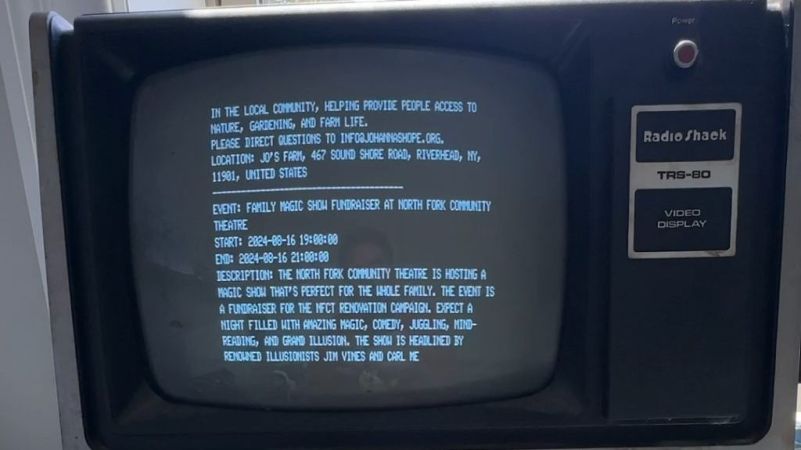
This Home Made Mac Has A Real CRT

Cathode-ray tube (CRT) televisions may no longer be in production, but its last bastion came in the form of extremely cheap little Chinese portable sets with a black-and-white tube. They’re now useless for broadcast TV, so can often be had for next-to-nothing. [Action Retro] has a video showing a Mac Classic clone using one, and with a built-in Raspberry Pi and a copy of RiscOS it almost makes a usable computer.

The video below the break is a little heavy on the 3D printer sponsor and the Mac case comes from a Thingiverse project, but it’s well executed and we’re grateful for being introduced to that original project. We’d have gone for a period-correct beige filament rather than the glow-in-the-dark green one used here.

We’re guessing that more than one reader will have a few of those TVs around the place, such is their ubiquity. Is it worth making this as a novelty item? It depends upon your viewpoint, but we can’t help liking the result even if perhaps it’s not for us. If RiscOS isn’t quite the thing,  there’s an option a little closer to the real thing.

Continue reading “This Home Made Mac Has A Real CRT”

Building The Unreleased Lemmings Arcade Cabinet From 1991

Back in the early 90s the world was almost graced with an arcade version of Lemmings, but after a few board revisions it was abandoned in 1991. Now the folk over at UK-based [RMC – The Cave] on YouTube have managed to not only get their mitts on a nearly finished prototype board, but have also designed and built a period-appropriate cabinet to go with it. This involved looking at a range of arcade cabinets created by Data East and picking a design that would allow both for the two-player mode of the game, and fit the overall style.

The finished Lemmings arcade cabinet. (Credit: RMC – The Cave, YouTube)

Arcade cabinets came in a wide range of cabinet styles and control layouts, largely defined by the game’s requirements, but sometimes with flourishes to distinguish the cabinet from the hundred others in the same arcade.

In this particular case the typical zig-zag (Z-back) style was found to be a good fit as on the Data East Night Slashers 1993-era cabinet, which then mostly left the controls (with two trackballs) and cabinet art to figure out. Fortunately there is plenty of inspiration when it comes to Lemmings art, leading to the finished cabinet with the original mainboard, the JAMMA wiring harness with MultiPi JAMMA controller, a 19″ CRT monitor and other components including the 3D printed controls panel.

With more and more new arcades popping up in the US and elsewhere, perhaps we’ll see these Lemmings arcade cabinets appear there too, especially since the ROMs on the prototype board were dumped for convenient MAME-ing.

Continue reading “Building The Unreleased Lemmings Arcade Cabinet From 1991″

Vintage Ribbon Cable Repair Saves Poqet PC

It sometimes seems as though computing power in your pocket is a relatively new phenomenon, but in fact there have been ultraportable computers since the 8-bit era. They started to become useful around the end of the 1980s though as enterprising manufacturers started cramming full-fat PC XTs into pocket form factors. Of these the one to own was the Poqet PC, a slim clamshell design that would run for ages on a pair of AA cells . If you have one today you’d be lucky if its display ribbon cable is without faults though, and [Robert’s Retro] is here with a fix previously thought impossible.

A large proportion of the video below the break is devoted to dismantling the unit, no easy task. The cable once exposed is found to have delaminated completely, and he takes us through the delicate task of attaching a modern equivalent. We particularly like the way in which the cable’s own springiness is used to retract it. The result has a white cable rather than the original black, but that’s a small price to pay for a machine that works rather than a broken paperweight.

If early pocket computing is your thing, it’s a subject we’ve covered before.

Continue reading “Vintage Ribbon Cable Repair Saves Poqet PC”

You Can Program AVRs From The Commodore 64

These days, most of our microcontroller boards come with bootloaders so you can squirt hex into them straight over USB. However, you don’t need to do things this way. If you’re more old school, you can program your AVRs right from a Commodore 64. [Linus Akesson] shows us how.

Programming an AVR isn’t that hard. By holding the chip in reset, it’s possible to flash code via a serial protocol using just three wires. However, that’s pretty impractical to do with modern PCs — they don’t come with addressable IO pins anymore. Normally, you’d use a dedicated programmer to do the job, but [Linus] found his had died on a Friday night. So he set about turning his C64 into one instead.

He decided to use the pins of the C64’s Joystick Port 2, with pins 1, 2, 3, and 4 hooked up to SCK, MOSI, Reset, and MISO on the AVR, respectively. 5 V and Ground were also provided courtesy of the C64’s port. He then whipped up a simple bit of assembly code to read a bit of AVR hex and spit it out over the Joystick port following the in-circuit programming protocol. With a 1541 Ultimate to load files on to the C64 in hand, it was easy to pull his compiled AVR program off his modern PC, chuck it on the C64, and then get the old Commodore to program the AVR in turn.

It’s not the first time [Linus] has wowed us with a C64 in hand. If you’ve got your own fresh projects for the best-selling computer of all time, don’t hesitate to let us know!

A small, white thermal printer with a cartoon cat face above the paper outlet. It is sitting on a black mat on top of a pale wooden table. A Raspberry Pi sits nearby.

Bluetooth Printer Works With AppleTalk

For retrocomputing enthusiasts, getting old computers to work with newer peripherals can be an exciting challenge or horrible headache. If you need to print out receipts from an old Mac, you might just be in luck now that [Hamin Mousavi] has gotten AppleTalk to work with cat printers.

[Mousavi] uses a Raspberry Pi 4 here in his version of the hack, but any Bluetooth capable computer running Linux should work. His command line screenshots are from a Debian-based system, but you should be able to translate to other systems as needed.

Thanks to previous work on these thermal printers, drivers are available for them on many other systems, so the tricky part comes down to getting the web connection to the printer working through the Linux box and then getting the Mac (in this case an iMac G3) to recognize the printer as something to install.

We’ve seen people do some really interesting things with thermal printers like making them D&D tools, breaking their paper DRM, and even black and white “Polaroids.

Continue reading “Bluetooth Printer Works With AppleTalk”