ColecoVision Cart Rises From Ashes

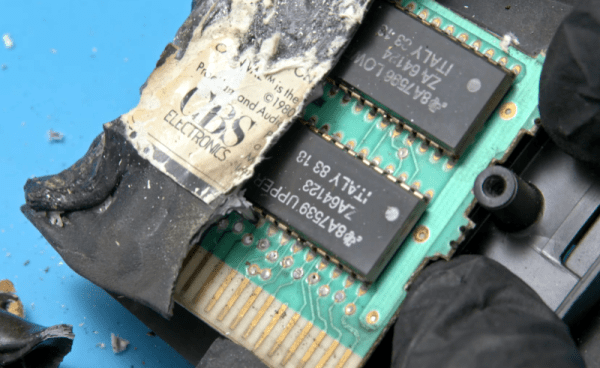
We felt bad for [Mark] of Mark Fixes Stuff. Apparently, his house burned down and took virtually everything, including his retrocomputer collection. He did manage to pull out a few things from the remains including a ColecoVision cartridge that was — honestly — melted. We probably would have written it off, but [Mark] was determined to recover something.

He was fortunate that the PCB was not burned, but it was covered in soot and possibly other things. However, the case looked like a chocolate bar left on a dashboard for a few summer days in the tropics.

Continue reading “ColecoVision Cart Rises From Ashes”

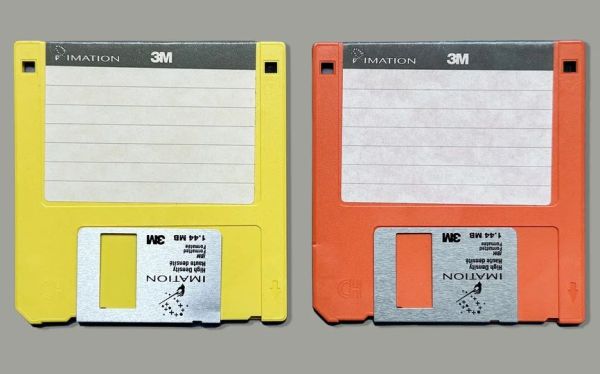
3M’s Floppy Disks: A Story Of Success And The Birth Of Imation

3M, or as it was officially called until 2002, the Minnesota Mining and Manufacturing Company is one of those odd-duck companies where if you ask what products they manufacture the answer is pretty close to a general ‘yes’. Throughout its 121 year history, it’s moved from producing sandpaper to also producing adhesives, laminates, personal protective equipment, as well as a nearly infinite list of further products which at one point in time included a magnetic storage range of products. How this latter came to be is the subject of an article by [Ernie Smith], focusing on floppy disk storage.

Although 3M was not the one to invent floppy disks or magnetic storage, their expertise in making small grains of material stick in an organized fashion on a wide range of materials came in handy. This first allowed 3M to make a name for itself with its Scotch magnetic (reel-to-reel) tape, followed by 3M moving into the floppy disk market by 1973. Over the years following this introduction, 3M storage media came to be known as highly reliable, but as the 1990s saw the magnetic storage market mature and stagnate, 3M management saw the writing on the wall and spun this division off into a new company: Imation.

While the floppy disk isn’t quite dead yet, at this point in time Imation and its main competitors like Memorex are now mostly just a fading memory — while 3M is still plowing ahead, creating new divisions and divesting as opportunities arise.

The Apple They Should Have Made, But Didn’t

Whenever there is a large manufacturer of a popular product in the tech space, they always attract tales of near-mythical prototypes which would have changed everything on the spot had they just not been cancelled by the bean counters. The Sony-Nintendo PlayStation prototypes for example, or any of a number of machines inexplicably axed by Commodore.

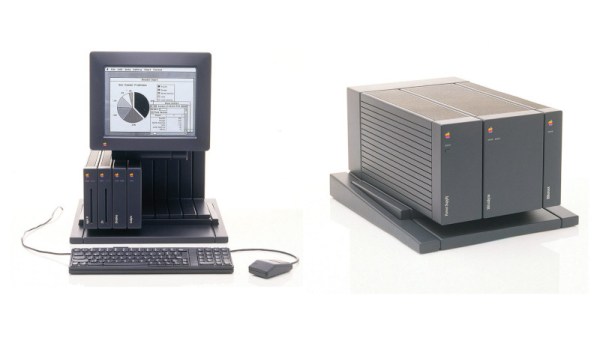
Apple is no exception. They brought the instantly forgettable twentieth anniversary Mac and the pretty but impractical G4 Cube to market, but somehow they rejected the Jonathan, a razor-sharp modular machine from the mid-1980s.

It’s easy after so long associating Apple with the Mac to forget that in the mid-80s it was simply one of their several computer lines, and not the most successful one at that. The 16-bit machine was something of a slimmed-down evolution of the Lisa, and it thus it doesn’t necessarily follow that every other Apple machine of the day also had to be a Mac. Into this would have come the Jonathan, a high-end modular machine bridging the gap between domestic and business computing, with a standard bus allowing processor modules for different operating systems, and upgrades with standard “books”, hardware modules containing peripherals, not all of which would have come from Apple themselves. It would have been Apple’s first 32-bit machine, but sadly it proved too adventurous for their management, who feared that it might tempt Apple users into the world of DOS rather than the other way round.

What strikes us about the Johnathan is how out of place it looks on a 1980s desk, it would be the mid-1990s before we would come close to having machines with these capabilities, and indeed we’ve never seen anything quite as adventurous hardware-wise. It’s certainly not the only might-have been story we’ve seen though.

3D Printing Computer Space

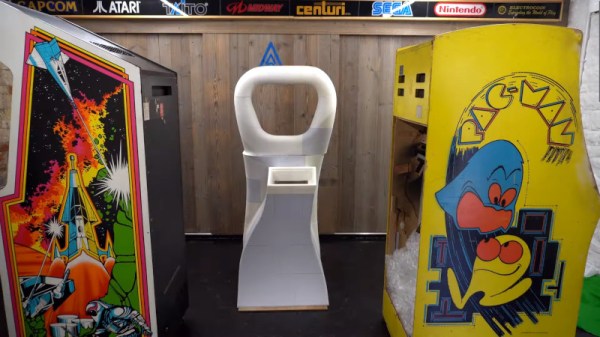
The first computer game available as a commercial arcade cabinet is unsurprisingly, a rare sight here in 2024. Nolan Bushnel and Ted Dabney’s 1971 Computer Space was a flowing fiberglass cabinet containing a version of the minicomputer game Spacewar! running on dedicated game hardware. The pair would of course go on to found the wildly successful Atari, leaving their first outing with its meager 1500 units almost a footnote in their history.

Unsurprisingly with so relatively few produced, few made it out of the United States, so in the UK there are none to be found. [Arcade Archive] report on a fresh build of a Computer Space cabinet, this time not in fiberglass but via 3D printed plastic.

The build itself is the work of [Richard Horne], and in the video he takes us through the design process before printing the parts and then sticking them all together to make the cabinet. Without a real machine to scan or measure he’s working from photographs of real machines, working out dimensions by reference to other cabinets such as PONG that appear alongside them. The result is about as faithful a model of the cabinet as could be made, and it’s cut into the many pieces required for 3D printing before careful assembly.

This is the first in a series, so keep following them to see a complete and working Computer Space take shape.

Continue reading “3D Printing Computer Space

Retrotechtacular: The IBM 7070

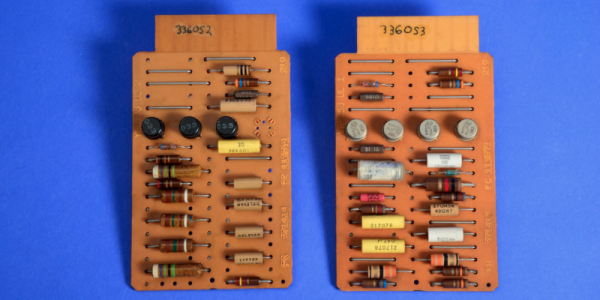
If you think of IBM mainframe computers, you most likely are thinking of the iconic S/360 or the slightly newer S/370. But what about the 7070 from 1958? It had transistors! It didn’t, however, use binary. Instead, it was a decimal-architecture machine. You can see a lost video of the machine below.

It was originally slated to upgrade the older IBM 650 and 705 computers. However, it wasn’t compatible with either, so IBM had to roll out the IBM7080, which was compatible, at least, with the 705. Both machines could run 650 code via emulation.

Continue reading “Retrotechtacular: The IBM 7070”

The Intel 8088 And 8086 Processor’s Instruction Prefetch Circuitry

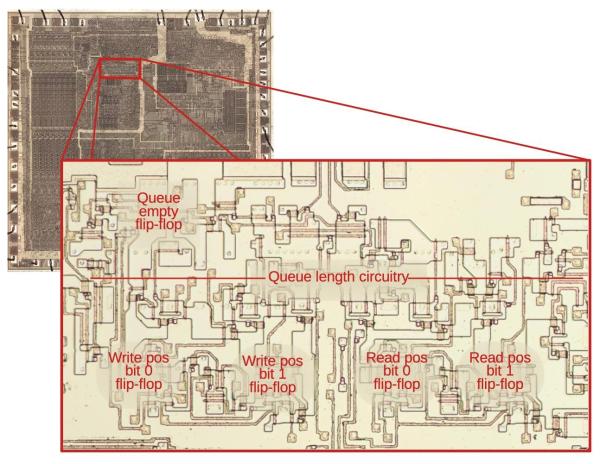
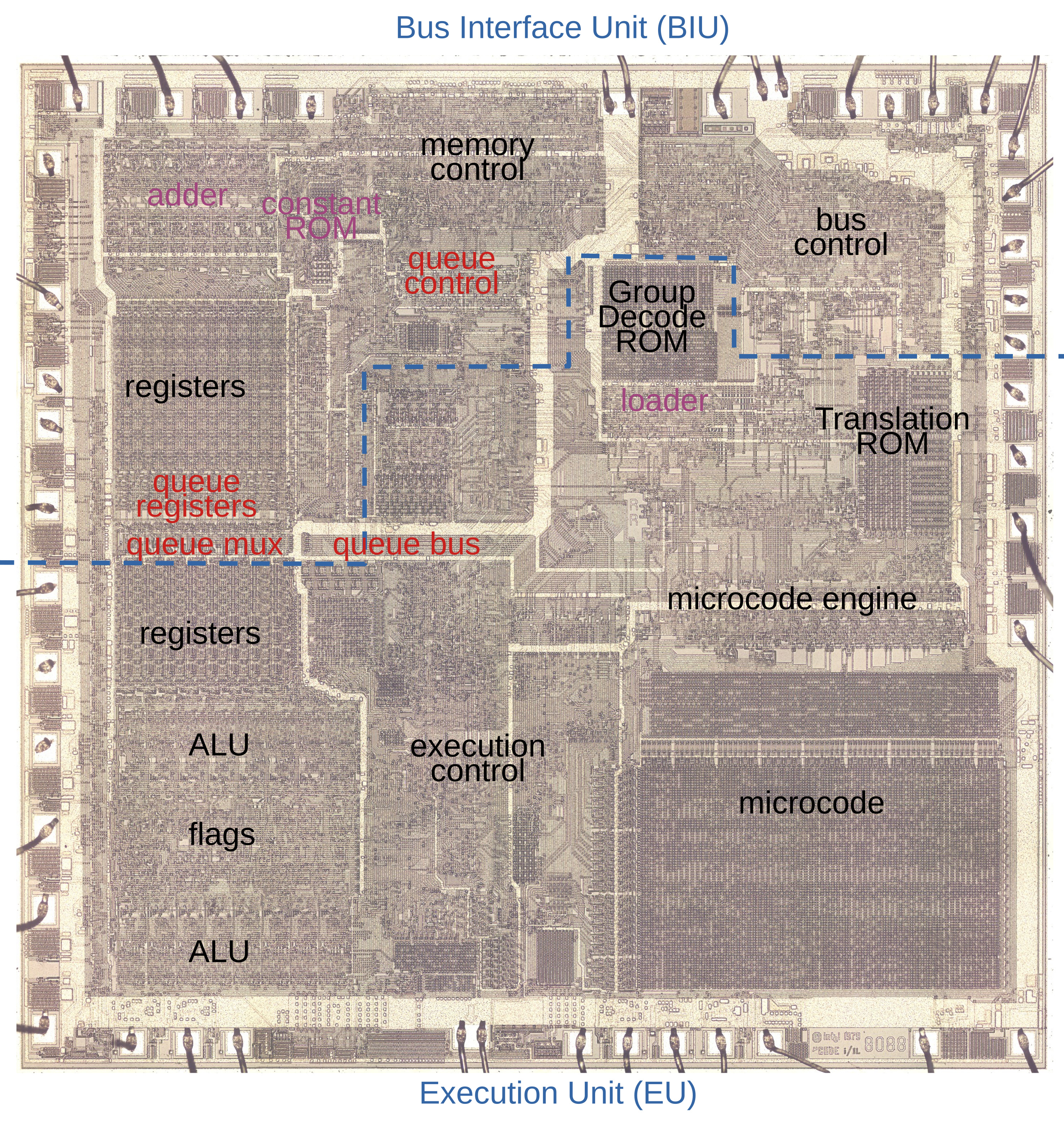
The 8088 die under a microscope, with main functional blocks labeled. This photo shows the chip's single metal layer; the polysilicon and silicon are underneath. (Credit: Ken Shirriff)
The 8088 die under a microscope, with main functional blocks labeled. This photo shows the chip’s single metal layer; the polysilicon and silicon are underneath. (Credit: Ken Shirriff)

Cache prefetching is what allows processors to have data and/or instructions ready for use in a fast local cache rather than having to wait for a fetch request to trickle through to system RAM and back again. The Intel 8088  (and its big brother 8086) processor was among the first microprocessors to implement (instruction) prefetching in hardware, which [Ken Shirriff] has analyzed based on die images of this famous processor. This follows last year’s deep-dive into the 8086’s prefetching hardware, with (unsurprisingly) many similarities between these two microprocessors, as well as a few differences that are mostly due to the 8088’s cut-down 8-bit data bus.

While the 8086 has 3 16-bit slots in the instruction prefetcher the 8088 gets 4 slots, each 8-bit. The prefetching hardware is part of the Bus Interface Unit (BIU), which effectively decouples the actual processor (Execution Unit, or EU) from the system RAM. While previous MPUs would be fully deterministic, with instructions being loaded from RAM and subsequently executed, the 8086 and 8088’s prefetching meant that such assumptions no longer were true. The added features in the BIU also meant that the instruction pointer (IP) and related registers moved to the BIU, while the ringbuffer logic around the queue had to somehow keep the queueing and pointer offsets into RAM working correctly.

Even though these days CPUs have much more complicated, multi-level caches that are measured in kilobytes and megabytes, it’s fascinating to see where it all began, with just a few bytes and relatively straight-forward hardware logic that you easily follow under a microscope.

Retrotechtacular: TOPS Runs The 1970s British Railroad

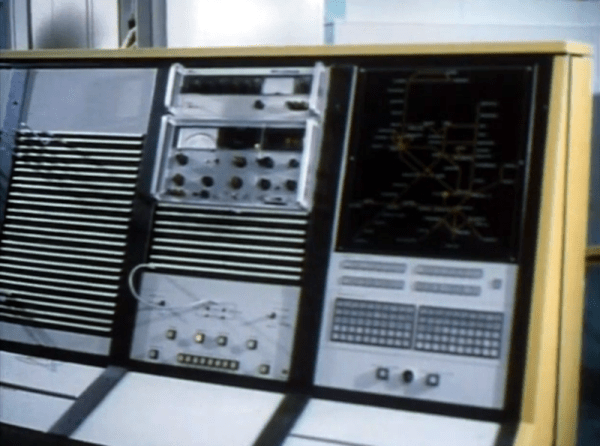
How do you make the trains run on time? British Rail adopted TOPS, a computer system born of IBM’s SAGE defense project, along with work from Standford and Southern Pacific Railroad. Before TOPS, running the railroad took paper. Lots of paper, ranging from a train’s history, assignments, and all the other bits of data required to keep the trains moving. TOPS kept this data in real-time on computer screens all across the system. While British Rail wasn’t the only company to deploy TOPS, they were certainly proud of it and produced the video you can see below about how the system worked.

There are a lot of pictures of old big iron and the narrator says it has an “immense storage capacity.”  The actual computers in question were a pair of IBM System/370 mainframes that each had 4 MB of RAM. There were also banks of 3330 disk drives that used removable disk packs of — gasp — between 100 and 200 MB per pack.

As primitive and large as those disk drives were, they pioneered many familiar-sounding technologies. For example, they used voice coils, servo tracking, MFM encoding, and error-correcting encoding.

Continue reading “Retrotechtacular: TOPS Runs The 1970s British Railroad”