Doubling The CPU Speed Of The TRS-80 Model 100 With A Mod Board

The TRS-80 Model 100 was released in 1983, featuring an 80C85 CPU that can run at 5 MHz, but only runs at a hair under 2.5 MHz, due to 1:2 divider on the input clock. Why cut the speed in half? It has a lot to do with the focus of the M100 on being a portable device with low power usage. Since the CPU can run at 5 MHz and modding these old systems is a thing, we got a ready-made solution for the TRS-80 M100, as demonstrated by [Ken] in a recent video using one of his ‘daily driver’ M100s.

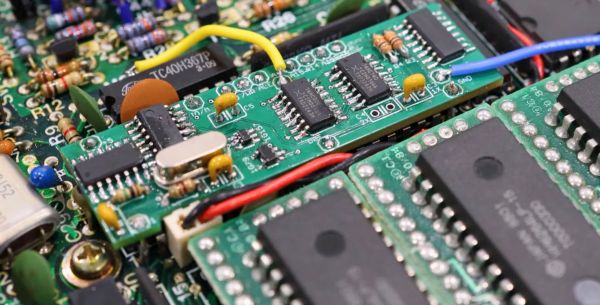
This uses the board design from the [Bitchin100] website, along with the M100 ROM image, as one does not simply increase the CPU clock on these old CPUs. The issue is namely that along with the CPU clock, connected components on the CPU bus now have to also run at those speeds, and deal with much faster access speed requirements. This is why beyond the mod board that piggybacks on top of the MPU package, it’s also necessary to replace the system ROM chip (600 ns) with a much faster one, like the Atmel AT27C256R (45 ns), which of course requires another carrier board to deal with incompatible pinouts.

Continue reading “Doubling The CPU Speed Of The TRS-80 Model 100 With A Mod Board”
Developing In Pascal On The Commodore 64 With Abacus Super Pascal 64

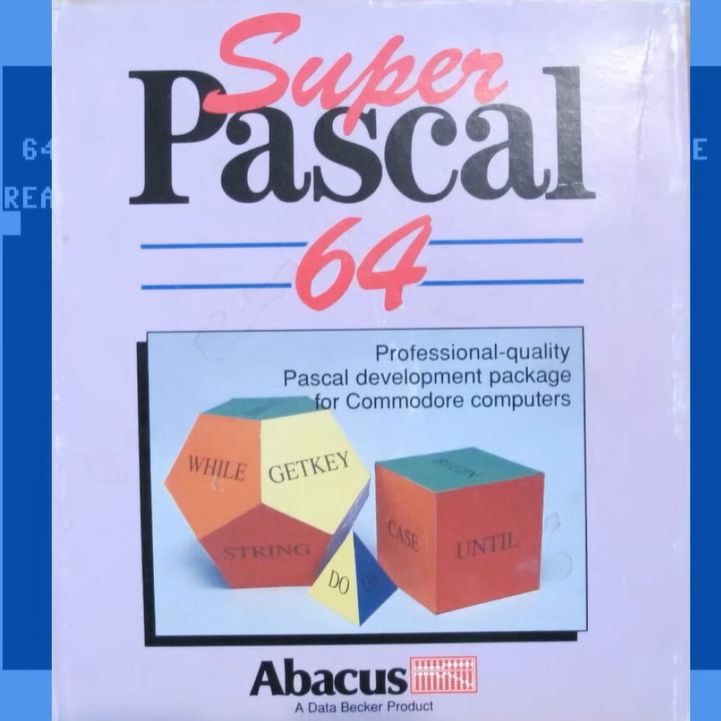
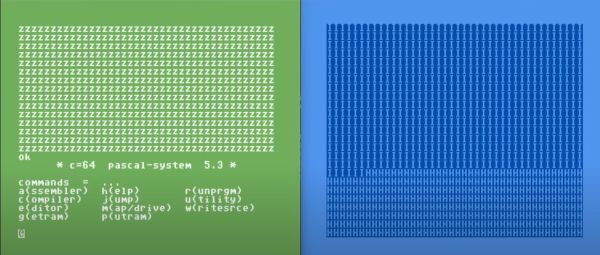
Abacus Super Pascal 64 for the Commodore 64.

Most people associate the Commodore 64 with Commodore BASIC and precompiled applications, but it also had a number of alternative development environments produced for it. One of these was Super Pascal 64 by Abacus. A solid introduction to this software package is provided in a video tutorial by [My Developer Thoughts] on YouTube. This uses the Abacus Super Pascal 64 software and manual from the [Lyon Labs] website, which incidentally has a lot more development environments and operating systems for the C64 listed for your perusal.

Abacus’ Super Pascal supports the official Pascal language, requiring nothing more than a Commodore 64 and two Commodore 1541 floppy disk drives to get started. One FDD is for the Super Pascal software, which boots into the development environment, the other FDD and the disks in it are the target for the current project’s source code and compiled binary. Although the lack of support for FDDs other than the 1541 is somewhat odd, this comes presumably from the operating system nature of the development environment and the 1541 being by far the most common FDD for the C64.

Continue reading “Developing In Pascal On The Commodore 64 With Abacus Super Pascal 64”

Tandy Pocket Computer Assembly Is… Weird

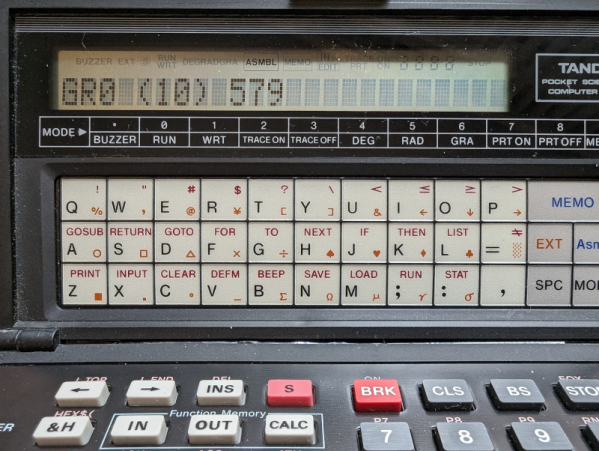
Radio Shack had a long history of buying things overseas, having their name slapped on them, and selling them in the United States. That was the case with the Tandy Pocket Computers, which were in that awkward space between calculators and full-blown computers. Like many computers of those days, if you wanted to do anything interesting, you needed to turn to assembly language. But as [Old Vintage Computing Research] recalls, the assembly for these little devices was very strange, even for an assembly language. He found out that there is a reason it is so strange and shares it in a deep dive into the device’s machine code history.

The story starts with the Japanese government. In 1969, the ministry in charge of such things decided that it wouldn’t be fair for people who knew a particular computer to have an advantage when taking the Information Technology Engineer exam. So, logically, they made up a fictitious instruction set and architecture for the test. Since no one used it, no one would have an unfair advantage.

However, eventually, Japanese manufacturers started making computers that used the architecture. The architecture was COMP-X, and the assembler was CAP-X. The post covers the history of machines either using the architecture or emulating it going back to the 1970s. It eventually winds up at the Sharp and Casio pocket computers that would wear Radio Shack livery in much of the world, especially the United States.

Continue reading “Tandy Pocket Computer Assembly Is… Weird”

Minitel, The 1980s Console Game Platform You Never Had

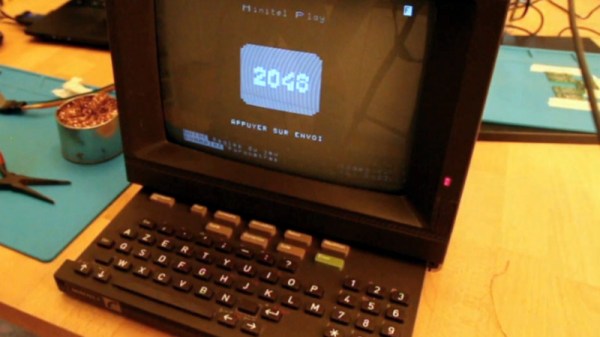
We’ve made no secret over the years here at Hackaday of our admiration for the Minitel. The ubiquitous CRT terminals which made 1980s France the most connected country in the world never made it to where we grew up, but OH! how we wanted them to! We’ve seen quite a few Minitels repurposed as serial terminals here, but for the time being we think [Louis H] has won the Minitel Internet with his plugin game console cartridges. These have a DIN plug to fit the Minitel serial port, and present themselves as a serial game.

The cartridge itself is an extremely simple affair, a tube which fits over the DIN plug body, containing a slim PCB with an ATmega328 and its supporting components. The games must be programmed such that their gameplay can work over a serial interface, so as an example the first game is a version of 2048.

We applaud both the simplicity and creativity of this project, and we love it that a new 1980s console we never knew we had has been unearthed, without the need for hardware modification. Meanwhile if you’d like to peer inside an Alcatel Telic 1, we can take you there.

[Usagi] Whips A Chain Printer Into Shape

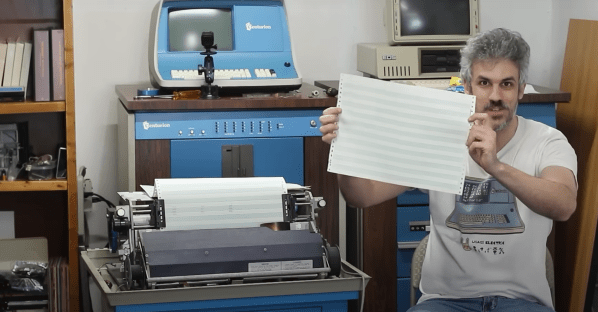
What does it take to get a 47-year-old printer working? [Usagi Electric] shows us it’s not too hard, even if you don’t exactly know what you’re doing.  When we last left this project, he’d tested and verified his power supply was working. This week, after a bit of cleaning, it was time to dig into the mechanics.

If you haven’t seen a chain printer in action before, definitely check one out. They’re big, loud, and sound a bit like a turbine when they spool up. The type chains on these printers never stops moving. This means the printer has to know exactly where a particular letter is before launching one of 66 hammers at it. If the timing is off, parts will fly. To the average computer user, they’re quite intimidating.

Thankfully [Usagi’s] printer was in pretty good shape. When he flipped the big power switch, there was plenty of strange noises, culminating in the test pattern of dollar signs. Probably an early reminder to customers that they needed to order more print supplies.

Continue reading “[Usagi] Whips A Chain Printer Into Shape”

Revisiting A Z80 Game From 1990

Back in the days of 8-bit computers, like no doubt many readers of similar age, we wrote little games. First in BASIC, then augmented with little machine code speed-ups. We didn’t come close to [Óscar Toledo Gutiérrez] though, who’s reverse engineering a 2K all-machine-code game he wrote back in 1990. As a tale of software archaeology it’s fascinating.

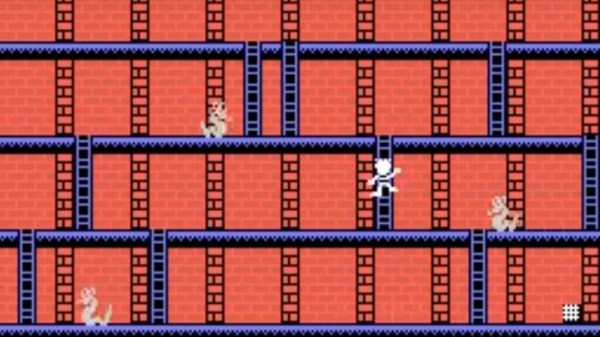
The game itself is an avoid-the-monsters platformer with plenty of ladders for the little sprite-based protagonist to run down. The computer was a Mexican homebrew educational machine with a TMS9118 display chip and an AY-3-8910 synthesizer, so the result had both color and music. His run through the code breaks it down neatly into individual sections, so it’s possible to see what’s going on without an in-depth knowledge of machine code.

He readily admits it bears all the hallmarks of an 11-year-old’s knowledge at the time, and that it has some parts less elegant, but nevertheless it’s something of an achievement at any age. It was out of date gameplay-wise in 1990 but in 1982 it could probably have been bought on a tape by eager kids. Here in 2024 he’s got it for download should you have a Colecovision or an MSX. There’s a gameplay video below the break, take a look.

Continue reading “Revisiting A Z80 Game From 1990”

It Wasn’t DOOM That Killed The Amiga

If you were the type of person who might have read Hackaday had we been around in the late 1980s or early 1990s, it’s a reasonable guess that you would have had a 16-bit home computer on your desk, and furthermore that it might have been a Commodore Amiga. These machines gave the best bang for the buck in those days with their impressive multimedia capabilities, and they gained a fervent following which persists to this day. [Carl Svensson] was one of them, and he’s penned a retrospective on the demise of the platform with the benefit of much hindsight.

The heyday of the Amiga from its 1985 launch until the days of the A1200 in the early-to-mid 1990s saw Moore’s Law show perhaps its fastest effects for the consumer. In that decade the PC world jumped from the 8088 to the Pentium, and from a PC speaker and CGA if you were lucky, to a Sound Blaster 16 and accelerated SVGA. By comparison the Amiga didn’t change much except in model numbers and a few extra graphics modes, and when a faster processor came it was far to little too late.

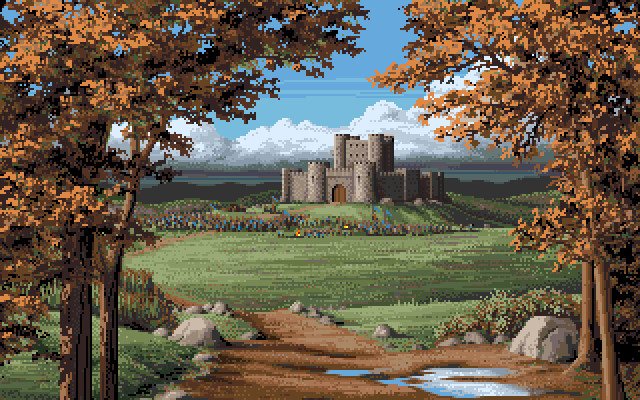
Defender of the Crown, released in 1986

There’s a well-worn path with some justification of blaming Commodore-s notoriously awful management for the debacle, but the piece goes beyond that into the mid ’90s. His conclusion is that what really killed the Amiga was that the CPU price reductions which defined the x86 world at that time never came to 68k or PowerPC lines, and that along with the architecture zealotry of the fan base meant that there would never be the much-longed-for revival.

He also takes a look at the other home computer platforms of the era, including the “all its killer architecture managed to kill was, sadly, Atari itself” Atari Falcon, and the Acorn Archimedes, which also lives on for enthusiasts and is perhaps the most accessible survivor. From here having also the benefit of hindsight we can’t disagree with him on his assessment, so perhaps it’s best to look at the Amiga not as the platform we should rightfully still be using, but the great stepping stone which provided us a useful computer back in t he day without breaking the bank.