Flying Robots Jam Out In A Robotic Orchestra

Flying Robot Symphony

[KMel Robotics] is at it again, this time stealing our hearts with a flying robotic orchestra. It’s an amazing feat of technology and music combined.

We first saw something like this with the swarm playing the James Bond theme, which was impressive in itself — the orchestra has just become a bit more advanced with this latest piece.

Most of the instruments are playable by adding weighted levers with special landing pads for the hexrotors to bounce off of, but we think our favorite instrument is the stringed one — another robot adjusts the tension of the wire to change the pitch, much like a tremolo on a guitar. Couple this with an electric amp and you have some very sleek sounds.

Another instrument of note are the drums, which use a deconstructed and hacked together piano action to play the notes. Stick around to hear the sounds of our new robotic overlords!

Continue reading “Flying Robots Jam Out In A Robotic Orchestra”

A H-Bridge Motor Controller Tutorial Makes It Simple To Understand

hbridge tutorial

[Afroninja] is back with another great tutorial on basic electronics. This time around he’s explaining H-Bridge motor controllers and how they work!

Even if you don’t have much (or any) experience with basic electrical circuits, [Afroninja] explains the concept of an H-Bridge motor controller in a clear, concise and easy way to understand. So what’s an H-Bridge anyway? For any project using DC motors, if you want to be able to spin up the motor in either direction, you’re going to need a method to power the motor in two different configurations, i.e. you’re going to have to swap the polarity some how.

The easiest way of doing this is with an H-Bridge. It’s called an H-Bridge… because it’s shaped like an H, with the motor in the very middle. It allows both polarities to control the motor — however if you do it with just plain old switches or relays, you could short the circuit if you try going in both directions at once! To solve this, [Afroninja] explains how to poka-yoke (Japanese term for Idiot-Proof) the circuit, by using transistors which will sink the voltage if you try to abuse the circuit.

It’s a 5 minute video and well worth the watch — stick around after the break to learn more!

Continue reading “A H-Bridge Motor Controller Tutorial Makes It Simple To Understand”

HexDrake — A Low Cost 2-DOF Hexapod

hexdrake low cost hexapod

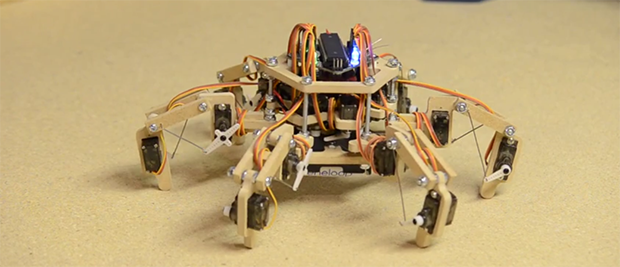
[David’s] been making robots since he was 16. After conquering the basics, he wanted to build something a bit more interesting than a simple wheeled-robot — he wanted to buy a hexapod but they were too expensive — so he decided to design his own low-cost version!

It’s made out of hand-cut wood, SG90 servos, an Arduino and a 16-channel servo controller. A 2.4GHz remote control sends commands to the Arduino which then communicates to the USC servo controller, allowing for intricate control of the 14 servos that make up the HexDrake.

He’s also added a few LED arrays for the eyes of his robot, which in the future will be animated to give expression to his little hexapod.

It’s an extremely well built little bot, and [David’s] made a very in-depth Instructable for anyone who would like to follow in his footsteps. Stick around after the break to see it scurry around!

Continue reading “HexDrake — A Low Cost 2-DOF Hexapod”

Morphex Ready To Roll

Sphere Morphing Hexabot Takes On The Wilderness

[Zenta’s] sphere morphing hexabot, the MorpHex, continues to impress us. He’s just released a video showing it off — by having it roll down a hill!

We’ve been following the MorpHex since 2011, and it really is an amazing project — especially when it started to roll around on its own! In this latest update, [Zenta] was trying to get a good outdoor test video, as he’s never seen a hexapod robot roll down a hill. The video (and rolling) goes smoothly until about 3 minutes 36 seconds in, when the MorpHex experiences a catastrophic inner body servo failure!

Surprisingly, it didn’t fail during its tumble down the hill, but when it was just walking around afterwards. [Zenta] attributes it to a poor quality servo and had bad feelings about it breaking previously. Not fixing it earlier resulted in having to spend 10 hours of his Easter holiday taking Morphex apart and repairing it! Just goes to show… don’t wait until it’s too late to fix something!

Continue reading “Sphere Morphing Hexabot Takes On The Wilderness”

Micro-Robots Are Scary Awesome

A team of scientists at SRI international are creating real-life replicators from Star Gate SG1 — micro-robots capable of smart (and scary!) manufacturing. Thousands working in parallel will be able to achieve tasks previously unheard of, in a completely compact and integrated system.

These tiny ant-like robot systems are magnetically controlled and can use tools, move at incredible speeds, and swarm over surfaces. SRI’s vision was “to have an army of ants under your control”. It’s actually been an ongoing project since the 1990’s — but a recent undisclosed chunk of funding from DARPA has helped accelerate the project — giving it a new title of the MicroFactory for Macro Products project.

You have to see the video to believe it. Potential applications for these tiny swarm-bots include precise pick & place manufacturing, micro bio-technology, electronics manufacturing, and even rapid prototyping of high quality parts.

We get shivers just watching them slide around effortlessly on almost any surface.

Continue reading “Micro-Robots Are Scary Awesome”

PenguinBot Follows Light, Goes Screech In The Night

The Arduino Based Penguin Robot
Ever have one of those weekend projects that takes on a life of its own? [Michael] did, and the result is this PenguinBot. While [Michael’s] wife was away for the weekend he happened upon a broken toy penguin. The batteries had leaked inside, destroying the contacts. Rather than bin the toy, [Michael] made it awesome by turning it into an autonomous robot. [Michael’s] goal was to create a robot that could roam around the house avoiding obstacles, or follow a light source like a flashlight.

He started by pulling out most of the original electronics. Two dollar store toy trains gave their lives and their motors to replace the penguin’s original drive system. An Arduino Pro Mini became PenguinBot’s brain. Sensors consisted of two light sensing CdS cells, an AdaFruit sound sensor, and a MaxBotix ultrasonic sensor. With the ultrasonic sensor mounted on a servo, it can detect obstacles in any direction. The CdS cells and some software will allow PenguinBot to follow lights, like any good photovore robot should.

Click past the break to see PenguinBot in action

Continue reading “PenguinBot Follows Light, Goes Screech In The Night”

MountainBeest – A Theo Jansen Creature Comes Alive In My Garage

About a year ago, a member of my family sent me a video featuring [Theo Jansen’s] StrandBeest, knowing that I was interested in all kinds of wacky and hackish inventions. My initial reaction was something to the effect of “wow that’s a neat device, but that guy is a little crazy.” For better or worse, the idea that this was an incredible invention turned over in my head for some time. Eventually, I decided that I needed to build one myself.  Apparently I’m a little crazy as well.

Theo’s original beest runs on a complicated linkage system powered by wind. He was nice enough to publish the linkage lengths or “eleven holy numbers,” as he calls him at the bottom of this page. He doesn’t, however, really explain how the connections on his PVC power transmission system work, so I was left to try to figure it out from his videos.  As you’ll see from build details and video to follow, this isn’t trivial. Keep reading past the jump to learn the adversity that I encountered, and how it was overcome in the end.

Continue reading “MountainBeest – A Theo Jansen Creature Comes Alive In My Garage”